

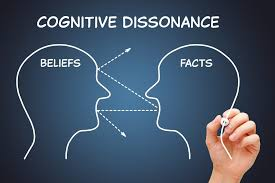
Cognitive dissonance is a state of psychological discomfort that arises when a person holds two or more cognitions (beliefs, attitudes, or knowledge) that are inconsistent with each other, or when they behave in a way that conflicts with their beliefs. The concept was introduced by Leon Festinger (1957), who argued that people are motivated to reduce this discomfort by changing one of the conflicting cognitions, adding new cognitions to rationalise the inconsistency, or reducing the importance of one of the conflicting beliefs.
Festinger and Carlsmith conducted a classic experiment on cognitive dissonance. Participants performed a tedious, repetitive task for an hour, then were asked to tell the next participant (actually a confederate) that the task was interesting and enjoyable. Some participants were paid USD 1 for this, while others were paid USD 20. Afterwards, all participants rated how much they had genuinely enjoyed the task. Counterintuitively, participants paid only USD 1 rated the task as more enjoyable than those paid USD 20.
Festinger and Carlsmith explained this using dissonance theory: those paid USD 20 had a clear external justification for lying (they were well-paid), so they experienced little dissonance -- they lied for the money. Those paid only USD 1 had insufficient external justification for their lie, creating dissonance between their belief ('the task was boring') and their behaviour ('I just told someone it was interesting'). To reduce this dissonance, they adjusted their attitude -- convincing themselves the task was actually somewhat interesting. This is the paradox of insufficient justification: the smaller the reward, the greater the attitude change.
Cognitive dissonance operates widely in daily life. Smokers who know smoking causes cancer must manage dissonance between this knowledge and their continued smoking. Common dissonance-reduction strategies include dismissing the evidence ('the studies are exaggerated'), adding consonant cognitions ('I exercise, so it balances out'), or minimising the importance of health ('I could be hit by a bus tomorrow anyway'). Post-purchase dissonance -- the regret people feel after major purchases -- leads people to seek information that confirms their decision was correct and avoid information that challenges it. This shows confirmation bias and cognitive dissonance often work together.
Evaluation
Cognitive dissonance theory has strong experimental support and explains a wide range of attitude-behaviour inconsistencies. However, Bem's (1967) self-perception theory proposed an alternative explanation for Festinger and Carlsmith's findings: people observe their own behaviour and infer their attitudes from it ('I said the task was interesting for USD 1; I must have found it somewhat interesting'). This interpretation does not require positing an uncomfortable internal state. Cross-cultural research has also found that dissonance and the need to resolve it may be more pronounced in individualist cultures where consistency between private beliefs and public behaviour is valued more highly than in collectivist cultures.
Compliance refers to a change in behaviour in response to an explicit or implicit request from another person, without necessarily changing private attitudes. Compliance techniques are strategies designed to increase the likelihood that a person will agree to a request. These techniques exploit psychological mechanisms such as commitment, consistency, reciprocity, and social proof.
The foot-in-the-door (FITD) technique involves making a small, easily agreed-to initial request, then following up with a larger request. The logic is that agreeing to the small request creates a sense of commitment and a self-image as a helpful person, which makes the individual more likely to agree to the larger request to remain consistent. Freedman and Fraser (1966) demonstrated this in a field experiment: householders who agreed to display a small 'drive safely' sign in their window were significantly more likely to later agree to a large, ugly 'drive carefully' billboard on their lawn than those who were approached directly with the large request. Cognitive dissonance provides the mechanism -- once you have committed to a position, refusing a related request creates inconsistency.
The door-in-the-face (DITF) technique works in the opposite direction. The requester begins with an extremely large, unreasonable request that the target is expected to refuse, then follows up immediately with a smaller, more reasonable request -- the one they actually wanted compliance with. The smaller request appears reasonable by contrast with the large one, and the target feels that the requester has made a concession by reducing the demand, triggering reciprocity norms. Cialdini et al. (1975) showed that participants who had refused a request to counsel troubled youth for two years were significantly more likely to agree to chaperone a single day trip than those asked directly.
Other Compliance Techniques & Evaluation
The low-ball technique involves getting agreement to a favourable offer, then revealing additional costs after commitment is established. The that's-not-all technique offers an initial deal and then immediately adds a bonus before the target responds. The scarcity principle (Cialdini, 1984) exploits the sense that limited availability increases desirability -- 'only 3 left in stock' -- making compliance more likely.
Compliance techniques have been well-studied in both laboratory and field settings, and their effectiveness is generally supported. However, many studies rely on hypothetical or mildly inconvenient requests, so the magnitude of effects in high-stakes situations requires caution. Cross-cultural research suggests that DITF may be less effective in highly collectivist cultures where direct negotiation and face-saving operate differently. Awareness of compliance techniques can reduce their effectiveness, although research shows that even people who identify the technique being used often still comply with it.
Conformity refers to a change in behaviour, beliefs, or attitudes to match those of a group or social norm, even in the absence of explicit pressure. Conformity is a fundamental social psychological phenomenon and reflects the basic human need to belong and to be accepted. Research identifies two main types of conformity: informational social influence and normative social influence.

Occurs when people look to others as a source of information about the correct way to behave or think, particularly in ambiguous or novel situations. Associated with private acceptance -- the person genuinely changes their belief.
Occurs when people go along with the group to avoid social rejection or gain social approval, even when they privately disagree. Associated with public compliance but private disagreement.
Solomon Asch's classic conformity experiments provide strong evidence for normative conformity. Participants were shown a standard line and asked to match it to one of three comparison lines -- a task so easy that participants made almost no errors when alone. In the experimental condition, each participant was seated with a group of confederates who unanimously gave the same wrong answer on critical trials. On approximately 36.8 percent of critical trials, participants conformed and gave the same incorrect answer as the group. About 25 percent of participants never conformed, while some conformed on most trials. When debriefed, conforming participants often reported knowing the group was wrong but feeling unwilling to stand out. Asch varied conditions to show that conformity increased with group size up to about three people and dropped dramatically when even one confederate gave the correct answer, showing that unanimity is crucial to conformity pressure.
Evaluation
Asch's research provided landmark evidence for the power of social pressure on behaviour. However, the artificial lab setting -- with strangers completing an unimportant visual task -- may underestimate or overestimate real-world conformity depending on the context. Replications across cultures have generally found conformity, but levels vary: collectivist cultures tend to show higher conformity rates than individualist cultures. Smith and Bond (1998) reviewed 31 conformity studies across 17 countries and found a range of conformity rates from 14 percent to 58 percent, demonstrating cultural variation.
Cultural dimensions are measurable frameworks that describe the shared values and orientations that define cultures and differentiate them from one another. Research on cultural dimensions attempts to identify the key axes along which cultures vary systematically, allowing cross-cultural comparisons of behaviour, cognition, and social norms.
Geert Hofstede's pioneering research, conducted across IBM employees in 40 countries in the 1970s and later expanded to 76 countries, identified several major cultural dimensions:
Research Application & Evaluation
Berry et al. (2006) used Hofstede's individualism-collectivism dimension to study conformity and compliance across cultures, finding that collectivist cultures show higher levels of both. In collectivist cultures, conformity to group norms is not experienced as external pressure but as an expression of in-group loyalty and social harmony.
Cultural dimensions research has been enormously influential in cross-cultural psychology and has generated testable predictions. However, Hofstede's dimensions have been criticised for treating countries as culturally homogeneous, ignoring within-culture variation. Schwartz (1992) proposed an alternative framework identifying 10 universal value types, arguing that Hofstede's model was too simplistic. Additionally, cultural dimensions may change over time as societies modernise and globalise, making static cultural profiles potentially outdated. Finally, the risk of stereotype and overgeneralisation is real when applying national-level cultural data to individual behaviour.
The terms emic and etic describe two contrasting approaches to cross-cultural research in psychology. They originate from linguistics (phonemic and phonetic analysis) and were applied to psychology by Pike (1967) to distinguish between culturally specific and universally applicable levels of analysis.
Studies behaviour from within a specific culture, using concepts, categories, and measures that are meaningful to the people being studied. Values cultural specificity and is typically associated with qualitative methods such as ethnography, participant observation, and grounded theory. An example is Ainsworth's critique of Strange Situation cross-cultural applications -- in Japan, where mother-infant separation is far less common, infants showed different attachment patterns that could not be meaningfully categorised using the original American framework.
Studies behaviour from outside a culture, using theories and measurement tools developed in one cultural context and applying them across multiple cultures. Assumes some psychological constructs are universal across cultures. Sometimes called an imposed etic when the framework does not fit the target culture well. Ekman's (1969) cross-cultural research on facial expressions found that basic emotions were recognised at above-chance levels across culturally isolated peoples in New Guinea and Western participants -- providing evidence for a degree of universality in emotional expression.
Combining Approaches: Many researchers argue that the most rigorous cross-cultural work combines emic and etic approaches -- a strategy sometimes called the derived etic. This involves first conducting emic research within specific cultures to identify culturally meaningful concepts, then searching for commonalities across cultures that may represent genuine universals.
Evaluation: The emic approach produces culturally valid data but limits generalisability. The etic approach enables cross-cultural comparison but risks misrepresenting cultures through inappropriate conceptual frameworks. The critique of psychology's WEIRD bias (Western, Educated, Industrialised, Rich, Democratic) -- identified by Henrich, Heine, and Norenzayan (2010) -- reinforces the importance of emic research to ensure psychology's theories reflect the full diversity of human experience rather than a narrow slice of it.
Acculturation refers to the process of psychological and cultural change that occurs when individuals from one culture come into sustained contact with another culture. Berry's model of acculturation (1997) is the most widely used framework for understanding the different ways individuals may navigate life between cultures.
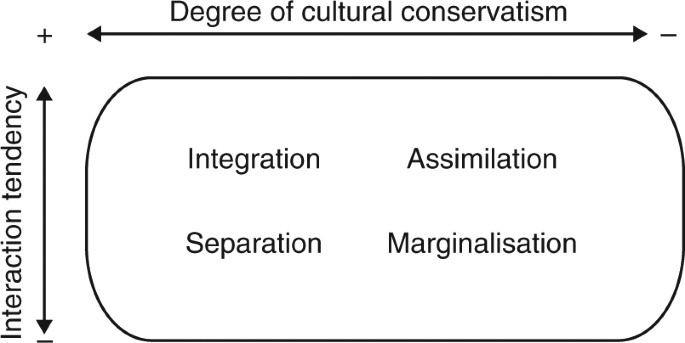
Berry et al. (2006) conducted a large-scale study of immigrant youth across 13 countries (ICSEY), involving over 5,000 participants. They found that integration was the most common strategy and was associated with the best psychological adaptation, including life satisfaction, positive self-esteem, and lower psychological problems. Marginalisation was least common and associated with worst outcomes. However, outcomes were also influenced by the attitude of the receiving society -- immigrant youth who experienced ethnic discrimination or lived in less multicultural host societies showed poorer psychological outcomes regardless of their own acculturation strategy.
Evaluation
Berry's model is influential and widely applied, providing a clear and practical framework. However, the model has been criticised for presenting acculturation as a matter of individual choice, when in reality the receiving society constrains available options. The model also implies that cultures are relatively fixed and separate, whereas in reality cultural contact produces hybrid identities that do not fit neatly into Berry's categories. Additionally, the model was developed primarily from research on voluntary immigrants and may not apply as well to refugees or involuntary migrants facing fundamentally different circumstances.
Social Learning Theory (SLT), detailed in Unit 1, has specific applications in the context of human relationships and social behaviour. In the relational context, SLT explains how social behaviours -- including aggression, cooperation, gender roles, and prosocial behaviour -- are acquired and maintained through observation of others in social settings.
Within family systems, parents and siblings serve as primary models for relationship behaviours. Children observe how adults in their household manage conflict, express affection, negotiate, and respond to authority, and they internalise these patterns as templates for their own relationships. Research on intergenerational transmission of parenting styles suggests that people often replicate the parenting behaviours they experienced, for better or worse, because those behaviours have been deeply encoded through years of observational learning.
In peer relationships, SLT helps explain the formation and maintenance of social norms within adolescent groups. Adolescents are particularly motivated to observe and imitate peers because peer acceptance becomes a primary source of social reinforcement during this developmental period. Peer modelling of risk behaviours -- substance use, sexual behaviour, antisocial conduct -- explains much of the clustering of such behaviours within peer groups.
Bandura's concept of self-efficacy has direct relevance to relationship quality. People with higher relationship self-efficacy -- confidence in their ability to communicate, resolve conflict, and maintain intimacy -- tend to form and sustain more satisfying relationships. Self-efficacy in social contexts is built through mastery experiences, vicarious learning, and social persuasion.
SLT also connects to the concept of media influence on social attitudes and relationship norms. Prolonged exposure to media portrayals of relationships -- whether in advertising, film, social media, or pornography -- provides models that viewers may absorb and incorporate into their own schemas about what relationships look like, what is expected from partners, and how conflict and intimacy are expressed.
Which of the following best illustrates the process of social comparison as described by Tajfel and Turner's Social Identity Theory?
Answer: C. A football fan argues that their national team has a superior record and playing style compared to a rival nation’s team.
Outline two acculturation strategies identified by Berry (1997) and explain how each is associated with a different psychological outcome.
Command term — "Outline": Give a brief account or summary. Do not evaluate; simply describe each strategy and link it to a psychological outcome (e.g., acculturative stress, well-being, identity loss). Award 1 mark per strategy described + 1 mark per psychological outcome linked = 4 marks total.
"Maya moved to Canada at age fourteen from a collectivist culture. At school, she consciously adopted Canadian norms of direct communication and peer socialisation to fit in. At home, however, she maintained her family's traditions, language, and values without conflict. Five years later, she reports high life satisfaction and a strong sense of self."
(a) Identify the acculturation strategy Maya appears to be using and justify your answer with reference to Berry's model.
(b) Using your knowledge of Social Identity Theory, explain how Maya's management of two cultural identities may affect her self-concept and psychological well-being.
(c) Suggest one limitation of applying Berry's acculturation model to Maya's situation.
SL: Discuss how Social Learning Theory explains the acquisition of social behaviours within relationships. Refer to relevant research in your answer.
HL: "The emic approach produces more culturally valid data than the etic approach and should therefore be preferred in cross-cultural psychological research." Evaluate this claim with reference to relevant theories and research.
4.7 Social Identity Theory
Social Identity Theory (SIT), developed by Henri Tajfel and John Turner (1979), proposes that a significant portion of people's self-concept derives from their membership in social groups. People do not merely belong to groups -- they incorporate group membership into their identity and are motivated to maintain a positive social identity by favourably comparing their in-group to relevant out-groups.
Three Core Processes
Tajfel's Minimal Group Experiments (1970)
Tajfel conducted a series of classic experiments in which he created groups based on the most trivial possible criteria -- such as overestimating versus underestimating the number of dots in a display, or preference for paintings by Klee versus Kandinsky. Participants were told their group assignment and asked to allocate points to anonymous in-group and out-group members. Even without knowing anything about the individuals, participants consistently allocated more points to in-group members than out-group members and even chose options that maximised the difference between groups over options that maximised total points for both groups. These findings showed that the mere act of categorisation into groups is sufficient to produce discrimination.
Evaluation
Social Identity Theory has broad explanatory power, accounting for intergroup conflict, prejudice, nationalism, sports rivalries, and other forms of in-group favouritism with a relatively parsimonious framework. However, SIT focuses primarily on the cognitive aspects of group membership and gives less attention to the material and power dimensions of intergroup relations. Reicher and colleagues have criticised the theory for underemphasising the role of social context and historical power asymmetries in shaping intergroup dynamics. Additionally, not all individuals invest equal amounts of their self-esteem in group membership, and the relationship between social identity and behaviour is moderated by factors such as the salience of group membership and the permeability of group boundaries.