

On this page:
3.1 Genetic Inheritance 3.2 Neuroplasticity 3.3 Neurotransmission 3.4 Enculturation 3.5 Diathesis-Stress Model in Human Development Practice Questions
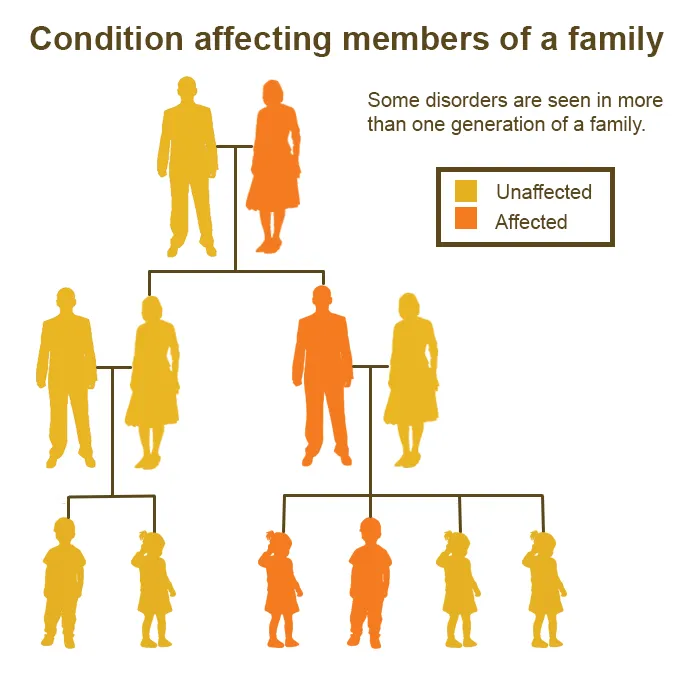
Genetic inheritance refers to the transmission of biological information encoded in DNA from parents to offspring. Genes influence a wide range of psychological characteristics, including intelligence, personality traits, susceptibility to mental disorders, and some cognitive abilities. However, it is critical to understand that genes do not determine behaviour directly; rather, they set tendencies and predispositions that interact with environmental factors.
Humans have 23 pairs of chromosomes in every cell nucleus, each containing thousands of genes. Each person inherits one set of chromosomes from each biological parent. Most psychological traits are polygenic -- influenced by many genes working in combination -- rather than being controlled by a single gene. This means that genetic inheritance of psychological characteristics is probabilistic rather than deterministic.
Twin studies have been the primary method for estimating heritability -- the proportion of variance in a trait that can be attributed to genetic factors in a given population. Identical (monozygotic) twins share 100 percent of their DNA, while fraternal (dizygotic) twins share approximately 50 percent. If a trait has a genetic component, identical twins should show higher concordance rates (both having the trait) than fraternal twins. Studies of intelligence, for instance, consistently find concordance rates of approximately 75 to 85 percent for identical twins compared to 40 to 55 percent for fraternal twins.
Research identifies genetic contributions to many mental health conditions. Twin studies estimate the heritability of schizophrenia at around 80 percent and the heritability of major depressive disorder at approximately 35 to 40 percent. The heritability of autism spectrum disorder has been estimated at over 80 percent in some twin studies. However, it is important not to interpret heritability estimates as fixed or absolute -- heritability describes a statistical relationship within a specific population and environment, not an immutable biological fate.
Specific gene variants associated with psychological disorders have been identified through genome-wide association studies (GWAS). The MAOA-L gene variant (sometimes called the warrior gene) has been associated with increased aggression and antisocial behaviour, particularly in males who have also experienced childhood maltreatment -- demonstrating gene-environment interaction rather than pure genetic determination. Similarly, the 5-HTT gene variant studied by Caspi et al. (2003) predisposes individuals to depression only in combination with environmental stress.
Evaluation
Genetic inheritance research has produced important insights into the biological basis of development and psychopathology. However, heritability estimates from twin studies are population-specific and environmental influences are often underestimated because identical twins frequently share not only genes but also environments. The media tendency to identify 'genes for' specific traits vastly oversimplifies the polygenic, probabilistic nature of genetic influence on behaviour. Importantly, genetic predispositions are not fixed destinies -- epigenetic processes (chemical modifications to DNA that affect gene expression without changing the sequence) allow environmental experiences to influence which genes are activated or silenced.
Neuroplasticity refers to the brain's ability to change its structure and function in response to experience, learning, and injury. For most of the 20th century, neuroscientists believed that the adult brain was fixed and incapable of significant structural change. This view has been overturned by research demonstrating that the brain remains plastic throughout the lifespan, though with greater plasticity during sensitive periods of development in childhood.
Synaptic plasticity: the strengthening or weakening of connections between neurons. Hebb's rule (1949) -- 'neurons that fire together wire together' -- describes the basic mechanism by which repeated activation of a synaptic connection strengthens it. This is the foundation of learning and memory.
Structural plasticity: physical changes in brain anatomy, including the growth of new dendrites (dendritic arborisation), the formation of new synapses (synaptogenesis), and in some brain regions such as the hippocampus, the generation of new neurons (neurogenesis).
Functional reorganisation: after brain injury, functions originally managed by damaged areas may be taken over by adjacent or connected regions. This is particularly well-documented in patients recovering from stroke.
Maguire et al. (2000) conducted a structural MRI study comparing the brains of 16 London taxi drivers (who must learn the complex layout of London's streets for the Knowledge exam) against 50 non-taxi drivers. They found that taxi drivers had significantly greater grey matter volume in the posterior hippocampus -- a region associated with spatial navigation. Furthermore, the magnitude of hippocampal enlargement was positively correlated with the number of years spent as a taxi driver, suggesting a dose-response relationship between spatial experience and hippocampal structure. This study provides strong evidence that prolonged environmental experience causes measurable structural changes in the adult human brain.
Neuroplasticity also means that harmful experiences can reshape the brain in damaging ways. Research on adverse childhood experiences (ACEs) -- including abuse, neglect, and household dysfunction -- has consistently found that children who experience multiple ACEs show structural and functional differences in the amygdala (heightened reactivity), prefrontal cortex (reduced volume and connectivity), and hippocampus (reduced volume). These changes contribute to increased risk of mental health disorders, cognitive difficulties, and health problems in adulthood. This demonstrates that the same plasticity that enables learning and recovery can also entrench the effects of adversity.
Evaluation
Research on neuroplasticity has transformed rehabilitation medicine, educational practice, and our understanding of recovery from brain injury. It challenges fatalistic views of brain damage and provides a scientific basis for the effectiveness of therapy and environmental enrichment. However, the degree of plasticity varies by brain region, age, and individual factors -- not all brain changes are reversible, and the mechanisms underlying functional recovery after injury are still not fully understood. Additionally, most structural neuroimaging studies are correlational; they show associations between experience and brain structure but cannot always establish cause and effect.
Neurotransmission is the process by which nerve impulses are communicated from one neuron to another via the release and reception of chemical messengers called neurotransmitters. It is the fundamental mechanism through which the nervous system coordinates behaviour, cognition, and emotion. Understanding neurotransmission is essential to understanding how psychoactive drugs work and how disruptions in neural communication contribute to psychological disorders.
A neuron consists of a cell body (soma), dendrites that receive incoming signals, and an axon that carries the signal to the terminal buttons. The process of neurotransmission proceeds as follows:
Understanding neurotransmission has been central to the development of psychopharmacological treatments. SSRIs (Selective Serotonin Reuptake Inhibitors) work by blocking the reuptake of serotonin from the synaptic cleft back into the presynaptic neuron, leaving more serotonin available to bind to postsynaptic receptors. This is based on the hypothesis that depression is associated with insufficient serotonergic transmission. While SSRIs are effective for many patients, the mechanism is more complex than simple serotonin level correction -- onset of clinical benefit typically takes several weeks despite immediate effects on serotonin levels, suggesting that longer-term changes in receptor sensitivity or neuroplasticity may be involved.
Evaluation
Neurotransmission provides a precise, mechanistic account of how chemical signals translate into psychological states and behaviours, and it has generated testable pharmacological predictions. However, most neurotransmitter systems interact with many others, and their effects depend heavily on which brain circuits they operate in and which receptor subtypes are involved. Dopamine, for instance, can both energise approach behaviour (in the nucleus accumbens) and contribute to working memory function (in the prefrontal cortex). Reducing neurotransmission to simple balances of single chemicals is therefore an oversimplification.
Enculturation is the lifelong process through which individuals learn and internalise the values, norms, behaviours, language, and roles of their culture. It begins at birth and continues throughout the lifespan. Through enculturation, people come to share a cultural framework that shapes their perception of the world, their judgements about right and wrong, their interpersonal expectations, and their sense of identity.
Enculturation occurs through both deliberate instruction (e.g., parents explicitly teaching rules of behaviour) and implicit observation (e.g., children watching how adults interact and internalising those patterns). Social Learning Theory provides an important mechanism for enculturation: children observe and imitate models -- parents, teachers, peers, and media figures -- and these observations shape their understanding of culturally expected behaviour. The models children identify with most strongly tend to be those who are similar to them, who have high status, or who are rewarded for their behaviour.
Fagot (1978) observed parents interacting with infants as young as 13 months and found that parents responded differently to behaviour depending on the child's sex. Boys were encouraged to engage in physical activities and discouraged from playing with dolls. Girls were encouraged to play with dolls and to stay close to parents. These differential reinforcement patterns transmitted gender norms to children before those children could consciously reflect on them, demonstrating how enculturation operates at an early and largely unconscious level.
Enculturation does not merely shape social behaviour -- it also influences cognition. Reed and Lave (1979) studied tailors from the Vai and Gola tribes in Liberia, comparing those who had received formal schooling with those who had not. They found that formally schooled participants performed better on abstract arithmetic problems presented in decontextualised, Western formats, while unschooled tailors performed better on the same mathematical operations when embedded in practical tailoring contexts. This suggests that formal education enculturates specific modes of abstract reasoning that are not universal but culturally specific.
Evaluation
Enculturation research captures the profound impact of culture on development and helps explain cross-cultural differences in behaviour, cognition, and identity. However, it is difficult to separate the effects of enculturation from genetic predispositions or universal developmental processes. Methodologically, most enculturation research uses observational or correlational designs that cannot establish causation. Social Cognitive Theory explains the mechanisms of enculturation through modelling and reinforcement, but it may underestimate children's active agency in selecting and resisting cultural messages. Additionally, in globalised societies, individuals are simultaneously enculturated into multiple cultural frameworks, complicating the concept.
The diathesis-stress model has particular relevance to human development, where it helps explain why individuals with similar genetic or biological backgrounds develop along different psychological trajectories depending on their developmental environments.
In a developmental context, diatheses may include genetic vulnerabilities inherited at conception, prenatal exposures (e.g., maternal stress, alcohol, or infections), temperamental factors such as high emotional reactivity or low impulse control, or early attachment experiences. These vulnerabilities do not produce disorders on their own. It is the interaction with stressful developmental environments -- including childhood adversity, trauma, family dysfunction, or peer victimisation -- that translates vulnerability into disorder.
Real-World Application: Case Example
Imagine two children raised in the same household, both with a family history of depression. The first child faces peer rejection at school (a stressor) and develops clinical depression by age 14. The second child, whose social environment remained supportive, develops no disorder. The diathesis-stress model explains this clearly: the diathesis was present in both children, but only the first encountered a significant stressor. Genetic risk alone is not sufficient — disorder emerges when vulnerability and stress combine.
A key concept within this model is the idea of a threshold — the level of stress required to activate a given vulnerability. Individuals with high biological sensitivity (such as a highly reactive temperament) have a lower threshold, meaning even relatively minor stressors can trigger a disorder. Those with lower biological sensitivity require considerably more stress before a disorder emerges.
Crucially, this threshold is not fixed. Early positive experiences — such as secure attachment, consistent caregiving, or a supportive school environment — can raise the threshold over time, building resilience. This is one of the strongest arguments for early intervention: it does not change a child's genetic makeup, but it can meaningfully reduce the chance that their vulnerability is ever activated.
The traditional diathesis-stress model focuses primarily on negative outcomes, treating biological sensitivity as a liability. Belsky's differential susceptibility hypothesis challenges this by arguing that sensitivity is essentially neutral — it amplifies both bad and good environmental effects.
Evidence for this comes from research on the serotonin transporter gene (5-HTT). Caspi et al. (2003) found that individuals carrying the short allele of this gene were more likely to develop depression following stressful life events. Critically, follow-up research found that these same individuals, when placed in nurturing, low-stress environments, showed better mental health outcomes than those without the short allele. The gene did not predispose them to depression — it made them more responsive to their environment in general.
The practical implication for child development is significant: highly sensitive children should not be viewed as inherently "at risk," but as "high-responders" who stand to gain the most from positive environments and the most to lose from negative ones. This reframing has real consequences for how parents, teachers, and clinicians approach sensitive children.
Epigenetics adds a biological layer to the diathesis-stress model by explaining precisely how environmental stress becomes physically embedded in the body. Three mechanisms are worth understanding:
For evaluation purposes, students should note that while epigenetic research is compelling, establishing direct causal links in humans is methodologically difficult. Many key findings come from rodent studies, and the degree to which human epigenetic modifications are reversible or heritable remains an open question.
Which of the following best describes the process of reuptake in neurotransmission?
Answer: C. The transport of neurotransmitters from the synaptic cleft back into the presynaptic neuron for reuse>
Using one research study, explain how enculturation shapes cognitive development in children.
Command term — "Explain": Provide a detailed account with reasons. Identify the study, describe its procedure and findings, and explain what these reveal about enculturation's role in cognitive development. [1 mark: study; 1 mark: procedure; 1 mark: findings; 1 mark: implication for enculturation]
"Arjun grew up in a household with a history of anxiety disorders. As a child he was described as highly emotionally reactive. At age 12, his family relocated internationally, and he struggled to adapt to his new school environment, where cultural expectations and social norms were very different from those he had grown up with. By age 15, he had developed significant generalised anxiety and social withdrawal. His younger sister, raised in the same household but who did not relocate, shows no signs of anxiety disorder."
(a) Using the diathesis-stress model, explain why Arjun developed an anxiety disorder while his sister did not.
(b) Identify one epigenetic mechanism that could explain how Arjun's early stressors may have become embedded in his biology.
(c) Belsky's differential susceptibility hypothesis offers an alternative interpretation of Arjun's situation. Outline what this hypothesis would predict about Arjun in a different developmental environment. [4 marks]
SL: Discuss how enculturation shapes identity and behaviour across development. Refer to relevant research in your answer.
HL: "Neurotransmission provides a complete biological explanation for the development of psychological disorders." Evaluate this claim with reference to relevant theories and research.