

On this page:
Introduction What Exactly Is a Wave? Mechanical vs Electromagnetic Waves Transverse Waves Longitudinal Waves Essential Wave Parameters The Wave Equation in Practice What Determines Wave Speed? Wave Intensity Wavefronts and Rays Phase and Phase Difference Energy Transfer Without Matter Transfer Polarization The Principle of Superposition Why Understanding Waves Matters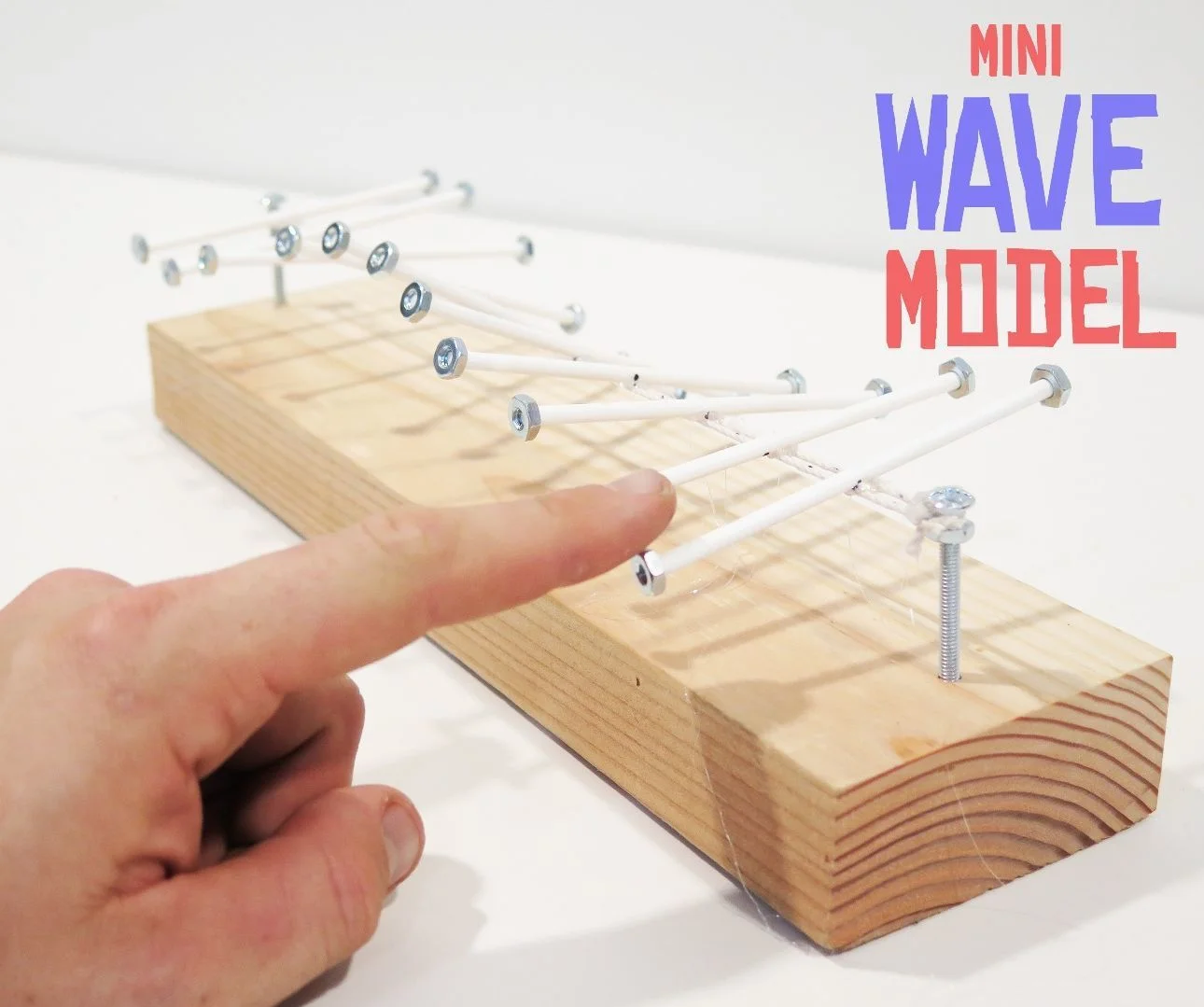
Drop a stone in a calm pond. Watch the ripples spread outward in perfect circles. Pluck a guitar string and see it vibrate. Shout across a canyon and hear your voice echo back. Turn on your phone, and it instantly connects to a cell tower miles away.
What do all these have in common? Waves.
Waves are one of nature's most fundamental ways of transferring energy. They're everywhere around us, even when we can't see them. Some we can observe directly, like water ripples. Some we can hear, like sound. Some are completely invisible but affect our lives every day, like radio waves and microwaves.
But here's what makes waves truly special: they transfer energy from one place to another without transferring matter.
Think about those pond ripples again. The wave pattern moves outward across the water's surface, carrying energy away from where you dropped the stone. But the water itself? It's just bobbing up and down. Individual water molecules aren't flowing outward with the wave. The wave moves; the medium stays mostly in place.
Understanding waves isn't just academic. It's the foundation for understanding light, sound, earthquakes, radio communications, medical imaging, quantum mechanics, and countless other phenomena. Master waves, and you've unlocked one of physics' most powerful concepts.
A wave is a disturbance that transfers energy through space or through a medium, without transferring matter.
Every wave needs three things:
Require a medium. No medium, no wave. These waves involve actual particles of matter oscillating and passing energy along.
Examples: Sound waves, water waves, seismic waves, waves on strings
Astronauts in space can't hear each other — no air molecules to vibrate.
Don't need a medium. Can travel through space. Oscillations of electric and magnetic fields propagating through space.
Examples: Light (visible, infrared, ultraviolet), radio waves, microwaves, X-rays, gamma rays
Sunlight reaches Earth across 150 million km of space.
Speed of all EM waves in vacuum: c = 3.00 × 10⁸ m/s
Grab a rope, tie one end to a wall, and shake the free end up and down. A wave travels along the rope toward the wall. But notice something: the wave moves horizontally along the rope, while the rope itself moves vertically, up and down.
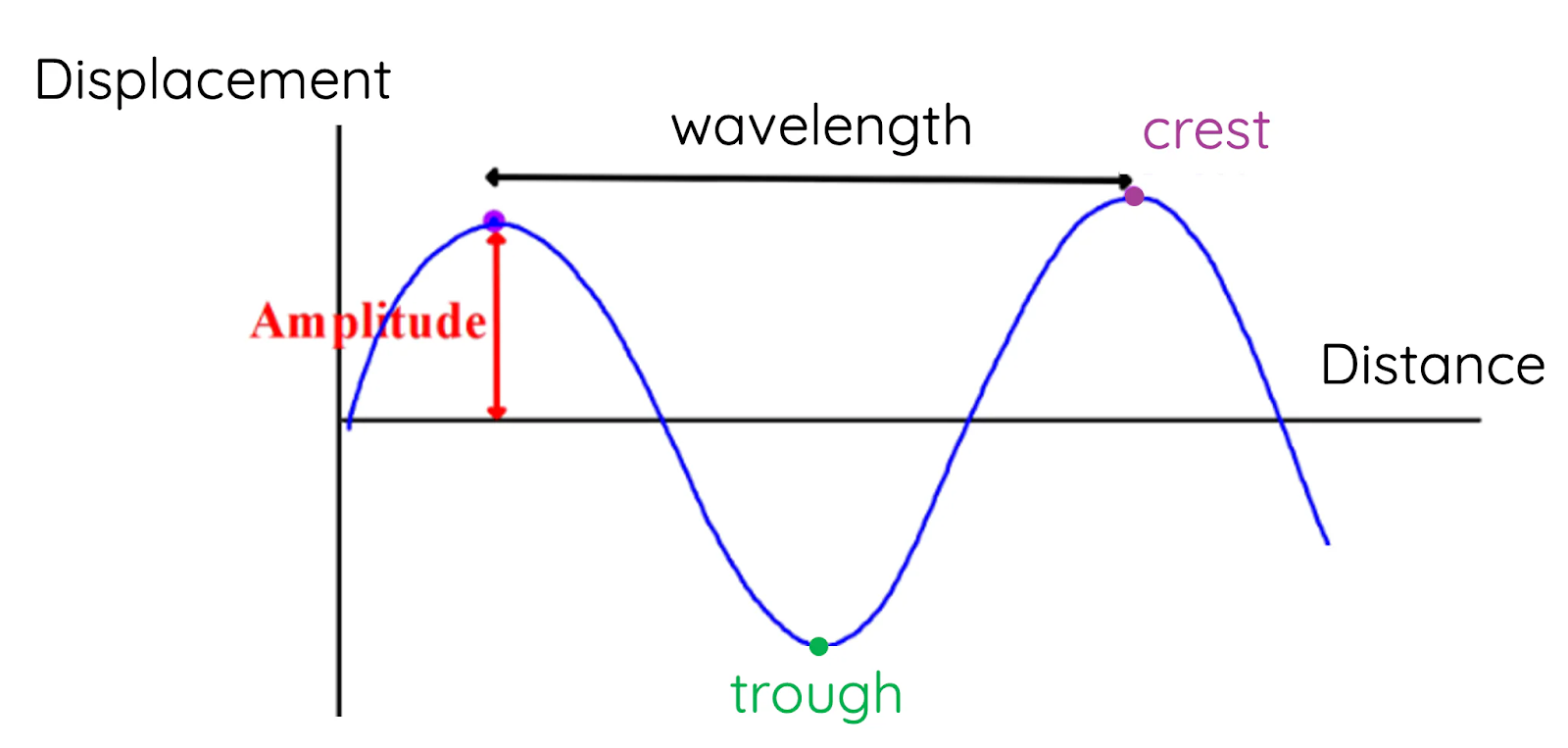
Transverse wave: The particle displacement is perpendicular to the direction of wave propagation.
The disturbance travels in one direction; the medium oscillates at right angles to that direction.
Examples:
Key features: Have crests (highest points) and troughs (lowest points), can be polarized, relatively easy to visualize.
Longitudinal wave: The particle displacement is parallel to the direction of wave propagation.
The disturbance and the particle motion are in the same direction.
Examples:
Key features: Have compressions (high pressure) and rarefactions (low pressure), cannot be polarized, harder to visualize.
v = fλ
Speed = frequency × wavelength
Example 1: A wave on a rope has frequency 50 Hz and wavelength 6.0 m. Find wave speed.
v = fλ = (50)(6.0) = 300 m/s
Example 2: Sound in air travels at ≈340 m/s. Middle C has frequency 262 Hz. Find wavelength.
λ = v/f = 340/262 = 1.30 m
Example 3: Light travels at 3.00 × 10⁸ m/s. Green light has wavelength 500 nm. Find frequency.
f = v/λ = (3.00 × 10⁸)/(500 × 10⁻⁹) = 6.00 × 10¹⁴ Hz (600 trillion oscillations per second!)
Crucial Insight: If wave speed is fixed (by the medium), then frequency and wavelength are inversely related: f ∝ 1/λ.
Higher frequency automatically means shorter wavelength. Lower frequency automatically means longer wavelength.
Waves on strings: v = √(T/μ)
T = tension (N), μ = linear mass density (kg/m)
Sound in gases: v ∝ √T (T = absolute temperature)
| Medium | Speed (m/s) |
|---|---|
| Air (20°C) | ~340 |
| Water (25°C) | ~1500 |
| Steel | ~5000 |
| Aluminum | ~5100 |
Sound travels faster in solids than in liquids, and faster in liquids than in gases.
Intensity: I = P/A
P = power (W), A = area (m²)
SI unit: W/m²
Inverse Square Law (point source): I = P/(4πr²)
Intensity ∝ Amplitude²: I ∝ A²
Double the amplitude → quadruple the intensity (and energy).
Double the distance from a source → intensity drops to one-quarter.
Wavefront: A surface connecting all points that are in phase — all points at the same stage in their oscillation.
Ray: A line drawn perpendicular to the wavefronts, showing the direction of energy propagation.
Rays are useful for tracing paths (optics). Wavefronts are useful for understanding interference and diffraction patterns.
Phase: Describes where a particle is in its oscillation cycle at a particular moment.
In phase: Same displacement and velocity at the same time.
Phase difference:
Phase difference (radians) = (2π/λ) × path difference
Waves transfer energy without transferring matter. The medium oscillates in place while the energy moves through it.
How much energy a wave carries depends on:
Unpolarized wave: Oscillations occur in all possible perpendicular directions randomly.
Polarized wave: Oscillations are restricted to one specific plane.
Applications: Polaroid sunglasses block horizontal glare. 3D movies use polarization for different images in each eye.
Important: Only transverse waves can be polarized. Longitudinal waves cannot.
This is how we know light is a transverse wave and sound is longitudinal.
Principle of superposition: When two or more waves meet at a point, the resultant displacement equals the algebraic sum of the individual displacements.
y_total = y₁ + y₂ + y₃ + ...
After passing through, each wave continues unchanged.
Unlike particles, waves don't bounce off each other — they pass through each other. While overlapping, their displacements add together.
This principle is the foundation for understanding interference.
Master the wave model — understanding types of waves, their properties, and how they propagate — and you've built a foundation for understanding countless phenomena from everyday life to cutting-edge physics.