

On this page:
Introduction Conduction Convection Radiation Comparing the Three Mechanisms Factors Affecting Heat Transfer Practical Applications Thermal Equilibrium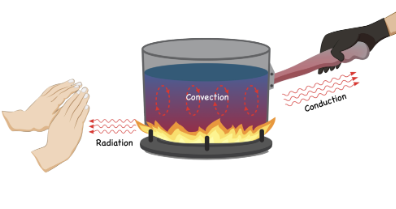
Thermal energy (also called internal energy in some contexts) is the total kinetic and potential energy of all particles (atoms and molecules) in a substance due to their random motion and interactions.
Temperature, on the other hand, is a measure of the average kinetic energy of particles in a substance. While related, thermal energy and temperature are distinct concepts. A large cool lake contains more thermal energy than a cup of hot coffee, even though the coffee has a higher temperature.
Heat is defined as the energy transferred between objects or systems due to a temperature difference. Heat always flows spontaneously from a higher temperature to a lower temperature until thermal equilibrium is reached.
SI unit: joule (J)
Heat is not a substance or fluid, despite common language like "heat rises" or "let the heat out." Heat is energy in transit. Once transferred, it becomes part of the object's thermal energy.
Energy transfers from hot to cold through three distinct mechanisms: conduction, convection, and radiation. Understanding each mechanism helps explain everything from why metal feels colder than wood at room temperature to how Earth receives energy from the Sun.
Definition: Conduction is the transfer of thermal energy through a substance without any bulk movement of the substance itself. Energy transfers through collisions between neighboring particles.
In solids, conduction occurs when faster-moving particles collide with slower-moving neighbors, transferring kinetic energy. In metals, free electrons also contribute significantly to conduction, making metals excellent conductors.
Thermal conductivity (k): A material property that measures how readily a material conducts heat. High k means a good conductor; low k means a good insulator.
SI unit: W/(m·K) or W·m⁻¹·K⁻¹
Q/t = kA(T₁ - T₂)/d
Q/t = heat transfer rate (W), k = thermal conductivity, A = cross-sectional area, T₁ - T₂ = temperature difference, d = thickness
Good conductors: Metals (copper k ≈ 400 W·m⁻¹·K⁻¹, aluminum k ≈ 200 W·m⁻¹·K⁻¹) because of free electrons that move rapidly and transfer energy efficiently.
Good insulators: Air (k ≈ 0.024 W·m⁻¹·K⁻¹), wood, plastic, fiberglass. These materials trap air or have structures that impede particle collisions.
Example: A window pane is 4 mm thick with an area of 2 m² and thermal conductivity 1.0 W·m⁻¹·K⁻¹. Inside temperature is 20°C, outside is 5°C. Find the heat transfer rate.
Q/t = kA(T₁ - T₂)/d = (1.0)(2)(20 - 5)/(0.004) = (1.0)(2)(15)/0.004 = 7500 W = 7.5 kW
The window loses 7.5 kilowatts of heat to the outside.
Definition: Convection is the transfer of thermal energy through a fluid (liquid or gas) by the bulk movement of the fluid itself.
Convection occurs because heating a fluid decreases its density (thermal expansion), causing it to rise. Cooler, denser fluid sinks to replace it, creating a convection current — a continuous circular flow pattern.
Natural (free) convection: Occurs due to density differences caused by temperature variations. No external force needed. Examples: hot air rising from a radiator, ocean currents, atmospheric circulation.
Forced convection: Requires an external mechanism (fan, pump) to move the fluid. Examples: car radiator with fan, forced-air heating systems, cooling tower pumps.
Convection is far more effective than conduction in fluids because bulk motion transfers large amounts of matter (carrying energy) quickly.
Real-world applications:
Convection cannot occur in solids because particles are fixed in position and cannot flow.
Definition: Radiation (thermal radiation) is the transfer of energy by electromagnetic waves, requiring no medium. Energy travels through a vacuum or transparent medium.
All objects with a temperature above absolute zero emit electromagnetic radiation. The hotter the object, the more radiation it emits and the shorter the peak wavelength.
Stefan-Boltzmann Law: P = εσAT⁴
σ = 5.67 × 10⁻⁸ W·m⁻²·K⁻⁴ (Stefan-Boltzmann constant)
ε = emissivity (0 to 1), A = surface area, T = absolute temperature (K)
Wien's Displacement Law: λ_max = b/T
b = 2.90 × 10⁻³ m·K (Wien's displacement constant)
Example: The Sun has a surface temperature of about 5800 K. Find its peak wavelength.
λ_max = b/T = (2.90 × 10⁻³)/5800 = 5.0 × 10⁻⁷ m = 500 nm
This is in the green part of the visible spectrum, though the Sun emits across all visible wavelengths, appearing white.
Properties of thermal radiation:
| Mechanism | Medium Required | Speed | Effectiveness |
|---|---|---|---|
| Conduction | Solids, liquids, gases | Slowest | Best in solids, especially metals |
| Convection | Fluids only (liquids, gases) | Moderate | Very effective in fluids |
| Radiation | None (works in vacuum) | Speed of light | Dominant at high temperatures or across space |
Definition: Two objects are in thermal equilibrium when they have the same temperature and no net heat transfer occurs between them.
When objects at different temperatures contact each other, heat flows from hot to cold until both reach the same temperature. This is the zeroth law of thermodynamics: if A is in thermal equilibrium with B, and B is in thermal equilibrium with C, then A is in thermal equilibrium with C.
Thermometers work based on this principle. A thermometer reaches thermal equilibrium with the object being measured, and the thermometer's temperature indicates the object's temperature.