

On this page:
Introduction The Electron: The First Piece Thomson's "Plum Pudding" Model Rutherford's Gold Foil Experiment The Nuclear Model The Problem: Classical Physics Fails Atomic Spectra: A Crucial Clue Bohr's Revolutionary Model Energy Levels in Hydrogen Electron Transitions and Photon Emission Absorption and Emission The Nucleus: Protons and Neutrons Isotopes Ionization Energy Beyond Bohr: The Modern Quantum Model Why Atomic Structure Matters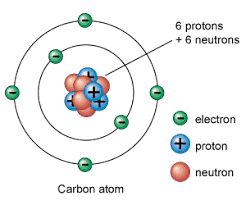
Look around you. Your desk, your phone, the air you breathe — what are they really made of?
For thousands of years, philosophers wondered whether you could keep cutting matter into smaller and smaller pieces forever, or whether you'd eventually reach some fundamental, indivisible particle. The ancient Greeks called this ultimate particle the "atom" (from atomos, meaning "uncuttable").
They were right that matter is made of atoms. But atoms aren't actually indivisible — they have internal structure. And understanding that structure unlocked the secrets of chemistry, nuclear energy, and quantum mechanics.
The journey to understand atomic structure is one of physics' greatest detective stories. Scientists couldn't see atoms directly (they're too small — about 10⁻¹⁰ m across). They had to deduce atomic structure from indirect evidence, from experiments that seemed to show impossible results.
This lesson traces that journey from the discovery of the electron through Rutherford's shocking nuclear model to Bohr's revolutionary quantum ideas — laying the foundation for modern atomic physics and chemistry.
J.J. Thomson (1897) proved cathode rays were streams of negatively charged particles. He determined the charge-to-mass ratio:
e/m = 1.76 × 10¹¹ C/kg
This ratio was enormous — about 2000 times larger than for hydrogen ions.
Electron properties:
Thomson proposed (1904) that the atom is a sphere of positive charge with electrons embedded in it like plums in a pudding. This explained electrical neutrality and why electrons don't fall into the center.
But this model was about to be shattered by a surprising experiment.
Ernest Rutherford (1911) fired alpha particles (positively charged helium nuclei) at a thin gold foil.
Rutherford was stunned. He said: "It was as if you fired a 15-inch shell at a piece of tissue paper and it came back and hit you."
Conclusion: Most of the atom is space. There's a tiny, massive, positively-charged nucleus at the center.
If the nucleus were the size of a marble, the atom would be about 100 meters across — the size of a football field.
Example: A hydrogen atom has diameter ~10⁻¹⁰ m, nucleus diameter ~10⁻¹⁵ m. What fraction of the atom's volume does the nucleus occupy?
Volume ratio = (r_nucleus/r_atom)³ = (10⁻¹⁵/10⁻¹⁰)³ = (10⁻⁵)³ = 10⁻¹⁵ (one-trillionth!)
According to classical electromagnetic theory, accelerating charges radiate energy. Electrons orbiting the nucleus are constantly accelerating, so they should spiral into the nucleus in a fraction of a second, emitting a continuous spectrum of radiation.
Reality: Atoms are stable. Electrons don't spiral in. Atoms emit only specific wavelengths of light, not continuous spectra.
Classical physics couldn't explain atoms. Something fundamental was missing.
When you heat elements or pass electric current through their gases, they emit only specific colors (wavelengths).
Hydrogen's visible spectrum:
Balmer formula: 1/λ = R(1/2² - 1/n²) where n = 3, 4, 5, 6, ...
R = 1.097 × 10⁷ m⁻¹ (Rydberg constant)
Niels Bohr (1913) proposed:
These postulates were revolutionary. They said classical physics simply doesn't apply at atomic scales.
E_n = -13.6 eV/n²
n = 1, 2, 3, 4, ... (principal quantum number)
1 eV (electron volt) = 1.60 × 10⁻¹⁹ J
The negative sign means the electron is bound. Energy must be added to free it (ionization).
E_photon = E_high - E_low = 13.6(1/n_low² - 1/n_high²) eV
λ = hc/E_photon
h = 6.63 × 10⁻³⁴ J·s (Planck's constant), c = 3.00 × 10⁸ m/s
Example: An electron in hydrogen jumps from n = 3 to n = 2. Find the photon energy and wavelength.
E_photon = E₃ - E₂ = (-1.51) - (-3.40) = 1.89 eV
E = 1.89 × 1.60 × 10⁻¹⁹ = 3.02 × 10⁻¹⁹ J
λ = hc/E = (6.63 × 10⁻³⁴)(3.00 × 10⁸)/(3.02 × 10⁻¹⁹) = 659 nm (red light)
Electron drops from high to low energy, emits a photon
Produces a bright line spectrum
Photon absorbed, electron jumps from low to high energy
Produces a dark line spectrum
When white light passes through cool hydrogen gas, hydrogen absorbs photons at specific wavelengths, creating dark lines. This is how we identify elements in stars — by their absorption lines.
| Particle | Charge | Mass |
|---|---|---|
| Proton | +e = +1.60 × 10⁻¹⁹ C | m_p = 1.673 × 10⁻²⁷ kg (≈1836 m_e) |
| Neutron | 0 | m_n = 1.675 × 10⁻²⁷ kg (slightly heavier than proton) |
Atomic number (Z): Number of protons — defines the element
Mass number (A): Total number of nucleons (protons + neutrons)
Nuclear notation: AZX
Example: 126C — carbon-12: 6 protons, 6 neutrons, 6 electrons (neutral)
126C: 6p, 6n (98.9%)
136C: 6p, 7n (1.1%)
146C: 6p, 8n (trace, radioactive)
11H (protium): 0 neutrons
21H (deuterium): 1 neutron
31H (tritium): 2 neutrons, radioactive
Ionization energy is the minimum energy needed to remove an electron from an atom in its ground state.
For hydrogen: Ionization energy = 13.6 eV
Example: How much energy is needed to ionize hydrogen already in the first excited state (n = 2)?
E₂ = -3.4 eV, E_∞ = 0 eV
Ionization energy = 0 - (-3.4) = 3.4 eV (less than ground state)
Bohr's model worked perfectly for hydrogen but failed for more complex atoms. The modern quantum mechanical model replaces orbits with orbitals — probability distributions showing where electrons are likely to be found. Electrons don't orbit like planets — they exist as probability clouds described by wave functions.
But Bohr's key insights remain: energy is quantized, only certain states are allowed, transitions between states emit/absorb specific photon energies.
From the computer chips in your phone to the nuclear reactions in the sun, from medical imaging to understanding how stars form elements — it all comes back to atomic structure.