

On this page:
Introduction What Is Radioactive Decay? Nature of Radioactive Decay Nuclear Notation Alpha Decay Beta Decay Gamma Decay Ionization Radioactive Decay Equations Activity Decay Constant Half-Life Half-Life Graph Half-Life and Decay Constant Background Radiation Uses of Radioactive Decay Safety Precautions Why Radioactive Decay Is Important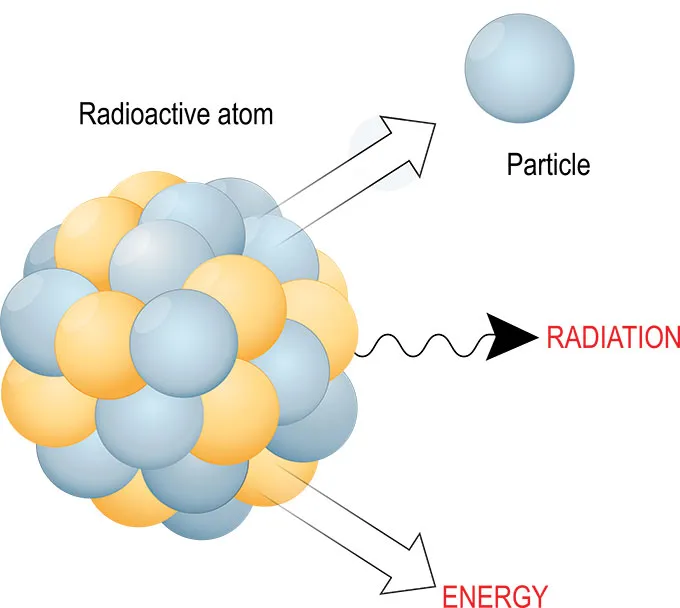
Everything around us is made of atoms. Most atoms are stable and remain unchanged for millions of years. However, some atoms are unstable and change naturally with time. During this change, they emit radiation and transform into different atoms.
This natural process is called radioactive decay.
Radioactive decay is an important topic in IB Physics because it helps us understand nuclear energy, medical imaging, dating of fossils, and even the age of the Earth.
Radioactivity occurs without any external influence. It does not depend on temperature, pressure, or chemical reactions. It is a spontaneous nuclear process.
For example: Uranium atoms inside rocks slowly decay into other elements over millions of years.
Radioactive decay is the spontaneous transformation of an unstable atomic nucleus into a more stable nucleus by emitting radiation.
An unstable nucleus contains too much energy or an imbalance between protons and neutrons. To become stable, it releases excess energy or particles.
During radioactive decay:
The original unstable nucleus is called the parent nucleus. The new nucleus formed after decay is called the daughter nucleus.
This makes radioactive decay very reliable for scientific measurements.
AZX
X = chemical symbol, Z = atomic number (protons), A = mass number (protons + neutrons)
Example: Uranium-238 is written as 23892U
Alpha decay occurs when a heavy nucleus emits an alpha particle.
An alpha particle consists of 2 protons and 2 neutrons — identical to a helium nucleus: 42He or α
During alpha decay:
Example: 23892U → 23490Th + 42He
Properties of Alpha Radiation:
Beta decay occurs when a neutron changes into a proton or a proton changes into a neutron.
A neutron changes into: a proton, an electron, and an antineutrino. The electron is emitted as beta radiation.
Example: 146C → 147N + 0-1e
Properties: Medium ionizing power, medium penetration (stopped by thin aluminum), travels close to speed of light.
A proton changes into a neutron, a positron, and a neutrino.
During beta decay:
Gamma decay occurs when a nucleus releases excess energy in the form of electromagnetic radiation.
Gamma radiation is not a particle — it's high-energy EM radiation similar to X-rays but with higher energy: 00γ
During gamma decay:
Example: X* → X + γ (excited nucleus releases gamma ray)
Properties of Gamma Radiation:
Radiation can remove electrons from atoms. This process is called ionization.
Ionization is important because radiation damage in living tissue is mainly caused by ionization.
Two important rules must always be followed:
Example Alpha Decay: 22688Ra → 22286Rn + 42He
Mass numbers: 226 = 222 + 4 ✓ | Atomic numbers: 88 = 86 + 2 ✓
Activity is the rate at which radioactive decay occurs.
SI unit: becquerel (Bq) — 1 Bq = 1 decay per second
High activity = many atoms decaying per second. Low activity = fewer atoms decaying.
A = λN
A = activity, λ = decay constant, N = number of nuclei
The decay constant (λ) represents the probability of decay per unit time.
Half-life (T½) is the time required for half of the radioactive nuclei in a sample to decay.
Example: If a sample has 1000 nuclei and half-life is 10 years:
The number of nuclei decreases exponentially.
A half-life graph shows number of nuclei or activity versus time.
T½ = ln2 / λ
ln2 ≈ 0.693
This equation is important in IB Physics calculations.
Radiation is always present in the environment — called background radiation.
Sources include:
Scientists subtract background radiation from measurements to obtain accurate results.
Proper handling reduces radiation risk significantly.
Radioactive decay connects several important areas of physics:
Understanding radioactive decay helps explain how atoms change and how nuclear energy is produced. It also allows scientists to measure time on a geological scale and understand processes inside stars and the Earth.
| Type | Composition | Penetration | Ionization |
|---|---|---|---|
| Alpha (α) | 2p + 2n (He nucleus) | Low (paper/skin) | High |
| Beta (β⁻) | Electron | Medium (thin aluminum) | Medium |
| Gamma (γ) | EM radiation | High (thick lead/concrete) | Low |