

Flip a light switch. Your phone charges on a wireless pad. A wind turbine spins in the breeze, generating electricity. A car's alternator keeps the battery charged. An electric guitar pickup converts string vibrations into electrical signals.
What do all these have in common? Electromagnetic induction — the process of creating electricity from changing magnetic fields.
This discovery, made by Michael Faraday in 1831, literally powered the modern world. Before Faraday, electricity was a laboratory curiosity generated by chemical batteries. After Faraday, we could generate electricity on an industrial scale. Every power plant on Earth — whether burning coal, splitting atoms, or harnessing falling water — uses Faraday's principle to generate the electricity that powers civilization.
Understanding electromagnetic induction means understanding how generators work, how transformers change voltage, how wireless charging operates, and how we've built the electrical infrastructure that defines modern life.
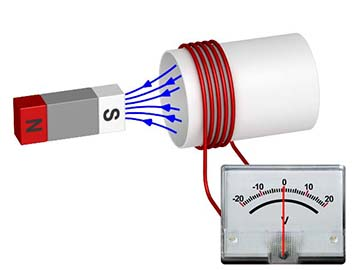
Michael Faraday discovered that when he moved a magnet through a coil, a current flowed in the wire — but only while the magnet was moving. Hold the magnet still, and the current stops. Move it again, current flowed.
The key insight: It's not the magnetic field itself that induces current — it's the change in magnetic field.
A stationary magnet near a coil does nothing. But move it, and you generate electricity. This is electromagnetic induction.
Φ = BA cos θ
Φ = magnetic flux (weber, Wb), B = field (T), A = area (m²), θ = angle between field and perpendicular
SI unit: weber (Wb), where 1 Wb = 1 T·m²
Example: A circular coil with radius 0.050 m sits perpendicular to a 0.40 T magnetic field. Find the magnetic flux.
A = πr² = π(0.050)² = 7.85 × 10⁻³ m²
Φ = BA = (0.40)(7.85 × 10⁻³) = 3.14 × 10⁻³ Wb = 3.14 mWb
ε = -N(ΔΦ/Δt)
ε = induced EMF (V), N = number of turns, ΔΦ = change in flux (Wb), Δt = time interval (s)
Three ways to change flux:
Example: A coil with 200 turns experiences flux change from 0.040 Wb to 0.010 Wb in 0.20 s. Find the induced EMF.
ε = -N(ΔΦ/Δt) = -200[(0.010 - 0.040)/0.20] = -200[(-0.030)/0.20] = -200(-0.15) = 30 V
The direction of the induced current is such that it opposes the change that caused it.
Nature resists change. If you increase flux through a coil, the induced current creates a magnetic field opposing that increase. If you decrease flux, the induced current creates a field trying to maintain the original flux.
Practical way to find direction:
ε = BLv
B = field (T), L = length of conductor (m), v = velocity perpendicular to field (m/s)
Example: A 0.30 m metal rod moves at 4.0 m/s perpendicular to a 0.50 T magnetic field. Find the induced EMF.
ε = BLv = (0.50)(0.30)(4.0) = 0.60 V
A generator converts mechanical energy into electrical energy using electromagnetic induction.
AC generator (alternator):
ε_max = BAωN
ω = angular velocity (rad/s), N = number of turns
Example: A generator coil has 500 turns, area 0.020 m², rotates at 60 rev/s in a 0.80 T field. Find maximum EMF.
ω = 2πf = 2π(60) = 377 rad/s
ε_max = BAωN = (0.80)(0.020)(377)(500) = 3016 V ≈ 3.0 kV
Vs/Vp = Ns/Np (voltage ratio)
Is/Ip = Np/Ns (current ratio)
Step-up: Ns > Np → Vs > Vp
Step-down: Ns < Np → Vs < Vp
For an ideal transformer: Power in = Power out → IpVp = IsVs
Example: A transformer has 100 turns in primary, 500 turns in secondary. Primary voltage is 120 V with 5.0 A current. Find secondary voltage and current.
Vs = Vp(Ns/Np) = 120(500/100) = 600 V
Is = Ip(Np/Ns) = 5.0(100/500) = 1.0 A
Power: 120 × 5.0 = 600 W in, 600 × 1.0 = 600 W out ✓
Why transformers matter: Power loss in transmission lines is I²R. Higher voltage means lower current for the same power, dramatically reducing loss. Near your home, substations step voltage back down to usable levels.
When a conductor moves through a magnetic field (or field changes in the conductor), induced currents flow in circular paths within the conductor itself — called eddy currents.
Applications:
Unwanted effects: Eddy currents waste energy as heat. Solution: Use laminated cores (thin insulated sheets) to restrict eddy current paths.
ε = -L(ΔI/Δt)
L = inductance (henry, H), 1 H = 1 V·s/A
When current changes in a coil, it creates a changing magnetic flux through itself, inducing EMF that opposes the current change. This is self-induction.
Inductors (coils designed for high inductance) resist changes in current and store energy in magnetic fields.
Faraday's discovery fundamentally changed human civilization. Without electromagnetic induction:
Understanding induction means understanding how we generate, transmit, and transform electrical energy — the foundation of technological civilization.
From the massive generators in power plants to the tiny transformer in your phone charger, from wireless charging pads to magnetic braking systems, electromagnetic induction powers our world.