

On this page:
Introduction Earth's Energy Balance What Is the Greenhouse Effect? The Mechanism: How It Works Greenhouse Gases Why These Gases Absorb Infrared Albedo and Reflectivity Enhanced Greenhouse Effect and Climate Change Energy Balance Calculations Consequences of the Enhanced Greenhouse Effect Mitigation and Solutions Black Body Radiation and Climate Modeling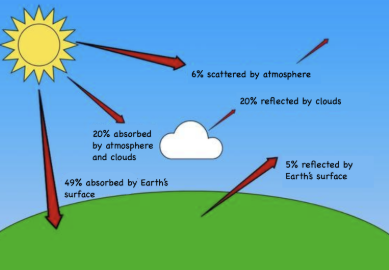
Earth receives energy from the Sun primarily as visible light and ultraviolet radiation. To maintain a stable temperature over time, Earth must radiate away exactly as much energy as it receives. This balance between incoming solar radiation and outgoing terrestrial radiation determines Earth's average temperature.
Without an atmosphere, Earth's average surface temperature would be approximately -18°C, far too cold for liquid water and life as we know it. Instead, Earth's actual average surface temperature is about +15°C. The 33°C difference is due to the greenhouse effect.
Definition: The greenhouse effect is the process by which certain gases in Earth's atmosphere absorb and re-emit infrared radiation, trapping thermal energy and warming the planet's surface and lower atmosphere.
The name comes from the (imperfect) analogy to a greenhouse, where glass allows visible light in, but traps heat inside. However, the mechanisms differ. Real greenhouses work primarily by preventing convection (hot air can't escape), while the atmospheric greenhouse effect works through radiation absorption.
The key point: greenhouse gases are transparent to incoming visible light but opaque to outgoing infrared radiation. This selective absorption creates the warming effect.
Greenhouse gas: A gas that absorbs and emits infrared radiation, contributing to the greenhouse effect.
Not all gases are greenhouse gases. Oxygen (O₂) and nitrogen (N₂), which make up 99% of the atmosphere, are NOT greenhouse gases.
Molecular structure matters. Greenhouse gases must have three or more atoms arranged such that vibration changes the molecule's electric dipole moment. When infrared radiation hits these molecules, it can excite vibrational modes, absorbing energy.
Diatomic molecules like O₂ and N₂ have only one vibrational mode (stretching), which doesn't change their dipole moment (they're symmetric), so they don't absorb infrared effectively.
CO₂ (linear, three atoms), H₂O (bent, three atoms), and CH₄ (tetrahedral, five atoms) have multiple vibrational modes that interact with infrared radiation, making them effective greenhouse gases.
Albedo is the fraction of incident radiation reflected by a surface, expressed as a value between 0 (perfect absorber) and 1 (perfect reflector).
Global average albedo: ≈0.3 (30% of incoming solar radiation is reflected to space)
Feedback effects: As ice melts due to warming, it exposes darker land or ocean beneath. Lower albedo means more absorption, more warming, more melting — a positive feedback loop amplifying climate change.
The natural greenhouse effect keeps Earth habitable. Without it, Earth would be frozen.
The enhanced greenhouse effect refers to the additional warming caused by human activities increasing greenhouse gas concentrations.
Since the Industrial Revolution (≈1750), human activities have significantly increased:
Global warming: The observed increase in Earth's average surface temperature. Global average temperature has risen approximately 1.1°C since pre-industrial times, with most warming occurring since 1980.
Climate change: Broader term encompassing temperature rise plus associated changes: sea level rise, ice melt, changing precipitation patterns, more extreme weather events, ocean acidification, ecosystem shifts.
Earth's energy balance can be modeled using the Stefan-Boltzmann law.
Solar constant S ≈ 1361 W/m²
Incoming power per unit area = S(1 - α)/4 ≈ (1361)(0.7)/4 ≈ 238 W/m²
Outgoing radiation: P = σT⁴
Setting equal: σT⁴ = S(1 - α)/4
Solving gives T ≈ 255 K = -18°C
This is Earth's effective radiating temperature — the temperature Earth would have without greenhouse gases. The actual surface temperature (≈288 K = 15°C) is 33 K higher due to the greenhouse effect.
Earth approximates a black body, an idealized object that absorbs all incident radiation and emits radiation based only on temperature. While not perfect (Earth's emissivity ≈ 0.95-0.98), this approximation enables climate modeling.
Climate models simulate Earth's atmosphere, oceans, ice, and land surfaces using physics principles:
These models, running on supercomputers, project future climate based on emission scenarios. Understanding the greenhouse effect combines radiation physics, atmospheric chemistry, and thermodynamics. It's a powerful example of how fundamental physics principles explain large-scale phenomena affecting billions of people.
Incoming solar power: S(1 - α)/4
Outgoing radiation: P = εσAT⁴
Equilibrium temperature: T⁴ = S(1 - α)/(4εσ)