

On this page:
Introduction The Kinetic Molecular Theory Defining Gas Properties Boyle's Law Charles's Law Gay-Lussac's Law The Ideal Gas Equation Molar Volume and Standard Conditions Kinetic Theory and Temperature Pressure from Kinetic Theory Real Gases and Deviations Gas Mixtures: Dalton's Law Applications of Gas Laws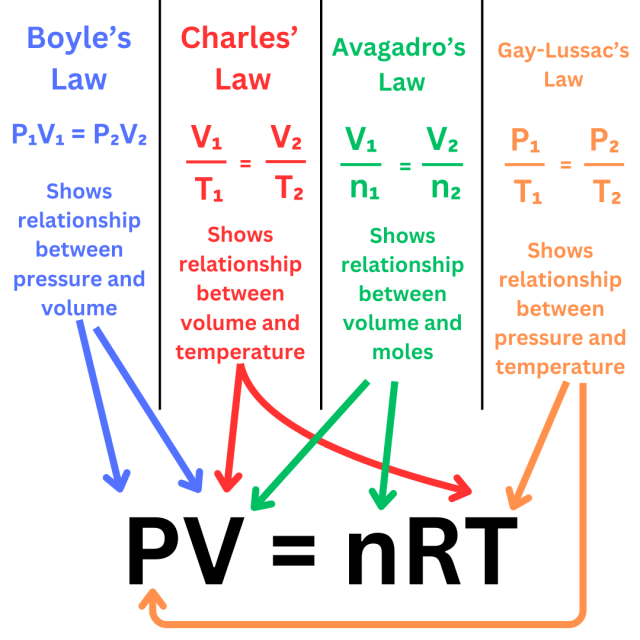
Understanding gas behavior begins with the kinetic molecular theory, which models gases as collections of tiny particles in constant, random motion.
The theory makes several assumptions about ideal gases:
Real gases deviate from these assumptions, especially at high pressure (molecules close together, volume matters) and low temperature (molecules slow, intermolecular forces significant). However, at normal conditions, real gases behave very nearly ideally.
Pressure (P): Force per unit area exerted by gas molecules colliding with container walls.
SI unit: pascal (Pa), where 1 Pa = 1 N/m²
Common units: atmosphere (1 atm = 101,325 Pa), bar (1 bar = 10⁵ Pa), mmHg or torr
Volume (V): The space occupied by the gas (the container volume).
SI unit: cubic meter (m³)
Common units: liter (L), where 1 L = 10⁻³ m³ = 1000 cm³
Temperature (T): A measure of the average kinetic energy of gas molecules.
Must use absolute temperature (Kelvin scale) for gas law calculations: T(K) = T(°C) + 273.15
Absolute zero (0 K = -273.15°C) is the theoretical temperature where molecular motion ceases.
Amount of substance (n): The quantity of gas measured in moles.
One mole contains Avogadro's number of particles: N_A = 6.02 × 10²³ mol⁻¹
Statement: For a fixed amount of gas at constant temperature, the pressure is inversely proportional to volume.
P ∝ 1/V (at constant T and n)
PV = constant
P₁V₁ = P₂V₂
Physical explanation: Decreasing volume forces molecules into a smaller space. An equal number of molecules collide with walls more frequently, increasing pressure. Temperature stays constant, so the average molecular speed doesn't change.
Example: A gas occupies 2.0 L at 100 kPa. Find the pressure if compressed to 0.5 L at constant temperature.
P₁V₁ = P₂V₂ → (100)(2.0) = P₂(0.5) → P₂ = 200/0.5 = 400 kPa
Practical applications: Syringes, bicycle pumps, breathing (diaphragm changes lung volume, changing pressure)
Statement: For a fixed amount of gas at constant pressure, the volume is directly proportional to absolute temperature.
V ∝ T (at constant P and n)
V/T = constant
V₁/T₁ = V₂/T₂
Physical explanation: Increasing temperature increases average molecular kinetic energy. Molecules move faster, hitting walls harder and more frequently. To maintain constant pressure, volume must increase, reducing collision frequency back to balance.
Example: A balloon has a volume of 3.0 L at 20°C. Find its volume at 100°C (pressure constant).
Convert to Kelvin: T₁ = 293 K, T₂ = 373 K
V₁/T₁ = V₂/T₂ → 3.0/293 = V₂/373 → V₂ = (3.0)(373)/293 = 3.82 L
Warning: Temperature must always be in Kelvin for gas law calculations!
Statement: For a fixed amount of gas at constant volume, the pressure is directly proportional to absolute temperature.
P ∝ T (at constant V and n)
P/T = constant
P₁/T₁ = P₂/T₂
Physical explanation: Higher temperature means faster-moving molecules. In a fixed volume, faster molecules collide with walls more frequently and with greater force, increasing pressure.
Example: A sealed rigid container has a pressure of 200 kPa at 25°C. Find the pressure if heated to 100°C.
T₁ = 298 K, T₂ = 373 K
P₁/T₁ = P₂/T₂ → 200/298 = P₂/373 → P₂ = (200)(373)/298 = 250 kPa
Safety concern: Sealed containers can explode if heated too much due to pressure increase.
PV = nRT
P = pressure (Pa), V = volume (m³), n = amount of substance (mol)
R = universal gas constant = 8.31 J·mol⁻¹·K⁻¹
T = absolute temperature (K)
Alternative form using the number of molecules N: PV = NkT
where k is Boltzmann's constant = 1.38 × 10⁻²³ J·K⁻¹ = R/N_A
Example 1: Calculate the volume of 2.0 mol of ideal gas at 100 kPa and 300 K.
V = nRT/P = (2.0)(8.31)(300)/(100,000) = 4986/100,000 = 0.0499 m³ ≈ 50 L
Example 2: A container holds 0.5 mol of gas at 2.0 atm and occupies 10 L. Find the temperature.
Convert: P = 2.0 × 101,325 = 202,650 Pa; V = 0.010 m³
T = PV/(nR) = (202,650)(0.010)/(0.5)(8.31) = 2026.5/4.155 = 488 K = 215°C
At standard temperature and pressure (STP), defined as T = 273 K (0°C) and P = 100 kPa (or sometimes 101.325 kPa), one mole of any ideal gas occupies:
V = nRT/P = (1)(8.31)(273)/(100,000) = 0.0227 m³ ≈ 22.7 L
This is the molar volume at STP. All ideal gases have the same molar volume at the same conditions, regardless of molecular identity.
Average kinetic energy of a gas molecule: KE_avg = (3/2)kT
This shows that temperature is a direct measure of average molecular kinetic energy. Higher T means faster average molecular speed.
The root-mean-square (rms) speed is:
v_rms = √(3RT/M) = √(3kT/m)
M = molar mass (kg/mol), m = molecular mass (kg)
This explains why lighter molecules (smaller M) move faster at the same temperature.
Example: Calculate the rms speed of oxygen molecules (M = 0.032 kg/mol) at 300 K.
v_rms = √(3RT/M) = √((3)(8.31)(300)/(0.032)) = √(7479/0.032) = √233,719 = 483 m/s
Oxygen molecules at room temperature move at nearly 500 m/s on average!
P = (1/3)(Nm/V)v_rms²
N = number of molecules, m = molecular mass, V = volume
This connects macroscopic property (pressure) to microscopic motion (molecular speed).
Combining with PV = NkT gives the relationship between temperature and kinetic energy shown earlier.
Real gases deviate from ideal behavior when:
The Van der Waals equation modifies the ideal gas equation to account for these factors:
(P + a(n/V)²)(V - nb) = nRT
where a and b are constants specific to each gas, accounting for intermolecular forces and molecular volume.
For most problems at moderate conditions, the ideal gas equation works well.
Dalton's Law of Partial Pressures: P_total = P₁ + P₂ + P₃ + ...
Partial pressure: P_i = x_i × P_total, where x_i is the mole fraction of gas i.
Example: A container holds 2 mol of oxygen and 3 mol of nitrogen at a total pressure of 500 kPa. Find each partial pressure.
Mole fractions: x_O₂ = 2/5 = 0.4; x_N₂ = 3/5 = 0.6
P_O₂ = (0.4)(500) = 200 kPa; P_N₂ = (0.6)(500) = 300 kPa
Total: 200 + 300 = 500 kPa ✓
Gas laws connect microscopic molecular behavior to macroscopic observable properties, providing powerful predictive tools across countless applications from industrial processes to atmospheric science.