Fusion and Stars
Look at the night sky. Thousands of stars shine every night. Have you ever wondered what makes stars glow for billions of years?
Stars do not burn like wood or coal. Instead, they produce energy through nuclear fusion, a process that releases enormous energy from tiny atomic nuclei.
Fusion powers the Sun and all other stars. Without fusion, stars would not shine, and life on Earth would not exist.
This lesson explains how fusion works, how stars produce energy, and how stars evolve during their lifetimes.
What Is Nuclear Fusion?
Nuclear fusion is a process in which two light atomic nuclei combine to form a heavier nucleus, releasing energy.
Example: Hydrogen nuclei combine to form helium inside stars.
During fusion:
- Small nuclei join together
- A heavier nucleus forms
- A large amount of energy is released
Fusion is different from nuclear fission. In fusion, nuclei combine. In fission, heavy nuclei split.
Fusion releases energy because of mass loss during the reaction.
Mass, Energy Relationship
E = mc²
E = energy released, m = mass lost, c = speed of light (3 × 10⁸ m/s)
Even a very small mass loss produces a huge amount of energy. In fusion reactions, the mass of the products is slightly less than the mass of the original nuclei. The missing mass becomes energy.
This is why stars can produce enormous energy for billions of years.
Fusion in Stars
Stars are mainly made of hydrogen gas. The extremely high temperature and pressure in the core allow fusion to occur.
Typical core conditions:
- Temperature ≈ 10 million K or higher
- Extremely high pressure
- Very high density
At these temperatures, atoms lose electrons and form plasma (where electrons and nuclei move freely). In plasma, nuclei move fast enough to overcome electrostatic repulsion and collide strongly enough to fuse.
Hydrogen Fusion
The most important fusion process in stars is hydrogen fusion.
Four hydrogen nuclei combine to form one helium nucleus. This process releases gamma radiation, neutrinos, and kinetic energy.
Hydrogen → Helium + Energy
The helium nucleus has slightly less mass than four hydrogen nuclei. That mass difference becomes energy.
Most stars spend most of their lifetime converting hydrogen into helium. This stage is called the main sequence stage.
Main Sequence Stars
A main-sequence star is a stable star where hydrogen fusion occurs in the core. Our Sun is a typical main-sequence star.
During this stage:
- Hydrogen fuses into helium
- Energy flows outward
- Star remains stable
Most stars spend about 90% of their lifetime in this stage.
High-mass stars: Hotter, brighter, shorter lifetime
Low-mass stars: Cooler, dimmer, longer lifetime
Forces Inside a Star
Gravitational Force
Gravity pulls matter inward toward the center, trying to compress the star.
Radiation Pressure
Fusion produces energy that pushes outward. Hot gases create pressure that expands the star.
Hydrostatic Equilibrium: When gravity and pressure balance, the star becomes stable.
If fusion slows down: Pressure decreases → gravity compresses the star → temperature increases → fusion speeds up again. This natural regulation keeps stars stable for long periods.
Energy Transport in Stars
Radiation: Energy moves outward as electromagnetic radiation. Photons are absorbed and re-emitted many times. It can take thousands of years for energy to reach the surface.
Convection: Hot gas rises while cooler gas sinks. This circulation transfers energy outward. Some stars have large convection zones.
Surface Temperature and Color
- Blue stars ≈ 20,000 K or higher (hottest)
- White stars ≈ 10,000 K
- Yellow stars ≈ 6000 K (like our Sun)
- Red stars ≈ 3000 K (coolest)
Hotter stars emit more energy and appear brighter.
Stellar Luminosity
Luminosity is the total energy emitted by a star per second (measured in watts).
Luminosity depends on:
- Surface temperature (hotter → more energy)
- Size of the star (larger → more energy)
The Hertzsprung–Russell Diagram (H–R Diagram)
The H–R diagram shows the relationship between luminosity and surface temperature.
Regions of the diagram:
- Main-sequence stars (most stars)
- Red giants
- White dwarfs
- Supergiants
The H–R diagram helps scientists understand stellar evolution.
Stellar Evolution
Stars change over time. This process is called stellar evolution. A star's evolution depends mainly on its mass.
Red Giant Stage
Eventually, all the hydrogen in the core becomes depleted. Fusion slows down. Gravity compresses the core, and the outer layers expand. The star becomes a red giant.
Characteristics: Very large radius, cooler surface, bright luminosity. Hydrogen fusion continues in a shell around the core.
Helium Fusion
When the core temperature becomes high enough, helium fusion begins. Helium nuclei combine to form heavier elements such as carbon.
Helium fusion requires higher temperatures than hydrogen fusion and produces less energy.
Low-Mass Star Evolution
Nebula
→
Protostar
→
Main Sequence
→
Red Giant
→
White Dwarf
After the red giant stage, outer layers drift away, forming a planetary nebula. The remaining core becomes a white dwarf.
White Dwarfs
A white dwarf is a small, dense star left after a low-mass star dies.
Characteristics: Very dense, very hot initially, small size, no fusion. White dwarfs slowly cool over billions of years, eventually becoming cold dark objects.
High-Mass Star Evolution
Nebula
→
Protostar
→
Main Sequence
→
Red Supergiant
→
Supernova
Massive stars fuse heavier elements: Helium → Carbon → Oxygen → Silicon → Iron
Iron fusion does not release energy. When iron forms, fusion stops, gravity collapses the core, and an explosion occurs — a supernova.
Supernova Explosion
A supernova releases enormous energy. During a supernova:
- Outer layers explode into space
- Heavy elements (gold, uranium) form
- Shock waves travel outward
Supernova remnants enrich space with heavy elements that later form new stars and planets.
Neutron Stars
After a supernova, the core may collapse into a neutron star.
Characteristics: Extremely dense, very small radius, strong gravity. A teaspoon of neutron star matter would weigh billions of kilograms.
Some neutron stars rotate rapidly and emit radio waves — these are called pulsars.
Black Holes
If the core is massive enough, gravity becomes extremely strong. The star collapses into a black hole.
Characteristics: Gravity extremely strong, light cannot escape, very small radius.
The boundary of a black hole is called the event horizon. Anything crossing this boundary cannot escape.
Binding Energy
Binding energy is the energy required to separate a nucleus into individual nucleons.
Helium nuclei have greater binding energy per nucleon than hydrogen nuclei. This difference explains why fusion releases energy. Fusion moves nuclei toward greater stability.
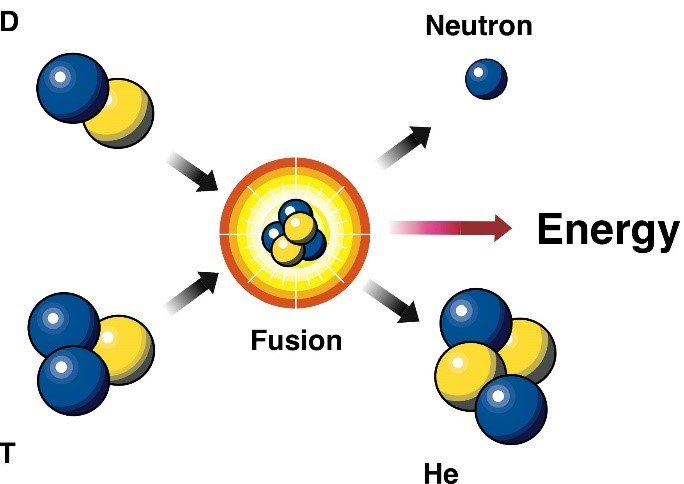
Fusion on Earth
Scientists are trying to produce fusion energy on Earth using hydrogen isotopes:
Deuterium + Tritium → Helium + Neutron + Energy
Requirements: Extremely high temperature, strong magnetic fields, plasma confinement.
Advantages: Fuel is abundant, no greenhouse gases, no long-lived radioactive waste.
However, fusion is difficult to control.
Importance of Fusion and Stars
Fusion and stars explain:
- How stars produce energy
- How elements are formed (nucleosynthesis)
- How the universe evolves
- How our Sun works
Every element in the human body was formed inside stars or supernova explosions.
In this way, the study of fusion and stars explains both the origin of energy and the origin of matter in the universe.
Summary of Stellar Evolution Paths
| Star Mass |
Evolution Path |
Final State |
| Low mass (≈ Sun) |
Nebula → Main Sequence → Red Giant → Planetary Nebula |
White Dwarf |
| High mass (>8× Sun) |
Nebula → Main Sequence → Red Supergiant → Supernova |
Neutron Star or Black Hole}⑤
|
Summary of Key Formulas