
On this page:
Introduction Structure of the Atomic Nucleus Nuclear Stability What Is Nuclear Fission? Energy Released in Fission Mass Defect Binding Energy Binding Energy per Nucleon Induced Fission Neutron Production Chain Reaction Critical Mass Nuclear Reactors Energy from Fission Advantages of Nuclear Fission Disadvantages of Nuclear Fission Radioactive Waste Comparison with Nuclear Fusion Summary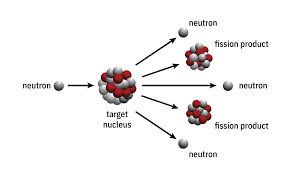
Have you ever wondered how a small piece of uranium can produce enormous amounts of energy? How can a nuclear power plant generate electricity for millions of homes using only a small amount of fuel?
The answer lies in nuclear fission.
Nuclear fission is one of the most important topics in IB Physics DP nuclear physics. It explains how energy is released from atomic nuclei and how this energy can be used in nuclear reactors and weapons.
Unlike chemical reactions, nuclear reactions involve changes inside the nucleus of an atom. Because nuclear forces are extremely strong, the energy released is much larger than in ordinary chemical reactions.
Understanding nuclear fission requires knowledge of atomic nuclei, binding energy, and chain reactions.
Every atom contains a tiny central nucleus made of:
Together they are called nucleons.
The number of protons is the atomic number (Z) — determines which element.
The total number of protons and neutrons is the mass number (A).
Example: Uranium-235 contains 92 protons and 143 neutrons (mass number = 235).
Nuclear reactions change the nucleus itself — different from chemical reactions where only electrons rearrange.
Not all nuclei are stable.
Heavy nuclei contain many protons. Since protons repel each other electrically, the nucleus becomes less stable as the number of protons increases.
Neutrons help stabilize the nucleus because they add nuclear force without adding electric repulsion.
However, when the nucleus becomes too large, it can split into smaller nuclei. This process is called nuclear fission.
Nuclear fission is the splitting of a heavy nucleus into two smaller nuclei along with the release of energy and neutrons.
A common example is the fission of uranium-235: A uranium nucleus absorbs a neutron and becomes unstable. The nucleus splits into two smaller nuclei and releases additional neutrons.
U-235 + neutron → fission fragments + neutrons + energy
The smaller nuclei produced are called fission products (e.g., barium and krypton, although many combinations are possible).
Nuclear fission releases a huge amount of energy compared to chemical reactions.
This energy comes from a difference in mass between the original nucleus and the final products. The total mass after fission is slightly less than the original mass.
This missing mass is called a mass defect.
E = mc² (Einstein's equation)
Even a tiny amount of mass produces a very large amount of energy because the speed of light squared is extremely large.
Mass defect = total nucleon mass − nucleus mass
If we add the masses of all protons and neutrons individually, the result is always larger than the actual nuclear mass. The missing mass has been converted into binding energy.
The greater the mass defect, the greater the nuclear binding energy.
Binding energy is the energy required to completely separate a nucleus into its individual nucleons. It is also equal to the energy released when the nucleus forms.
Binding energy shows how stable a nucleus is:
Binding energy is usually measured in MeV (mega electron volts).
Binding energy per nucleon = total binding energy ÷ number of nucleons
Medium-sized nuclei such as iron have the highest binding energy per nucleon. Heavy nuclei such as uranium have lower binding energy per nucleon.
When uranium splits into medium-sized nuclei, the binding energy per nucleon increases. This increase corresponds to the energy released. This is why fission produces energy.
Some nuclei can undergo fission naturally, but most fission reactions are induced fission — when a nucleus absorbs a neutron.
The neutron makes the nucleus unstable and causes it to split.
Uranium-235 is especially suitable because it can undergo fission with slow neutrons. Such materials are called fissile materials.
Examples: Uranium-235, Plutonium-239
During fission, extra neutrons are released. Typically, one fission reaction releases 2 or 3 neutrons.
These neutrons can cause further fission reactions, leading to a chain reaction.
A chain reaction occurs when neutrons from one fission reaction cause further fission reactions. One fission produces neutrons, which cause more fission, and the process continues repeatedly.
Critical mass is the minimum mass of fissile material needed to sustain a chain reaction.
Critical mass depends on shape, density, purity, and surrounding materials. A sphere has the smallest critical mass because it has the smallest surface area compared with volume.
Nuclear reactors use controlled nuclear fission to produce energy. The heat produced in fission is used to generate steam, which turns turbines to generate electricity.
The energy released from fission appears in several forms:
Most of the energy becomes heat, used to generate electricity in power stations.
Nuclear energy is very efficient. A small mass of uranium produces the same energy as tons of coal.
This makes them suitable for base-load electricity production.
Fission products are radioactive — they emit radiation as they decay.
Storage methods:
The activity of waste decreases over time as radioactive nuclei decay.
Splitting heavy nuclei
Currently used in nuclear power plants
Joining light nuclei
Releases even more energy but harder to control
Both processes release energy because the binding energy per nucleon increases.
| State | Neutron Balance | Reaction Rate |
|---|---|---|
| Critical | Each fission → exactly one more fission | Constant |
| Subcritical | Fewer neutrons cause fission | Slows down |
| Supercritical | More neutrons cause fission | .=Rapidly grows