

On this page:
Introduction Electric Charge Coulomb's Law Electric Field Electric Field Lines Electric Potential Energy and Potential Uniform Electric Fields Magnetic Fields Magnetic Field Lines Magnetic Force on Moving Charges Circular Motion in Magnetic Fields Magnetic Force on Current-Carrying Wires Comparing Electric and Magnetic Fields Applications Everywhere The Electromagnetic Connection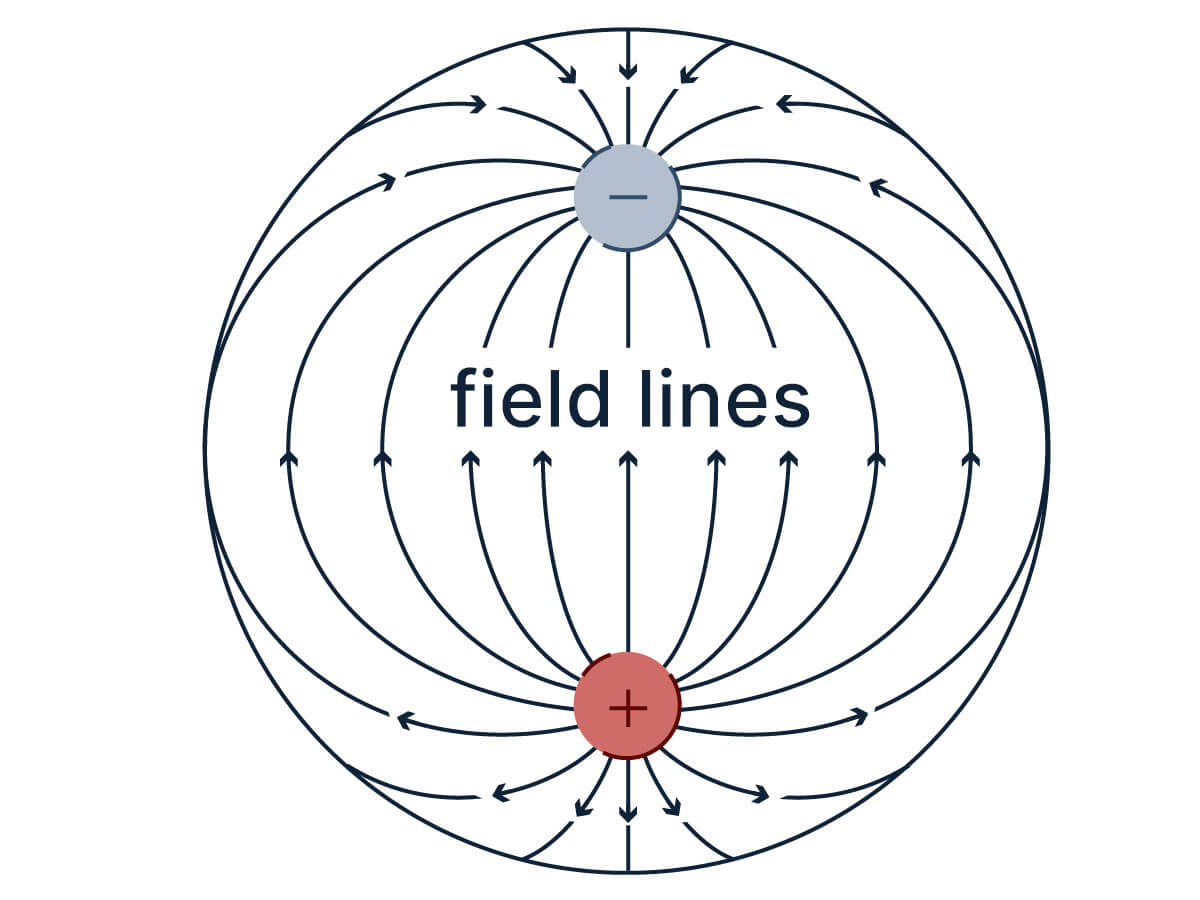
Rub a balloon on your hair. It sticks to the wall without any glue. Hold two magnets near each other; they either snap together or push apart with surprising force, even through the air. Your credit card works because a magnetic strip stores information. Your phone charges wirelessly through invisible fields.
These aren't mysteries. They're fields — regions of space where forces act at a distance.
We've already studied gravitational fields, where masses attract other masses. Now we turn to electric and magnetic fields, which are even more important in everyday technology. Electricity powers civilization. Magnetism enables motors, generators, speakers, hard drives, MRI machines, and particle accelerators.
Electric and magnetic fields are intimately connected — so much so that they're really two aspects of the same thing: the electromagnetic field. Light itself is an electromagnetic wave, oscillations of electric and magnetic fields propagating through space.
Understanding electric and magnetic fields means understanding how most modern technology works and how the universe behaves at its most fundamental level.
Just as mass creates gravitational fields, electric charge creates electric fields.
Elementary charge: e = 1.60 × 10⁻¹⁹ C (coulombs)
A proton carries charge +e. An electron carries charge -e. Charge is quantized — you can only have integer multiples of e.
Charge is conserved. You can't create or destroy net charge. You can only separate positive and negative charges.
SI unit: coulomb (C)
F = kq₁q₂/r²
k = 8.99 × 10⁹ N·m²/C²
Example: Two point charges, +3.0 μC and -5.0 μC, are separated by 0.10 m. Find the force between them.
F = (8.99 × 10⁹)(3.0 × 10⁻⁶)(-5.0 × 10⁻⁶)/(0.10)² = -13.5 N (attractive)
Comparing gravity and electric force: For two protons, FE/FG ≈ 10³⁶ — the electric force is about a million trillion trillion trillion times stronger than gravity! This is why electric forces dominate at atomic scales, while gravity dominates at planetary scales (where charges cancel out).
E = F/q (definition)
E = kQ/r² (for a point charge Q)
SI unit: N/C or V/m
Example: Find the electric field strength 0.20 m from a +6.0 μC point charge.
E = kQ/r² = (8.99 × 10⁹)(6.0 × 10⁻⁶)/(0.20)² = 1.35 × 10⁶ N/C
The field points away from positive charges and toward negative charges.
Rules for field lines:
Single positive charge: Lines radiate outward
Single negative charge: Lines point inward
Dipole (positive + negative): Lines curve from positive to negative
Uniform field (parallel plates): Lines are parallel, evenly spaced, pointing from the positive plate to the negative plate
EPE = kq₁q₂/r (electric potential energy)
V = kQ/r (electric potential for point charge)
ΔV = W/q (potential difference)
E = -ΔV/Δx (field is negative gradient of potential)
Electric potential (V) is the electric potential energy per unit charge. SI unit: volt (V), where 1 V = 1 J/C
Potential difference (voltage) between two points is the work done per unit charge in moving from one point to the other. A 9V battery maintains a 9-volt potential difference between its terminals.
Example: An electron (q = -1.60 × 10⁻¹⁹ C) moves through a potential difference of 100 V. How much work is done?
W = qΔV = (-1.60 × 10⁻¹⁹)(100) = -1.60 × 10⁻¹⁷ J
E = V/d
V = potential difference, d = separation
Example: Two plates are 0.050 m apart with a 500 V potential difference. Find the electric field.
E = V/d = 500/0.050 = 10,000 V/m = 1.0 × 10⁴ N/C
Magnetic fields don't exert forces on stationary charges — only on moving charges or on other magnets.
Magnetic field strength (B) — also called magnetic flux density.
SI unit: tesla (T), where 1 T = 1 N/(A·m)
For a bar magnet:
Magnetic field lines always form closed loops. There are no "magnetic charges" (magnetic monopoles).
Right-hand rules:
Straight wire: Thumb points in current direction, fingers curl in direction of magnetic field.
Coil (solenoid): Fingers curl in current direction, thumb points toward the north pole.
F = qvB sin θ
q = charge (C), v = velocity (m/s), B = field strength (T), θ = angle between v and B
Example: An electron (q = -1.60 × 10⁻¹⁹ C) moves at 2.0 × 10⁶ m/s perpendicular to a 0.050 T magnetic field. Find the force.
F = qvB = (1.60 × 10⁻¹⁹)(2.0 × 10⁶)(0.050) = 1.6 × 10⁻¹⁴ N
r = mv/(qB) (radius of circular path)
T = 2πm/(qB) (period — independent of velocity!)
Example: A proton (m = 1.67 × 10⁻²⁷ kg, q = 1.60 × 10⁻¹⁹ C) moves at 5.0 × 10⁶ m/s perpendicular to a 0.80 T field. Find the radius.
r = mv/(qB) = (1.67 × 10⁻²⁷)(5.0 × 10⁶)/[(1.60 × 10⁻¹⁹)(0.80)] = 0.065 m = 6.5 cm
Period independence from velocity is exploited in cyclotrons (particle accelerators).
F = BIL sin θ
B = field strength (T), I = current (A), L = length of wire in field (m)
Example: A 0.20 m wire carries 3.0 A perpendicular to a 0.40 T field. Find the force.
F = BIL = (0.40)(3.0)(0.20) = 0.24 N
This principle powers electric motors — magnetic forces on current-carrying coils create rotation.
| Property | Electric Field | Magnetic Field |
|---|---|---|
| Source | Charge (stationary or moving) | Moving charge (current) |
| Force on stationary charge | Yes (F = qE) | No |
| Force on moving charge | Yes (same as stationary) | Yes (F = qvB sin θ) |
| Field line pattern | Begin and end on charges | Form closed loops |
| Can you do work? | Yes (changes KE) | No (always perpendicular to motion) |
Key insight: Magnetic forces are always perpendicular to velocity, so they change direction but not speed. They can't do work or change kinetic energy — only redirect motion.
Electric and magnetic fields aren't really separate. A changing electric field creates a magnetic field. A changing magnetic field creates an electric field. They're unified into electromagnetism.
Light is an electromagnetic wave — oscillating electric and magnetic fields propagating through space, each creating the other continuously.
This unification, discovered by James Clerk Maxwell in the 1860s, was one of physics' greatest triumphs. It showed that electricity, magnetism, and light are all aspects of the same fundamental force.
Understanding electric and magnetic fields is understanding how the universe works at a fundamental level, and how we harness these forces to power modern civilization.