

On this page:
Introduction What's Actually Happening The Basic Principle Case 1: Observer Moving, Source Stationary Case 2: Source Moving, Observer Stationary Case 3: Both Source and Observer Moving The Doppler Effect for Light Application: Measuring Speed Medical Ultrasound Astronomy: Measuring Stellar Motion The Expanding Universe Weather Forecasting: Doppler Radar Sonic Booms and Shock Waves Why This Matters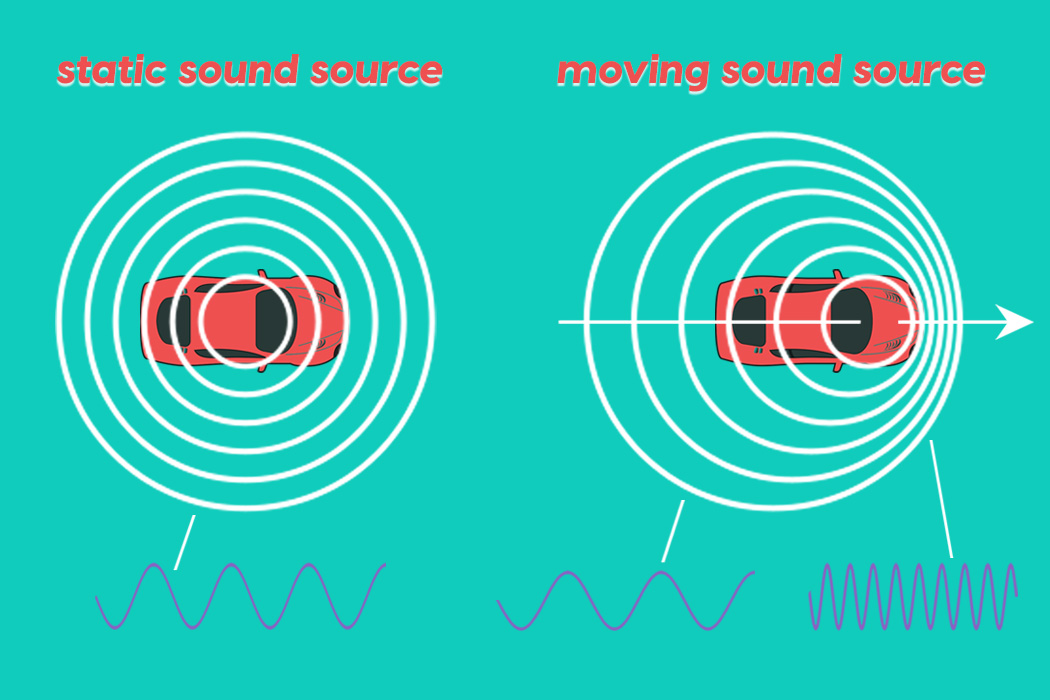
You're standing on a sidewalk. An ambulance races down the street toward you, siren blaring. As it approaches, you hear a high-pitched wail. Then it zooms past, and suddenly, the pitch drops noticeably lower as it speeds away.
But here's the weird thing: the siren itself hasn't changed. It's emitting sound at the same frequency the whole time. The paramedics inside the ambulance hear a constant pitch.
So why do you hear the pitch change?
This is the Doppler effect, named after Austrian physicist Christian Doppler, who explained it in 1842. It's one of those phenomena you've experienced countless times but maybe never thought deeply about.
The Doppler effect isn't just about ambulance sirens. It's how police radar guns measure your speed. It's how doctors use ultrasound to monitor blood flow. It's how astronomers discovered the universe is expanding. It's how we detect planets orbiting distant stars.
Understanding the Doppler effect means understanding how motion affects waves, and that opens doors to technologies from weather forecasting to cosmology.
Imagine a stationary ambulance with its siren on. Sound waves spread out evenly in all directions. The distance between wave crests (the wavelength) is the same in every direction.
Now the ambulance starts moving forward while the siren continues blaring. Each time the siren emits a new wave crest, the ambulance has moved slightly forward from where it emitted the previous crest.
In front of the ambulance: The wave crests bunch together. Wavelength decreases and frequency increases. Higher frequency means higher pitch.
Behind the ambulance: The wave crests spread apart. Wavelength increases and frequency decreases. Lower frequency means lower pitch.
The siren itself hasn't changed frequency. What's changed is how often the wave crests reach your ears, which depends on the relative motion between you and the source.
Doppler effect: The observed frequency (and wavelength) of a wave changes when there is relative motion between the source and the observer.
Key patterns:
This works for all types of waves — sound, light, water waves, seismic waves — whenever there's relative motion between source and observer.
f' = f(v ± v₀)/v
f' = observed frequency, f = source frequency, v = wave speed, v₀ = observer speed
Use + when observer moves toward source
Use - when observer moves away from source
Example: You drive at 30 m/s toward a stationary siren emitting 800 Hz. Sound speed = 340 m/s. What frequency do you hear?
f' = 800(340 + 30)/340 = 800(370/340) = 800(1.088) = 870.6 Hz
You hear 870.6 Hz instead of 800 Hz — about 9% higher pitch.
f' = fv/(v ∓ vₛ)
vₛ = source speed
Use - in denominator when source moves toward observer
Use + when source moves away from observer
Example: An ambulance (siren frequency 900 Hz) approaches you at 25 m/s. Sound speed = 340 m/s.
Approaching: f' = 900(340)/(340 - 25) = 900(340/315) = 900(1.079) = 971.4 Hz
Receding: f' = 900(340)/(340 + 25) = 900(340/365) = 900(0.932) = 838.4 Hz
The frequency drops from 971 Hz to 838 Hz — a 133 Hz drop — creating the characteristic nee-NAW sound as the ambulance passes.
f' = f(v ± v₀)/(v ∓ vₛ)
Top: + if observer moves toward source, - if away
Bottom: - if source moves toward observer, + if away
Maximum observed frequency (approaching each other): f' = f(v + v₀)/(v - vₛ)
Minimum observed frequency (moving apart): f' = f(v - v₀)/(v + vₛ)
For everyday speeds (v << c):
Δf/f ≈ v/c (approaching), Δf/f ≈ -v/c (receding)
Δλ/λ ≈ -v/c (approaching), Δλ/λ ≈ +v/c (receding)
Blue-shift: Source and observer moving together. Wavelength decreases (shifts toward blue end), frequency increases.
Redshift: Source and observer moving apart. Wavelength increases (shifts toward red end), frequency decreases.
Example: A star moves away from Earth at 0.01c. It emits light at 600 nm. What wavelength do we observe?
Δλ/λ = v/c = 0.01 → Δλ = 0.01 × 600 = 6 nm → λ' = 600 + 6 = 606 nm
The light is red-shifted by 6 nanometers.
Doppler ultrasound measures blood flow velocity without surgery, needles, or radiation.
Ultrasound waves reflect off moving blood cells. The frequency shift indicates how fast blood is flowing and in which direction.
Medical applications:
Starlight carries specific spectral lines — characteristic wavelengths emitted or absorbed by elements like hydrogen and helium.
Finding binary stars: One star's light alternately blue-shifts and red-shifts as it orbits its partner.
Detecting exoplanets: A planet makes its star wobble slightly. This tiny wobble causes tiny Doppler shifts in the star's light, revealing the planet's presence and properties.
Hubble's Law: v = H₀d
H₀ = Hubble constant ≈ 70 km/s per megaparsec
Edwin Hubble discovered that nearly all galaxies show redshift — they're moving away from us. More distant galaxies show greater redshift — they're receding faster.
The universe is expanding. Space itself is stretching, carrying galaxies apart.
Redshift parameter: z = Δλ/λ = (λ_observed - λ_emitted)/λ_emitted
For distant galaxies, z can be greater than 1, meaning wavelengths have more than doubled due to the universe's expansion.
Doppler radar measures both precipitation location AND velocity. By detecting frequency shifts in reflected radio waves, it reveals wind speeds and directions inside storms.
Critical applications:
Modern weather forecasting would be impossible without Doppler radar.
Mach number: M = v_source/v_wave
Shock wave cone angle: sin θ = 1/M
Subsonic (M < 1): Slower than sound
Sonic (M = 1): At sound speed
Supersonic (M > 1): Faster than sound — outruns its own sound waves, forming a cone-shaped shock wave.
Example: A jet flies at Mach 2 (twice the speed of sound). Find the shock wave angle.
sin θ = 1/M = 1/2 = 0.5 → θ = 30°
The shock wave forms a 30° cone behind the jet.
Sonic boom: When the shock wave passes over you, you hear a loud bang. It's not a one-time event when "breaking the sound barrier" — it's a continuous shock wave trailing the supersonic object.
The Doppler effect connects motion to wave properties measurably. It provides a non-contact method for determining velocities — you don't need to touch the object or attach sensors to it.
From police enforcement to medical diagnostics, from understanding cosmic expansion to predicting tornadoes, the Doppler effect reveals motion through wave observations.
Understanding the Doppler effect means understanding why ambulance sirens sound the way they do, how radar guns work, how doctors visualize blood flow, why the universe is expanding, and how we discover planets around distant stars.