

Electric charge is a fundamental property of matter. It comes in two types: positive and negative. Like charges repel, opposite charges attract.
The elementary charge e = 1.60 × 10⁻¹⁹ C is the magnitude of charge on a proton (+e) or electron (-e).
SI unit: coulomb (C)
One coulomb is an enormous amount of charge. Typical static charges are measured in microcoulombs (μC) or nanocoulombs (nC).
I = Q/t (average current)
I = dQ/dt (instantaneous current)
SI unit: ampere (A), where 1 A = 1 C/s
Definition: Electric current is the rate of flow of electric charge through a cross-sectional area.
One ampere means one coulomb of charge flows past a point each second.
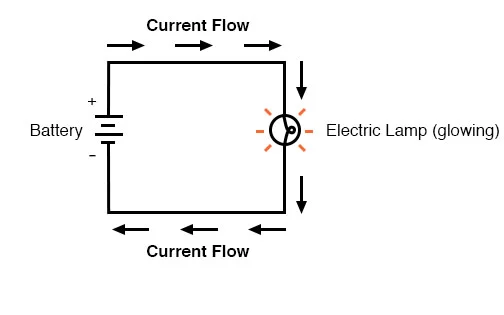
Direction convention: Current direction is defined as the direction positive charges would flow. In metals, electrons (negative) actually move, but the current direction is opposite to electron flow. This is conventional current.
Example: If 5.0 C of charge flows through a wire in 2.0 s, what's the average current?
I = Q/t = 5.0/2.0 = 2.5 A
V = W/Q
SI unit: volt (V), where 1 V = 1 J/C
Definition: Potential difference (voltage) between two points is the work done per unit charge in moving a charge from one point to the other.
Voltage represents electrical potential energy per unit charge. Higher voltage means more energy per charge.
Electromotive force (emf, ε): The potential difference provided by a cell or battery when no current flows. It's the energy supplied per unit charge by the energy source.
When current flows, the terminal voltage is less than the emf due to internal resistance: V = ε - Ir, where r is the internal resistance.
Example: A battery does 60 J of work moving 5.0 C of charge. Find the voltage.
V = W/Q = 60/5.0 = 12 V
R = V/I (definition of resistance)
SI unit: ohm (Ω), where 1 Ω = 1 V/A
Resistance is the opposition to current flow in a conductor. Higher resistance means less current for a given voltage.
Factors affecting resistance:
For a conductor of uniform cross-section: R = ρL/A
Temperature effect: For most conductors (metals), resistance increases with temperature. For semiconductors, resistance typically decreases with temperature.
Example: A copper wire (ρ = 1.7 × 10⁻⁸ Ω·m) has length 2.0 m and diameter 1.0 mm. Find resistance.
A = πr² = π(0.5 × 10⁻³)² = 7.85 × 10⁻⁷ m²
R = ρL/A = (1.7 × 10⁻⁸)(2.0)/(7.85 × 10⁻⁷) = 0.043 Ω
V = IR
Statement: For many conductors (called ohmic conductors), current is directly proportional to potential difference at constant temperature.
Ohmic conductors: Obey Ohm's law; resistance is constant. Examples: metal wires, resistors at constant temperature.
Non-ohmic conductors: Don't obey Ohm's law; resistance varies. Examples: diodes, transistors, light bulbs (filament temperature changes).
Example: A resistor has a resistance of 100 Ω. Find the current when 12 V is applied.
I = V/R = 12/100 = 0.12 A = 120 mA
P = VI (general formula)
P = I²R (using Ohm's law)
P = V²/R (using Ohm's law)
SI unit: watt (W), where 1 W = 1 J/s
Definition: Electrical power is the rate at which electrical energy is transferred or converted.
Energy consumed: E = Pt = VIt
SI unit: joule (J)
Practical unit: kilowatt-hour (kWh), where 1 kWh = 3.6 × 10⁶ J
Example: A 60 W light bulb operates at 120 V. Find current and resistance.
I = P/V = 60/120 = 0.5 A
R = V/I = 120/0.5 = 240 Ω
Series circuit: Components connected in a single path, so the same current flows through each.
Properties:
Adding resistors in series increases total resistance.
Example: Three resistors (10 Ω, 20 Ω, 30 Ω) connected in series to a 12 V battery. Find total resistance, current, and voltage across each.
R_total = 10 + 20 + 30 = 60 Ω
I = V/R = 12/60 = 0.2 A
V₁ = (0.2)(10) = 2 V, V₂ = (0.2)(20) = 4 V, V₃ = (0.2)(30) = 6 V
Check: 2 + 4 + 6 = 12 V ✓
Parallel circuit: Components connected across common points, so voltage across each is the same.
Properties:
Adding resistors in parallel decreases total resistance (more paths for current).
For two resistors in parallel: R_total = (R₁R₂)/(R₁ + R₂)
Example: Three resistors (10 Ω, 20 Ω, 30 Ω) in parallel across 12 V. Find total resistance and total current.
1/R_total = 1/10 + 1/20 + 1/30 = 6/60 + 3/60 + 2/60 = 11/60 → R_total = 60/11 ≈ 5.45 Ω
I_total = V/R_total = 12/5.45 = 2.20 A
Individual currents: I₁ = 1.2 A, I₂ = 0.6 A, I₃ = 0.4 A, Total = 2.2 A ✓
Kirchhoff's Current Law (KCL) – Junction Rule:
ΣI_in = ΣI_out
The sum of currents entering a junction equals the sum of currents leaving. This is conservation of charge.
Kirchhoff's Voltage Law (KVL) – Loop Rule:
ΣV = 0 (around closed loop)
The sum of potential differences around any closed loop equals zero. This is conservation of energy.
Real batteries have internal resistance (r) due to the resistance of the electrolyte and electrodes.
V = ε - Ir
When no current flows (open circuit), terminal voltage equals emf. When current flows, terminal voltage drops below emf.
Power dissipated internally: P_internal = I²r (wasted as heat)
Example: A battery (emf = 12 V, internal resistance = 0.5 Ω) delivers 2.0 A. Find the terminal voltage.
V = ε - Ir = 12 - (2.0)(0.5) = 12 - 1.0 = 11 V
The terminal voltage is 11 V, with 1 V dropped across internal resistance.
Ammeter: Measures current. Must be connected in series (current flows through it). Ideally has zero resistance to not affect the circuit.
Voltmeter: Measures potential difference. Must be connected in parallel (across components). Ideally has infinite resistance so no current diverts through it.
Understanding current and circuits is essential for all electrical and electronic technology, from power grids to smartphones to medical devices. These principles govern how we generate, transmit, and use electrical energy.