

On this page:
Introduction What Is Work? Work Formula When is work done and when is it not? Energy in relation to work Kinetic Energy (KE) Gravitational Potential Energy (GPE) Principle of Conservation of Energy What Is Power? Power Formula What Is Efficiency? Efficiency Formula Examples of Efficiency Why Efficiency MattersLet's start with the basic definition of work from a scientific perspective.
To determine scientific work, a force must cause a displacement in the same direction as the force.
Three conditions must be met in order for scientific work to happen:
If any of these three conditions are not met, then the scientific work is not done.
Now, let's consider what we do in our daily activities.
When you walk upstairs, carry your school bag, or push a grocery cart, you feel the work you have done.
But do you think physics would agree with you?
Doing work in physics is very specific and different from just feeling tired.
For example, you could push a wall and feel very tired, but in physics, you have done no work at all.
We can say that work in our daily activities doesn't sit right with the definition of work in physics.
But let's not forget that in our daily activities, we're not pushing a wall.
In our daily activities, we're not defining work as the push of a wall.
In our daily activities, we're not limiting ourselves to just activities that involve pushing a wall.
To calculate work, we can use the following formula:
Where:
Work done is a scalar quantity, meaning it does not have a direction, it is just a number. The SI Unit of work is joules (J). 1J equals the work done when a force of 1 Newton acts on a body and displaces it by 1 meter in the direction of the force.
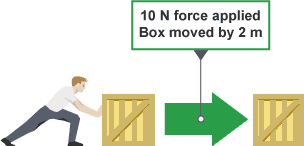
Let's look at a few scenarios and see how work is done.
Work done:
Work is NOT done when:
Energy is the ability to do work. Work done on an object results in the transfer of energy to that object. When an object does work, it transfers energy to something else.
Let us think of energy as a currency. When work occurs, energy is transferred from one object to another, just like a transaction using currency.
One of these is Kinetic Energy (KE), the energy of an object due to its motion. Kinetic energy can be found using the following formula:
Where:
Kinetic energy is directly proportional to the answer and is dependent on Mass (m) and Velocity (v), which is different from mass. When velocity is squared, this means that it is doubled from the original mass, and the kinetic energy will increase by four times. That is a lot of energy.
Examples of kinetic energy: Moving cars, birds that are flying, balls being rolled, and water flowing.
The other one is Gravitational Potential Energy (GPE), the energy stored in an object due to its position in a gravitational field. An object that is positioned higher will have more gravitational potential energy.
The equation to find the gravitational potential energy is as follows:
Where:
A book on a shelf, water in a dam, and a rock on a cliff all have gravitational potential energy.
One of the most important and basic principles in physics is the law of conservation of energy.
The energy in the universe is constant; it can't be created nor destroyed. Energy can transform into different forms, and the total amount of energy in a closed system will always be the same.
This is what every other law of physics is based on.
The moment you throw a ball away, the gravitational potential energy will be transformed into an equal amount of kinetic energy as the ball goes down. If you refer to the ground as a point of reference, the ball will have the greatest amount of GPE and zero KE at the highest point. The moment it touches the ground, the ball will have the greatest amount of KE, and the GPE will be zero. This is assuming the energy in the ball is not being considered. The energy in the system remains constant.
When you go upstairs, the chemical energy you have in your body is converted into gravitational potential energy.
What happens when you rub your hands together? You transform kinetic energy in your hands into thermal energy, which warms your hands.
This phenomenon of energy transformation occurs all the time in the world, and it is key to understanding how to analyze systems in the world and predict how they may behave.
Now consider the following: Two students go up the same staircase to the same height. They each do the same amount of work against gravity. However, one student runs up the staircase, and the other one walks up the staircase.
They have each done the same amount of work, but it still feels different to the students. The difference is power.
Power is the amount of work done in a specific amount of time and is also the amount of energy transferred in a specific amount of time.
Where:
Power can also be written as:
Where E represents the energy transferred.
The standard scientific unit of power is a watt (W), which is named in honor of the Scottish engineer James Watt. One watt is defined as the transfer of one joule of energy in one second.
Types of larger power measurements include:
A 60 W light bulb emits 60 joules of electrical energy every second. While a 100 kW car engine can do 100,000 joules of work in one second.
The power output of the student running upstairs is greater than that of the one walking, even though they are doing the same work.
Power is a measure of how fast work is done.
No machine or device is perfect. When a machine or device is used, some energy is always lost, often wasted in the form of heat or sound.
When you ride a bicycle, not all your effort goes into moving it forward. Some energy is lost in the friction in the chain, air resistance, and heat in the tires.
When a light bulb is on, it does not convert all the electrical energy into light. A lot of it gets wasted as heat, which is the reason why light bulbs get hot.
The word efficiency is used to refer to how useful the energy output is in comparison to the energy input, and is often expressed as a percentage.
Efficiency can also be calculated using power:
Efficiency is always less than 100% because some energy is always wasted in real systems. The closer efficiency is to 100%, the better the device is.
Efficiency is important for The Sustainable Development Goals and for the conservation of energy.
Engineers aim to find more efficient ways to design vehicles, appliances, and power plants. The more efficient a power plant is, the less fuel it consumes, the less it costs, and the less there is a negative effect on the environment.
Choosing an energy-efficient appliance is using your knowledge of physics to make a responsible choice for the environment.
In relation to energy systems, the concepts of work, power, and efficiency are interconnected.
The amount of energy transferred is described by work, while the rate of the transfer is described by power. The efficiency of a system describes how effectively it accomplishes a transfer.
An engine in a car is able to do a lot of work very quickly; however, if it is inefficient, it will simply burn fuel. An engine that is less powerful overall, but is highly efficient, will be a more practical and economical option.
The efficiencies when analyzing simple machines versus complex industrial systems are what make physics so critical to the fields of engineering, technology, and environmental science.