

Waves travel in a straight line and stop. They deflect from surfaces. They also bend during a transition from one medium to another.
These are all behaviors we've probably encountered in everyday life such as: the operation of mirrors, the bending of a straw when viewed in water, and the sonograph an ultrasound uses to see inside a patient.
Reflection, refraction, and diffraction are called wave phenomena. These apply to all types of waves: sound, light, water, seismic, and electromagnetic waves.
Reflection is a phenomenon where a wave encounters a barrier and is bounced back. It doesn't pass through it.
Waves remain in the same medium after a wave hits a reflecting surface; a change in direction occurs.
The Law of Reflection:
Angle of reflection = Angle of incidence
The angles are measured relative to the normal line, which is a line perpendicular to the reflecting surface at the wave's point of incidence.
Example: If a light ray reaches a mirror at an angle of incidence of 30°, then the angle of reflection is also 30° relative to the normal line.
Occurs on even and flat surfaces. Clear and sharp images are produced. All reflected rays remain parallel.
Examples: mirror, glassy water
Occurs on rough surfaces. Parallel incoming rays are reflected in many different directions due to varying surface normals.
Examples: paper, walls, clothing
Sound waves strike and bounce back off of hard surfaces, creating echoes and influencing concert hall design.
Sound reflection off curved surfaces can be concentrated and directed to particular points. This is why whispering galleries, such as the dome of London's St. Paul's Cathedral, allow people to clearly hear whispers over long distances.
Refraction refers to the change of direction of a wave as it crosses the boundary between two different media, as a result of a change in the speed of the wave.
When waves cross a boundary, their speed and wavelength change, but their frequency does not change. If the wave crosses the boundary at an angle, the change in speed at the boundary will result in the wave bending.
Rule: A wave will bend towards the normal if it slows down in the new medium, and away from the normal if it speeds up.
Snell's Law: n₁ sin θ₁ = n₂ sin θ₂
Where n₁ and n₂ are the refractive indices of the two media, and θ₁ and θ₂ are the angles of incidence and refraction from the normal.
The refractive index (n) quantifies the reduction in speed of light in a given medium compared to a vacuum:
n = c / v
c = speed of light in vacuum (3 × 10⁸ m/s)
v = speed of light in the medium
Example: The refractive index of glass is 1.5, meaning light travels 1.5 times slower in glass than in a vacuum.
Bent Straw: When a straw is in a glass of water, it appears bent. Light from the submerged portion changes direction when leaving water and entering air, causing the brain to perceive the straw as displaced.
Lenses: Light must be refracted for lenses to function properly. A convex lens bends parallel rays of light to converge at a specific focal point.
Mirage: Occurs when hot air near the ground has a lower refractive index than cooler air above. Light from the sky refracts through air layers of different temperatures, appearing as a reflection.
Total Internal Reflection occurs when a light ray traveling in a more optically dense medium reaches an interface with a less dense medium at an angle greater than the critical angle. The light completely reflects back into the dense medium rather than refracting out.
This principle is used in optical fibers — thin glass fibers that carry light signals over long distances. Applications include:
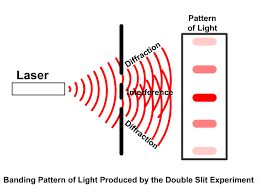
Diffraction is the spreading out of a wave when it passes through a gap or around an obstacle.
Waves do not travel in straight lines; they spread into the shadow behind an obstacle or behind gaps. The amount of spread depends on the size of the gap or obstacle relative to the wavelength.
When the gap is smaller than the wavelength, very little energy passes through. When the gap is larger than the wavelength, more energy passes through with less spreading.
Sound can be diffused more noticeably than light because sound wavelengths range from about 1.7 cm to 17 meters — comparable to the widths of doorways, windows, and buildings.
Radio waves have wavelengths from a few centimeters to hundreds of meters, allowing them to bend around hills and buildings so receivers can pick up signals even when obstructed.
Diffraction limits the usefulness of a lens and how many details can be distinguished in an image. Regardless of how advanced a lens may be, features smaller than the wavelength of light cannot be distinguished.
This explains why electron microscopes can image individual atoms, while light microscopes cannot. Electrons have much shorter effective wavelengths than visible light, allowing them to resolve smaller features.
Reflection, refraction, and diffraction are not discrete and separate phenomena. They are all the result of wave interactions at boundaries and obstacles, stemming from the same fundamental wave physics. They can all be applied to sound, light, water, and seismic waves.
They help explain how and why the world appears and behaves the way it does. Almost all optical and acoustic technologies, as well as communication systems developed by humans, are based on these principles.
| Phenomenon | Description | Example |
|---|---|---|
| Reflection | Wave bounces off a surface | Mirror, echo |
| Refraction | Wave bends when changing medium | Bent straw, lens |
| Diffraction | Wave spreads around obstacles | Sound around door, radio waves |