

When observing a wave, whether it's light from the edge of the universe, sound from a concert, or a ripple in a pond, there are three key measurable properties: speed, frequency, and wavelength.
These three properties are affected by each other, and there is one of the most elegant and useful equations in all of physics that describes the relationship between the three of them.
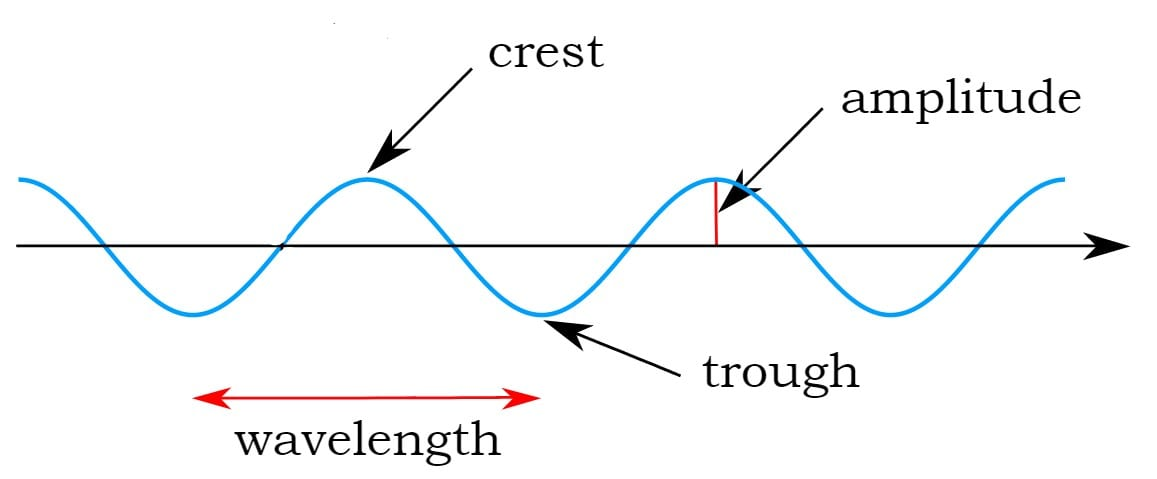
Imagine a wave that is propagating through a medium. Within one complete cycle, the wave propagates one wavelength. The amount of time it takes to complete that cycle is called the period T.
To find the speed of the wave, you use the distance (wavelength) and the time (the period).
So, in this case, the speed of the wave is given by: v = λ / T
Also, frequency f can be replaced with 1/T, so substituting gives you:
v = f × λ
This equation is valid for any type of wave, be it mechanical or electromagnetic, transverse or longitudinal.
The wave equation reveals a relationship that is not always obvious.
Regardless of wave speed, frequency and wavelength are inversely related. If frequency increases, wavelength must decrease in order to keep the wave speed the same. Conversely, if wavelength increases, frequency must decrease.
Example: Consider a wave that travels at a constant speed of 340 m/s (approximately the speed of sound in air).
Light with a high frequency has a short wavelength, while low frequency radio waves have very long wavelengths. The speed is constant, determined by the medium.
The medium through which a wave travels determines the speed of the wave, not the source that produces the wave.
| Medium | Speed of Sound (m/s) |
|---|---|
| Air (room temperature) | 340 m/s |
| Water | 1480 m/s |
| Steel | 5000 m/s |
The greater the density and elasticity of the medium, the greater the speed of sound.
In a vacuum: 3 × 10⁸ m/s
In glass or water: less than 3 × 10⁸ m/s (reason for refraction)
When a wave passes through different media:
- Speed changes
- Frequency remains constant
- Wavelength adjusts
Calculate the speed of a wave with a frequency of 500 Hz and a wavelength of 0.68 m.
Solution:
v = f × λ
v = 500 × 0.68 = 340 m/s
This is the speed of sound in air. Therefore, this wave is a sound wave.
Calculate the wavelength of a radio wave that has a frequency of 100 MHz (100 × 10⁶ Hz) and travels at the speed of light (3 × 10⁸ m/s).
Solution:
λ = v / f
λ = 3 × 10⁸ / (100 × 10⁶) = 3 m
The radio waves from that station have a wavelength of 3 meters.
Ocean waves have a wavelength of 8 m and travel at 4 m/s. Calculate their frequency and period.
Solution:
f = v / λ = 4 / 8 = 0.5 Hz
T = 1 / f = 1 / 0.5 = 2 seconds
One complete wave cycle passes every 2 seconds.
In the context of sound waves, frequency correlates with the psychological effect of pitch.
Audible range for humans: 20 Hz to 20,000 Hz
Infrasound: below 20 Hz
Ultrasound: above 20,000 Hz (used in medical imaging and by bats for echolocation)
For light waves, frequency determines the color.
Because different light frequencies travel at different speeds in a medium, a prism bends (refracts) white light by different amounts, producing a full spectrum of colors. This is also based on the wave equation.
v = f × λ
Important: All variables must be in consistent units:
If you see values in other forms (like MHz for frequency or km for wavelength), convert them before substituting.
The wave equation is consistent and remarkably effective. It is one of the most important equations to memorize. Similar to using a calculator, you should be able to use this equation without spending too much time on it.