

On this page:
Introduction What Is Energy Transfer? Types of Energy Transfer Mechanical Work Electrical Work Heating Conduction Convection Radiation What Is Energy Transformation? Different Types of Energy Examples of Transformation of Energy Law of Conservation Pendulum Energy Transformation Real World Energy Systems Conserving Energy is Important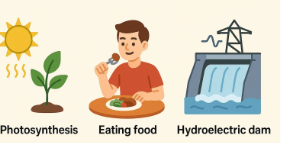
Think of a nice day where you feel warmth from the sun. Then you feel the nice breeze of the fan because you decided to start it. You wait a little bit after you eat breakfast and notice you have energy. Examples of energy from the sun are thermal energy, electrical energy, and chemical energy. All of these are examples of energy, and the presence of energy never stops.
Every day, in every second, energy is flowing, changing, and being transferred from system to system, and form to form.
Energy transfer is when energy moves from one system to another without changing form. For example, you have a hot cup of tea, and the heat from the cup moves to your hand. That heat is still thermal energy, but it is now just from the cup to your hand.
Another example is when you kick a soccer ball. The energy moves from your foot to the ball because your foot now has less energy.
Energy isn't created or destroyed. It simply changes form.
Mechanical work occurs when a force causes an object to move. In principle, it's the most straightforward way to transfer energy.
Pushing an example shopping cart means that you are transferring energy. You, the pusher, are an example of the cart's primary source of applied energy. The cart will then gain kinetic energy and move.
Thus, we see how a crane will lift construction materials, and in the process, transfer energy to those materials. As a result, the materials will gain increased gravitational potential energy.
Lastly, when a hammer hits a nail, the hammer transfers its kinetic energy to the nail, which drives it into wood.
If there are moving electric charges in a circuit, energy transfer occurs, and that's the way nearly all our devices gain energy.
An example of this is charging laptops: the electrical energy shifts from the power station via wires to the battery of your laptop, where it is chemically stored as energy.
Lastly, receiving energy, an electric motor diverts that energy to kinetic energy to spin a fan or power a machine.
You use electrical work and transfer energy every time you turn on an electric appliance.
The process where energy transfers because of a difference in temperature is known as heating. Heat moves from a hotter object to a cooler object. This process continues until the two objects reach the same temperature.
There are three mechanisms through which heating can occur.
Conduction transfer of heat occurs through direct contact. For example, when you place your hand on a metal spoon that is in hot soup, the spoon gets hot and so does your hand.
Convection is the transfer of heat through fluids (liquids and gases). In this case, the heated particles that move are the ones that carry energy. For instance, in a room that is heated, the hot air will rise to the top, while the cool air will sink to the bottom.
In space, there are no molecules. Hence, heat energy can be transferred in the form of electromagnetic waves (radiation). This occurs through space via waves. This is known as radiation. The energy from the Sun is converted to heat energy when it reaches the Earth.
Electromagnetic waves are another means of transferring energy. Heat energy, light energy, and other waves can all be referred to as radiation. The difference between radiation and other methods is that no medium is required for radiation to occur.
Energy transfer is moving energy between objects, while energy transformation is changing energy from one form to another.
Energy transformation happens when the state of energy is altered from one type to another.
All of the devices you use involve energy transformations. Your phone transforms the chemical energy from the battery into the light energy used for the screen, the sound energy for the speaker, and thermal energy as it heats up.
In order to grasp the concept of energy transformation, it is integral to understand the various forms energy takes.
When you turn on a light bulb, electrical energy is converted to light and thermal energy. You can verify it by feeling how hot the bulb is.
Each meal provides our bodies with food molecules that have stored energy in the form of chemicals. Our bodies break down food molecules and use the energy that was stored to create movement (kinetic energy), maintain a constant body temperature (thermal energy), and send signals (electrical energy) through our bodies.
Dam structures have the potential to create a lot of energy. When they release a large volume of stored water, it creates a rapid flow of moving water. This water is used to generate electricity by spinning turbines.
A toy car demonstrates energy conversions when it is powered by a battery. It starts with the stored energy in the battery (chemical energy), which gets converted into a flow of electricity (electrical energy) that starts the motor. The motor creates movement (kinetic energy) and also makes a noise that is converted into sound energy. The motor also creates heat energy, which is the result of friction from the moving parts.
Your active movement (kinetic energy) when you pluck on the guitar strings is transferred and stored in the strings. The strings produce sound energy that travels to your ear.
The law of conservation states that energy can never be created or destroyed. It can only be converted from one form of energy to another, or transferred from one object to another. The end result in a closed system is that the amount of energy remains constant.
This principle applies to everything in the universe. Be it a bouncing ball, a power plant, or a star exploding in the universe, energy is always conserved.
Let's consider a pendulum.
Assuming that no air resistance and no friction are applied, the total mechanical energy of the pendulum bob is transformed.
In the real world, energy transformations are never 100%. The thermal energy wastes energy in a way that we don't want.
A car's engine takes the chemical energy in fuel and converts it to kinetic energy to make the car move. However, the majority of that energy is lost to waste heat in the car's exhaust system, the engine cooling system, and through friction. That explains why car engines get hot and require cooling systems.
Charging your mobile phone takes electrical energy and converts it to chemical energy to charge your phone's battery. You probably noticed that the charger heats up, which is yet another example of energy being transformed into an undesirable form.
Even when some energy is transformed into heat or sound, that energy is not lost; it is still conserved. No energy disappears; it just ends up in forms that we cannot use.
The conservation of energy is relevant to technology, the environment, and society.
Energy-related problems can be solved because of the conservation of energy principle. The problem is not the absence of energy, but of understanding where the energy went and how to manipulate it.
The principle of conservation of energy connects all branches of science and all the phenomena of energy, from the smallest atomic systems to the largest cosmic systems. It is one of the most important principles of science.