

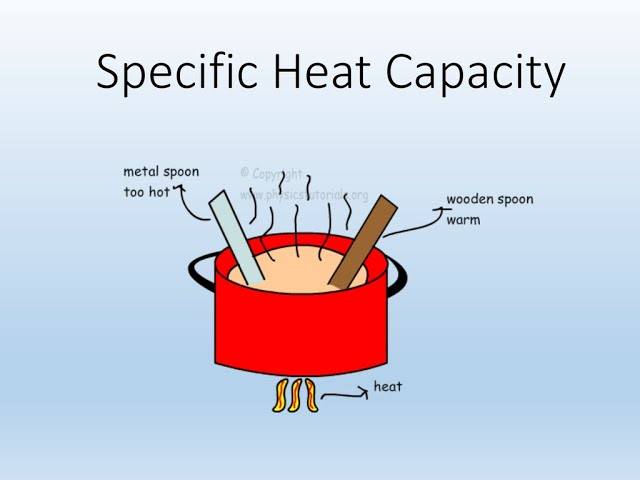
You touch a metal spoon stuck in a hot bowl of soup and it burns your fingers almost immediately. Now, you touch a wooden spoon in the very SAME bowl, and it barely feels warm.
Same soup. Same bowl. Same amount of time. But your experience is different in the two cases.
How is this so? The answer lies in thermal physics, the branch of physics that studies heat, temperature, energy (internal, external etc.) and how different materials respond to heat and temperature.
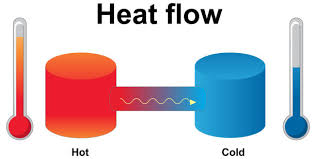
Students mix these two terms up all the time, and it is worth being very clear with it from the start.
A measure of the average kinetic energy of the particles in a substance. Measurement of temperature is done in degrees Celsius (°C) or kelvin (K).
Temperature differences result in the transfer of thermal energy (or heat). Heat energy moves from warmer objects to cooler ones due to their temperature differences. The measurement unit for heat is Joules (J).
Starting from the absolute zero, the Kelvin scale is the most commonly used by scientists. The absolute zero is the lowest temperature attainable, while particles are in the slowest possible state, with no movement.
Absolute zero = -273.15 degrees Celsius or 0 K.
To convert Celsius to Kelvin:
T(K) = T(°C) + 273
0°C = 273 K
100°C = 373 K
For calculations of the laws of gases and for the branch of burning stars (astrophysics), the Kelvin scale is extremely important, especially in the places where the temperature is close to absolute zero.
All bodies have internal energy, which is the energy arising from the movement of particles, and the energy resulting from their position (potential energy).
Results from particle movement, whether by a material's particles causing them to move, vibrate, rotate, or translate.
Derives from particle forces, specifically the bonds and intermolecular attractions that hold them in position.
Heating a substance results in an internal energy increase, which, depending on the situation, can lead to a temperature increase or a state change.
The energy required to heat different materials by the same amount can vary from one material to another. This is known as specific heat capacity.
Specific heat capacity (c) is the required energy to increase the temperature of a substance by 1 degree Celsius (1 K) for every 1 kg of that substance.
Q = m × c × ΔT
Q = heat energy (Joules)
m = mass (kg)
c = specific heat capacity (J/(kg·K))
ΔT = temperature change (K or °C)
Water has an atypically high specific heat capacity, which, at 4200 J/(kg·K), means that it requires, and, respectively, releases, copious amounts of energy to do either.
Most metals, on the contrary, have lower specific heat capacities than water:
| Substance | Specific Heat Capacity (J/(kg·K)) |
|---|---|
| Water | 4200 |
| Aluminum | 900 |
| Copper | 390 |
To heat a mass of 2 kg of water at 20 degrees celsius to 80 degrees celsius, how much heat energy is required?
ΔT = 80 − 20 = 60°C
Q = 2 × 4200 × 60 = 504,000 J = 504 kJ
Whenever a given solid changes state to become a liquid, or a liquid to a gas, energy is transferred and, at the same time, there is no change in temperature. The energy involved is referred to as latent heat, which signifies inactive.
The energy is transferred, without the input of further energy, to do work in overcoming the bonds, as the thermometer is reacting to no change.
Q = m × L
Where L is the specific latent heat measured in J/kg.
When a solid is heated at a steady pace to transition to gas and the temperature is plotted against time, a characteristic shape is formed called a heating curve.
The gas laws are all based on the same principle that gas molecules are in constant motion. The temperature, volume, or pressure will determine the speed and number of collisions.
Thermal physics is fundamental to the operation of engines, refrigerators, weather systems, climate science, cooking, medical technology, and industrial manufacturing.
The principles of this chapter are applied to the energy that heats your home, fuels your transportation, and refrigeration. Thermal physics is far from abstract; it is the physics of staying warm, staying cool, and keeping the world operational.