

On this page:
Introduction What Is the Solar System? The Sun Structure of the Solar System The Inner Solar System The Asteroid Belt The Outer Solar System Kuiper Belt and Oort Cloud Other Objects in the Solar System Gravity Holds It All Together Distances in the Solar System Why the Solar System Matters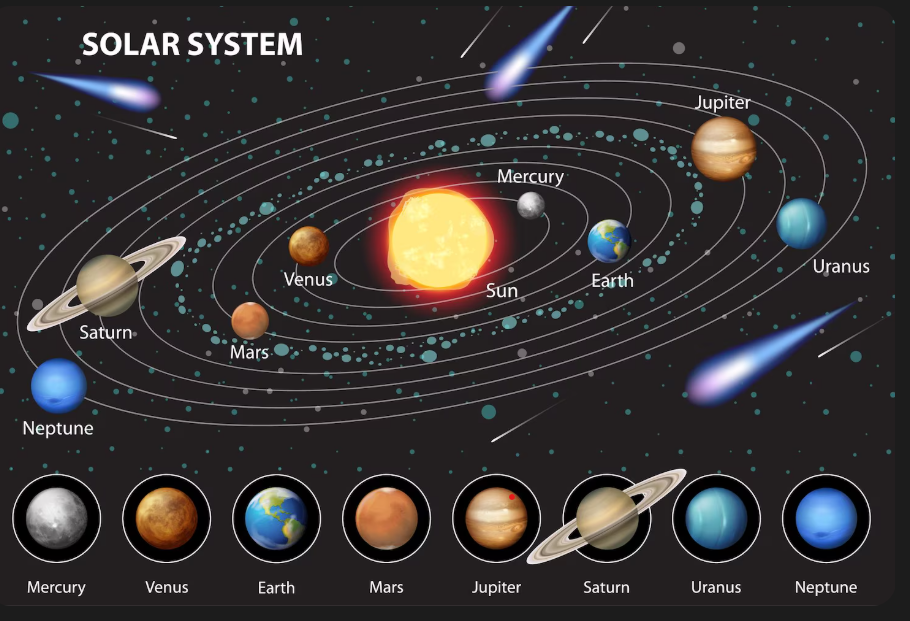
Step outside on a clear night and look up. Every single point of light you see is a star, most of them unimaginably far away. But eight planets, including the one you're standing on, orbit just one of those stars. That star is our Sun, and together with everything bound to it by gravity, it forms the Solar System.
The Solar System is a gravitationally bound system consisting of the Sun and all the objects that orbit it, including planets, moons, asteroids, comets, and dust.
It formed approximately 4.6 billion years ago from a rotating cloud of gas and dust called a solar nebula. Gravity pulled most of the material toward the center, where it became dense and hot enough to ignite nuclear fusion, and the Sun was born. The remaining material flattened into a disk around the young Sun and gradually clumped together to form the planets and other bodies we see today.
The Sun sits at the center of the Solar System and contains about 99.8% of all the mass in it. Everything else — all eight planets combined — makes up just 0.2%.
The Sun is a star, a massive ball of hot plasma held together by its own gravity. At its core, hydrogen nuclei fuse together to form helium, releasing enormous amounts of energy in the process. This nuclear fusion is the source of all the light and heat that sustains life on Earth.
The surface temperature of the Sun is about 5,500°C, while its core reaches around 15 million °C.
The Solar System is broadly divided into the inner solar system and the outer solar system, separated by the asteroid belt.
The Inner Solar System contains four rocky, terrestrial planets: Mercury, Venus, Earth, and Mars. These planets are relatively small, have solid surfaces, and are made primarily of rock and metal.
The Asteroid Belt lies between Mars and Jupiter. It contains millions of rocky and metallic objects ranging from tiny pebbles to objects hundreds of kilometers across. These are leftover material from the formation of the Solar System that never came together to form a planet, largely due to Jupiter's gravitational influence.
The Outer Solar System contains four gas giants: Jupiter, Saturn, Uranus, and Neptune. These planets are much larger than the terrestrial planets and are composed mainly of hydrogen, helium, and other gases or ices. They have no solid surface you could stand on.
Beyond Neptune lies the Kuiper Belt, a region of icy bodies including the dwarf planet Pluto. Even further out is the Oort Cloud, a vast spherical shell of icy objects thought to be the source of long-period comets.
The Solar System contains more than just the Sun and eight planets.
Every object in the Solar System stays in its place because of gravity. The Sun's enormous mass creates a gravitational pull that keeps planets in their orbits. Planets in turn hold their moons. The further an object is from the Sun, the weaker the gravitational pull, and the slower it moves in its orbit.
This relationship was described mathematically by Isaac Newton and later refined by Einstein's general theory of relativity.
The Solar System is so large that kilometers become impractical for describing distances. Instead, astronomers use the Astronomical Unit (AU), where 1 AU is the average distance from Earth to the Sun — about 150 million kilometers. Neptune, the farthest planet, is about 30 AU from the Sun.
For distances beyond the Solar System, astronomers use the light-year, the distance light travels in one year, approximately 9.46 × 10¹² km.
Understanding the Solar System is the first step in understanding our place in the universe. It shows us how gravity shapes structure on a massive scale, how stars are born, and how the conditions for life arise. Everything in astrophysics, from planetary motion to stellar evolution, starts right here, in our own cosmic neighborhood.