

On this page:
Introduction What is Static Electricity? Production of Static Electricity Charging by Friction What Causes Static Electricity to Form? Insulators and Conductors Electrostatic Induction Charge Detection Gold-Leaf Electroscope Dangers of Static Electricity Fire and Explosions Damaging Electronics Static Electricity and Lightning The Positive Side of Static Electricity Staying Safe Around Static Electricity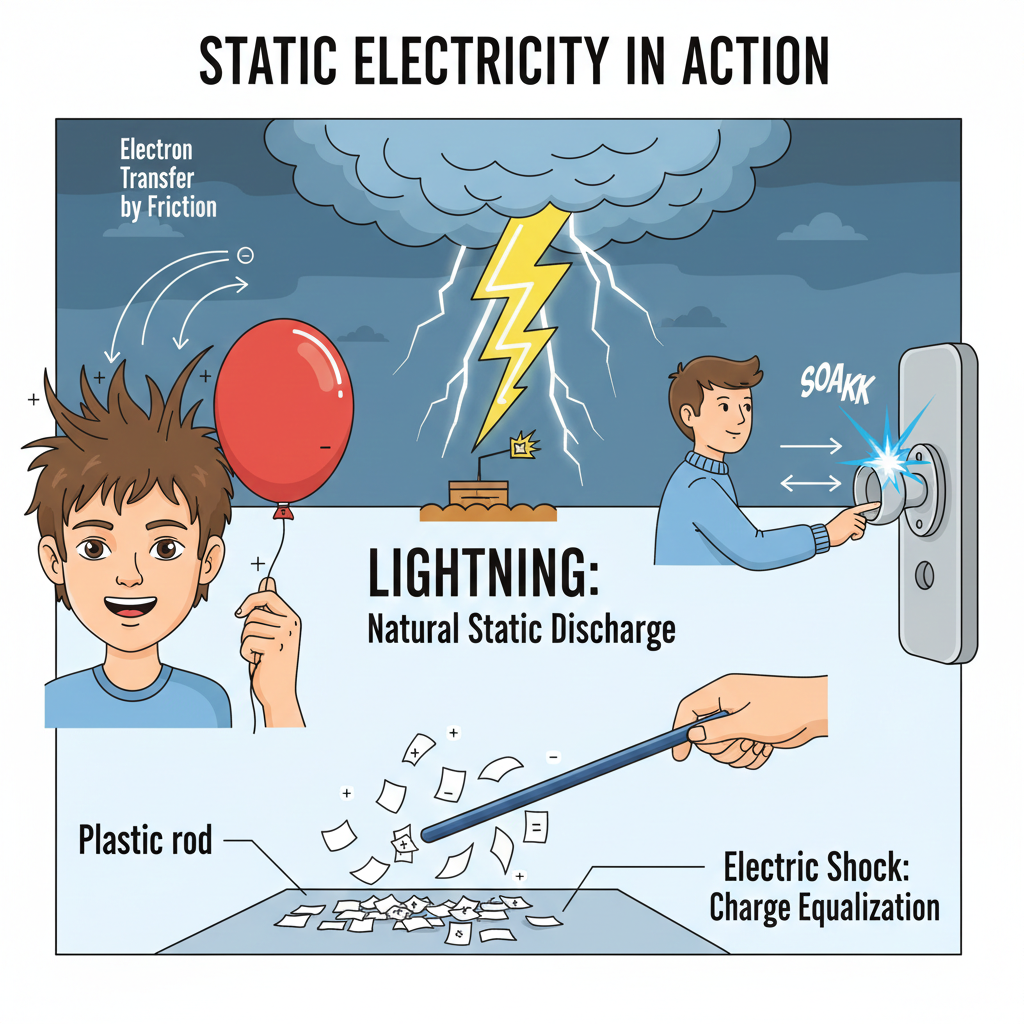
Have you ever gotten a shock from a doorknob after walking across a carpet? Have you ever seen your clothes stick together after taking them out of the dryer? Have you seen lightning?
All of these things are examples of static electricity.
The term "electricity" comes from the Greek word "elektron," meaning amber. The ancients first discovered static electricity when they noticed that fur rubbed on amber attracted small objects.
Static electricity occurs when an electric charge builds up on the surface of an object. The charge does not move, unlike current electricity.
"Static" means no. It also means that current electricity flows. In static electricity, there is a buildup of charge, but it does not move. The charge only moves when it is given an escape path.
Objects can become positively or negatively charged. A negative charge means that there is an excess of electrons. A positive charge means that there is an electron deficiency. Both positive and negative charges create an electric field.
Static electricity is the result of an imbalance of negative and positive charges. Most commonly, this is caused by friction.
When two different insulating materials are rubbed together, electrons are transferred from one material to the other.
Insulating materials can be classified based on their ability to attract and hold electrons. Some materials are able to hold electrons loosely and give them up easily, while others hold electrons tightly and grab them from other materials.
Example: When you rub a balloon on your hair, the balloon and hair obtain opposite charges. Electrons are transferred from your hair to the balloon. As a result, your hair becomes positively charged, and the balloon becomes negatively charged, and your hair stands up because the positively charged hair repels itself.
Static electricity creates the strongest charge on materials such as plastics, rubber, or air, which are known as insulators, as they have tightly bound electrons. This can be dry air, rubber, plastic, glass, and most synthetic materials.
Insulators: When insulators are charged and quickly rub against one another, they retain the charge on the insulator's surface due to the insulating material, which cannot conduct the charge.
Conductors: However, Conductors are the opposite of insulators. In conductors, electrons can move freely. Materials like copper, aluminum, and silver are excellent conductors.
When conductors become charged, the charges are instantly distributed out to the surface or discharged to the ground. This is why metal objects are not commonly charged or do not maintain static electricity unless they are added to a device that is insulating.
An important aspect of static electricity is that it can be worse in dry situations. There is dry humid air that contains water molecules to help conduct the charge away. During the winter months, when heating systems are being used, the air is dry, and static shock is more prevalent.
An interesting aspect of static electricity is the phenomenon of electrostatic induction, where a charged object can influence the distribution of charges within a nearby neutral object without direct contact.
Take, for example, a negatively charged rod that is brought close to a neutral metal sphere.
The negatively charged sphere then draws the electrons in the sphere to be repelled to the far side of the sphere. The side that is drawing away is the near side, which is negatively charged, while the far side is positively charged. The metal sphere remains neutral. Since it is negatively charged, it lost the positive charge that it held within itself.
Within the neutral sphere, there is a charge separation. The charge separation creates an attractive force toward the negatively charged rod.
This phenomenon can be used to explain why small pieces of paper jump toward positively and negatively charged objects. The paper becomes charged and then attracted to the object that charged it.
Static electric charges can be detected with an instrument known as a gold-leaf electroscope.
An electroscope uses leaves of gold to demonstrate static electricity and charge distribution.
They consist of a conductive section, the gold leaves are attached to, a rod that extends from the section, a disc at the top, and a glass case that encloses the whole system and provides insulation from the environment so that air currents won't disturb the gold leaves.
When a charged object approaches or touches the disc at the top of the electroscope, the charge of that object is conducted to the gold leaves. They will both have the same charge and will therefore repel each other. The more charge, the further apart they spread.
While people tend to perceive static electricity as a harmless phenomenon, there are situations in which it becomes very dangerous.
The most serious of these, from a safety perspective, is static electricity's ability to ignite materials that are flammable. When a charge is built up and suddenly discharged, the result is a spark. This spark has the ability to ignite a flammable gas. For this reason, it is standard for fuel tankers to be grounded prior to filling and emptying. One spark can lead to a catastrophic explosion.
In grain silos and flour mills, the presence of dust means that static sparks can cause disastrous explosions, and, as a result, the dust in these silos is often highly flammable.
Modern electronics use highly sensitive components that are easily destroyed by static discharge. Even a small static discharge is enough to destroy microchips in electronics.
That's why computer technicians wear ground-connected antistatic wrist straps. Special antistatic bags are used to package computer components to prevent the buildup of a static charge.
Of all natural demonstrations of static electricity, lightning is perhaps the most dramatic. During a thunderstorm, ice particles in a cloud collide and cause a charge to separate. The bottom of a cloud becomes negatively charged, and the top of the cloud becomes positively charged.
Once the electric field reaches a certain strength, the air becomes ionized, and a channel forms that allows the electric charge to flow rapidly between the cloud and the ground. This phenomenon is what we observe as lightning.
One bolt of lightning can carry over one hundred million volts, and the air around the bolt is heated to temperatures exceeding those of the surface of the Sun. This extreme heating causes air to expand rapidly, and thunder is the result of this rapid expansion.
Every year, lightning causes the deaths of people and animals, ignites fires, and causes damage to buildings. An understanding of static electricity allows for the implementation of safety protocols and lightning rods.
Even though static electricity can be dangerous, it can also be used for good.
Photocopiers and Laser Printers
Photocopiers and laser printers use static electricity to transfer toner to paper. Inside the body of the photocopier or printer, there is a drum. This drum is charged with static electricity to match the image or text of the paper. Subsequently, the toner, which is a charged powder, adheres to the drum in the areas with no charge. Finally, the toner is transferred to the paper, and heat fuses it to the paper.
Electrostatic Precipitators
Factories use these to clean the smoke before it is released into the atmosphere. As smoke passes through the precipitator, it gets charged. Subsequently, the smoke particles stick to metal plates with the opposite charge. This process further removes pollution from the atmosphere.
Paint Spraying
Car manufacturers use charged paint droplets while spraying. The body of the car is charged oppositely. As a result, paint is evenly drawn to the body of the car, reducing paint waste and ensuring complete coverage.
Understanding static electricity helps in staying and being safe.