

On this page:
Introduction The Three States of Matter Solids Liquids Gases Kinetic Theory of Matter Core Ideas of Kinetic Theory Particles in a Solid Particles in a Liquid Particles in a Gas Temperature and Particle Energy Absolute Zero Changes of State Melting and Freezing Evaporation and Boiling Condensation Sublimation Latent Heat Density Density Formula Connecting to Forces and Energy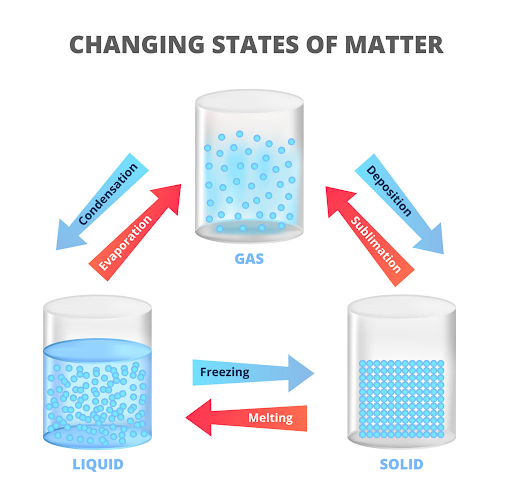
Everything Around You Is Matter
Your desk, the air you breathe, the water in your bottle, and the steam rising from a cup of tea—all of it counts. Matter is something that has mass and takes up space. But not everything behaves the same way. A rock sits still and holds its form. Water pours and takes the form of whatever it is in. Air spreads out and fills a whole room. Why do they behave so differently?
The answer lies in what's going on at a level too small for our eyes to see, the level of particles.
Matter exists in three common states: solid, liquid, and gas. Each state has its own set of properties, and those properties come directly from how the particles inside are arranged and how they move.
Solids have a fixed shape and a fixed volume. They do not flow, and they cannot be compressed. The particles in a solid are packed tightly together in a regular, ordered arrangement. They do not move from place to place; instead, they vibrate back and forth around fixed positions. The forces between particles in a solid are very strong, which is why solids hold their shape without needing a container.
Liquids have a fixed volume, but no fixed shape. They take the shape of whatever container they're poured into; the overall volume of liquid stays the same. The particles in a liquid are still close together, but they're not in a rigid arrangement. They can slide past each other, which is why liquids flow. The forces between particles are weaker than in solids, strong enough to hold them together but not strong enough to lock them in place.
Gases have no fixed shape and no fixed volume. They expand to fill any container that is available. The particles in a gas are far apart from each other, moving rapidly in all directions. The forces between gas particles are extremely weak, almost negligible. This is why gases can be compressed and why they expand to fill a room.
So what's really happening inside matter at the particle level? That is what the kinetic theory of matter explains.
The kinetic theory is built on a few core ideas that apply to all states of matter.
This theory is powerful because it explains the properties we observe in everyday life using invisible particle behavior. Let's go through each state again, this time through the lens of the kinetic theory.
In a solid, particles vibrate constantly, but they stay in their fixed positions. They have the least kinetic energy of the three states. The strong forces between particles act like invisible springs, pulling them back together whenever they move too far away. This is why solids are rigid and incompressible.
In a liquid, particles move more freely and have more kinetic energy than in solids. They continuously slide past each other, and they stay close enough that the liquid holds together as a body. This freedom of motion is why liquids flow and take the shape of their container, while still maintaining a precise volume.
In a gas, particles move very rapidly and are spread far apart. They have the highest kinetic energy of the three states. Collisions between gas particles and the walls of a container are what create gas pressure. Since the particles are so far apart and the forces between them are negligible, gases fill any space and can be compressed significantly.
Temperature isn't just a number on a thermometer. In the kinetic theory, temperature is a measure of the average kinetic energy of the particles in a substance. When you heat something, you are giving its particles more energy, causing them to move more quickly. When something cools down, the particles slow down and lose kinetic energy.
This is a fundamental concept in physics. It means that objects at the same temperature have particles with equal average kinetic energy, no matter what the objects are made of.
Absolute zero, which is zero Kelvin or −273°C, is the theoretical temperature at which particles would have zero kinetic energy and stop moving entirely. In practice, nothing in the universe truly reaches absolute zero; it serves as the starting point of the Kelvin temperature scale, the scale used in scientific calculations.
Matter does not permanently stay in one state. When enough energy is added or removed, it changes from one state to another. These changes have specific names.
Melting is when a solid turns into a liquid. Energy is added to the solid, causing particles to vibrate more and more until the forces that hold them in fixed positions can no longer maintain them there. The temperature at which this occurs is the melting point.
Freezing is the reverse; a liquid loses energy, and its particles slow down until the forces pull them into a fixed arrangement, forming a solid. This occurs at the freezing point, which is the same temperature as the melting point for a given substance.
Evaporation and boiling both involve a liquid becoming a gas; they are different. Evaporation takes place at the surface of a liquid at any temperature; the fastest-moving particles near the surface escape into the air. Boiling happens throughout the whole liquid at a specific temperature called the boiling point, when bubbles of gas form inside the liquid itself.
Condensation occurs when a gas loses energy, slows down, and turns back into a liquid. You see this on a cold glass on a humid day: water vapor from the air condenses on the cold surface.
Sublimation is a direct change from solid to gas without passing through the liquid phase. Dry ice, solid carbon dioxide, does this at room temperature, going directly from solid to gas.
In a change of state, temperature does not increase even though energy continues to be added. That energy is used to break the forces between particles instead of speeding them up. This energy is known as latent heat.
One property that ties directly to the states of matter is density. Density tells us how much mass is packed into a given volume.
Its SI unit is kilograms per cubic meter (kg/m³), although grams per cubic centimeter (g/cm³) is also commonly used.
Solids are typically the most dense because their particles are packed closely together. Liquids are less dense, and gases are the least dense because their particles are spread far apart with large empty spaces between them.
This is why ice floats on water; solid water is actually slightly less dense than liquid water, which is an unusual but important exception. It is also why a helium balloon rises: the gas inside is less dense than the surrounding air.
Density also explains why oil floats on water. Oil is less dense, so it sits on top. In any mixture of liquids, the least dense rises to the top and the most dense sinks to the bottom.
The kinetic theory is not just interesting science; it connects directly to forces and energy.
Understanding that temperature is kinetic energy, that state changes involve energy transfer, and that density depends on particle arrangement gives you the tools to analyze real physical systems.
Every concept in this lesson feeds into how forces and energy function at both the particle level and the scale of everyday objects.