

Take a moment and just listen. You can hear a fan, music, and the voices of people. You may even hear the sound of traffic. As you listen, your brain is constantly interpreting the sequence of pressure changes in the surrounding air.
Although sound is everywhere, the fascinating physics that accompany sound are often overlooked. Science revolves around the fields of medicine, music, and even architecture.
Sound is a longitudinal and mechanical wave that is produced by a vibrating object. They travel through mediums by alternating between compression and rarefaction.
Vibrations are the source of sound. A vocal chord, a guitar string, a hand clap, and even a speaker cone produce sounds by disrupting surrounding particles. The particles will then cause motion to adjacent particles, and that sequence continues until the disturbance travels outward as a wave.
When an object vibrates, it creates compressions in air by moving forward, and then rarefactions will occur as it moves back. A compression is an area of high air particle density, and likewise, a rarefaction is an area of lower air particle density.
These waves continue traveling from the source of sound and hit the eardrum in a person's ear. As the eardrum is hit, it will start vibrating. The brain then interprets the sound at the frequency of the source of sound.
Sound travels at different speeds in different materials. The elasticity and density cause sound waves to travel at different speeds. If in a given room there is air (at 20°C), then sound travels at 340 m/s.
In solids, liquids, and gases, sound travels at varying speeds. Generally, sound travels fastest in solids, slower in liquids, and slowest in gases. Denser materials are expected to slow down sound, however, solids exhibit even stronger intermolecular forces.
The speed of sound in gases is also affected by temperature. When air is at a higher temperature, the particles move faster, thus compressions are transmitted faster. With every 1°C increase in temperature, sound travels in air by 0.6 m/s.
The pitch of a sound is determined by the frequency of a sound wave.
Higher frequencies = higher pitches
Lower frequencies = lower pitches
Instruments like a piccolo are able to produce higher sounds than a bass guitar. Piccolos produce sounds at 4000-5000 Hz, while bass guitars produce sounds at 40-100 Hz. The human voice is able to mimic this range as well, and it typically ranges from about 80 Hz to 1100 Hz.
The human ear is able to distinguish between sounds between 20 Hz and 20,000 Hz. With age, this range narrows, and it is often first seen as high-frequency sounds are lost in older individuals. For this reason, some teenagers are able to hear high-frequency ringtones while adults are not.
Sounds that are lower than 20 Hz are known as infrasound and some animals such as elephants and whales use infrasound to communicate over long distances. Sounds that are higher than 20,000 Hz are called ultrasound.
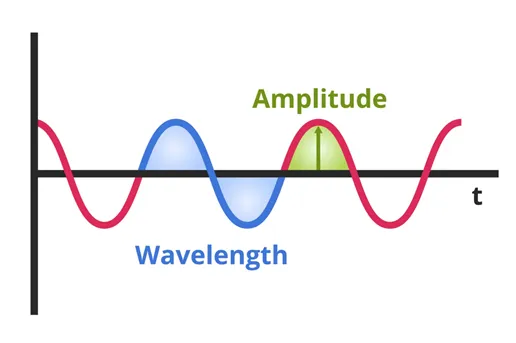
While frequency is responsible for determining pitch, the amplitude of the wave is responsible for determining loudness.
More amplitude means that there is more energy in the wave, which translates to a louder sound. Less amplitude means lower sounding sounds.
The loudness of sound is measured in decibels (dB). The decibel scale is logarithmic, so each increase of ten in the scale means a tenfold increase in the intensity of the sound.
Sound waves that are reflected by a hard surface are called echoes. If a sound can be heard after it is reflected off the surface and separated from the original sound, that is called an echo.
To hear an echo distinctly from its original sound, the sound reflection must come back after 0.1 seconds from the original sound. This is the minimum time required by the human ear to distinguish one sound from another. Given the speed of sound of 340 m/s, the minimum distance from the source of the sound to the reflecting surface is 17 m.
In sonar, sound is used to echo back and forth from an object. When a sound pulse is transmitted and hits an object, it comes back to the transmitter after some time. By determining the time elapsed for the round trip of the sound wave and knowing the speed of sound in water, the distance can be calculated.
The distance is divided by 2 to account for the distance the sound has traveled to the object and back.
Modern medicine uses ultrasound to obtain images of the human body. Ultrasound frequency is 1 MHz to 20 MHz. This is inaudible to humans. The transducer of the ultrasound emits waves or pulses into the body of the patient. The waves get reflected back, and some of them continue to travel deeper into the body.
The imaging of internal structures using returning echoes is what helps physicians diagnose organ conditions, evaluate blood circulation, assess fetal health, and locate cancers — all without using radiation or any other means that have potential hazards.
When two instruments are played at the same pitch and the same volume, their sound is recognizable and different. For example, a flute and a violin playing the concert sound very different. This is due to the differences in the sound waves produced by the instruments.
The sound waves of a pure tone are in the shape of a simple sine wave. However, all other musical instruments produce waves that are made of several components. The sound of a real flute is made of waves at the fundamental frequency (or pitch) and waves produced at multiples of the pitch. The sound waves produced in the flute, violin, and all other instruments have their unique sound quality or timbre.
When an object is vibrating at a certain frequency, it can reach a very high amplitude. If a sound wave of that frequency reaches that object, it is called resonance.
A singer hitting the correct note can cause a wine glass to break due to resonance. It's also the reason why bridges need to be built so they won't resonate at the same frequency as marching troops or strong wind. The bodies of the instruments are designed to resonate at certain frequencies and amplify specific sounds.