

On this page:
Introduction What Is Radioactivity? Alpha Radiation (α) Beta Radiation (β) Gamma Radiation (γ) Comparing the Three Types Nuclear Decay Equations Half-life Half-life Calculations Background Radiation Uses of Radioactivity Dangers of Radiation Protection from Radiation Why Radioactivity Matters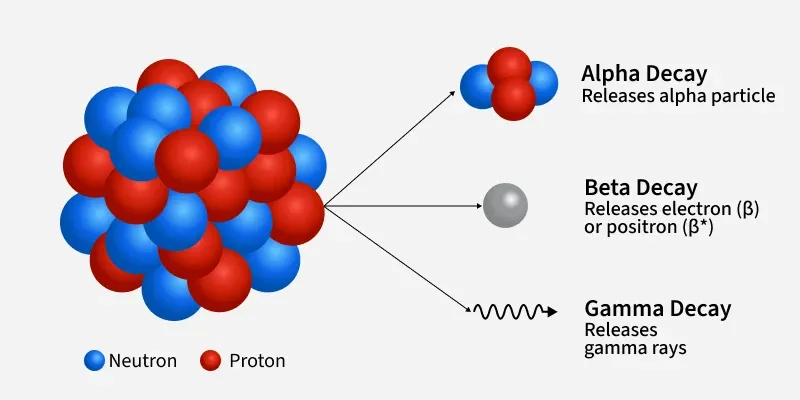
Deep inside certain atoms, something unstable is happening. The nucleus has too many neutrons, or too many protons, or simply too much energy, and it cannot stay in that state. Eventually, without any trigger from outside, it releases energy and particles in an attempt to become more stable.
This spontaneous emission from an unstable nucleus is called radioactivity, and it is one of the most fascinating, practically important, and genuinely misunderstood topics in all of physics.
Radioactivity is the spontaneous emission of radiation from an unstable atomic nucleus as it decays toward a more stable state.
The word spontaneous is important. Radioactive decay is not triggered by heat, pressure, chemical reactions, or any external influence. It happens randomly, at a rate that is completely characteristic of the particular nucleus involved, and cannot be sped up or slowed down by any ordinary means.
Not all nuclei are radioactive. Stable nuclei, those with the right balance of protons and neutrons held together comfortably by the strong nuclear force, do not decay. Unstable nuclei, those with an imbalance of protons and neutrons, or simply too large to be held together stably, will eventually decay.
An alpha particle consists of two protons and two neutrons bound together, identical to the nucleus of a helium-4 atom. It is written as 42He or simply α.
When a nucleus emits an alpha particle, it loses 2 protons and 2 neutrons. The atomic number decreases by 2 and the mass number decreases by 4.
Alpha particles are relatively large and heavy. Because of this, they interact strongly with matter and lose energy quickly. They can be stopped by a few centimeters of air or a single sheet of paper. They cannot penetrate skin.
However, if an alpha-emitting source is inhaled or swallowed, the particles cause intense ionization in the surrounding tissue and can cause severe biological damage. Alpha radiation is the most ionizing of the three types.
Beta decay occurs when a neutron in the nucleus transforms into a proton, emitting a fast-moving electron (the beta particle) along with an antineutrino.
The beta particle is written as 0-1e or simply β⁻. When beta decay occurs, the mass number stays the same (a neutron became a proton, no change in total nucleons) but the atomic number increases by 1.
Beta particles are much lighter and faster than alpha particles. They can penetrate several millimeters of aluminium or a few meters of air. They are stopped by thin sheets of metal like aluminium foil. Beta radiation is moderately ionizing — less so than alpha, more so than gamma.
Gamma radiation is not a particle, it is a high-energy electromagnetic wave, part of the electromagnetic spectrum at the highest-frequency end. It is emitted when a nucleus has excess energy after alpha or beta decay and releases that energy as a gamma ray photon.
Gamma emission does not change the atomic number or mass number — it only releases energy.
Gamma rays are highly penetrating. They require several centimeters of lead or meters of concrete to be significantly absorbed. They are the least ionizing of the three types per unit path length, but their penetrating power means they can irradiate the whole body from external sources.
| Type | Charge | Stopped By | Ionizing Ability | Range in Air |
|---|---|---|---|---|
| Alpha (α) | +2 | Paper, few cm air | High | Few cm |
| Beta (β) | -1 | Thin aluminium | Moderate | Few meters |
| Gamma (γ) | 0 | Thick lead/concrete | Low (per unit path) | Large distances |
Radioactive decay can be represented using nuclear equations, where mass numbers and atomic numbers must balance on both sides.
Alpha decay: Uranium-238 decays by alpha emission
23892U → 23490Th + 42He
Mass number: 238 = 234 + 4 | Atomic number: 92 = 90 + 2
Beta decay: Carbon-14 decays by beta emission
146C → 147N + 0-1e
Mass number: 14 = 14 + 0 | Atomic number: 6 = 7 + (−1)
Gamma emission accompanies many alpha and beta decays but does not change the nuclear composition, so it is sometimes written separately as 00γ.
Radioactive decay is random at the level of individual atoms — it is impossible to predict exactly when any specific nucleus will decay. But for a large collection of identical radioactive nuclei, the overall behavior is remarkably predictable.
Half-life (t₁/₂) = the time taken for half of the radioactive nuclei in a sample to decay.
After one half-life, half the original nuclei remain. After two half-lives, one quarter remain. After three half-lives, one eighth remain. And so on.
Examples of half-lives:
N = N₀ × (1/2)ⁿ
Where N = number remaining, N₀ = original number, n = number of half-lives
Example: A sample contains 800 atoms of a radioactive isotope with a half-life of 3 years. How many remain after 12 years?
Number of half-lives = 12 / 3 = 4
N = 800 × (1/2)⁴ = 800 × 1/16 = 50 atoms
There is a constant low level of radiation in the environment from natural and artificial sources, called background radiation.
Natural sources:
Artificial sources:
When measuring radiation from a specific source, background radiation must be measured separately and subtracted from the total reading.
Ionizing radiation damages living tissue by ionizing atoms within biological molecules, particularly DNA. This can lead to mutations, cell death, or uncontrolled cell division (cancer).
Alpha radiation is the most dangerous if the source enters the body through ingestion or inhalation.
Acute radiation syndrome results from a single large dose, causing nausea, hair loss, bone marrow damage, and potentially death.
Long-term low-level exposure increases the statistical risk of developing cancer over a lifetime.
Workers in nuclear medicine, radiography, and nuclear power wear dosimeters (badges that record cumulative exposure) to ensure they do not exceed safe limits.
Radioactivity sits at the intersection of the very small — individual atomic nuclei — and the very large — medical treatment, energy generation, archaeological dating, and national security. Understanding it means understanding both the power and the responsibility that comes with nuclear science.
The same physics that can treat cancer can also destroy it carelessly. The same isotope that dates ancient bones can, in other forms, contaminate environments for thousands of years. Knowledge of radiation is not just academic — it is essential for anyone living in the modern world.