

Have you ever tried to walk on soft snow in normal shoes? You sink in. But when you put on wide snow shoes, you leave almost no mark. The weight is the same. So what changed?
A sharp blade cuts through material as a result of the pressure it exerts due to its edges and as a result of the force you apply, it will be almost the same as cutting. But with a blunt blade, you will have to exert a lot more force to make it cut.
This is what is called pressure, and one of the most important and most used concepts in the field.
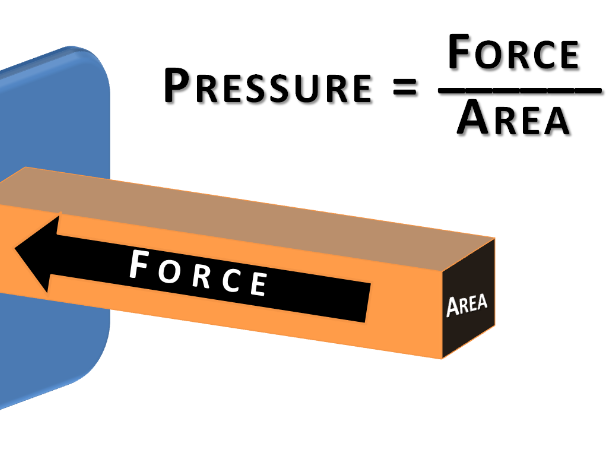
Pressure is defined as the force acting perpendicularly on a unit area of a surface.
To put it in further simplistic and simple terms, think of pressure as how concentrated force is. The same force used over a large area will create less pressure. The same force used over a single small area will create a lot more pressure.
Pressure is defined mathematically by the following equation:
Where:
1 Pa = 1 N/m²
Every solid object that is in contact with a surface transmits some pressure as a result of its mass. The magnitude of this pressure depends on the distribution of the object's mass.
Bed of nails: A bed of nails is a classic case. If you lie on one nail, that will be extremely painful because all the weight is concentrated on one tiny area, producing great pressure at that single point.
Stiletto heels: A person in stiletto heels is able to damage a wooden floor while a person in flat shoes is not. The small heel tip generates enough pressure to damage the floor.
The way liquids transmit pressure is different from solids and these differences lead to some interesting effects.
In a liquid, pressure increases at greater depths. This is because the greater the depth, the more liquid there is above the point, and the more weight is pressing down.
The formula for pressure at a depth within a liquid is:
In this formula:
Blaise Pascal's principle states that pressure applied to an enclosed liquid is transmitted equally throughout the liquid in all directions. This principle is known as Pascal's Principle.
Hydraulic systems function on basic principles of physics. In the case of a hydraulic lift, a hydraulic mechanic performs a task with very little effort because the task requires lifting a large object.
Hydraulic systems function on the principle of multiplying force/energy. In a system confined to space, such as a balloon, the gas is composed of small particles. The small particles are in a constant state of motion.
When a gas is heated, the particles move faster, creating more force on the boundary, which increases pressure. This principle of physics is always accurate and relied on in situations where gas is used.
When you inflate a tire, it becomes harder. Aerosol cans have warnings about heat. Pressure cookers help food cook faster. All these things happen because of the effect of increased pressure. Increased pressure allows water to be heated past the typical boiling point. This increases the temperature that the water can reach.
The Earth's atmosphere consists of a layer of gases. This layer of gases is held by the Earth's gravity and has weight. This weight, along with the weight of the air above it, is pushed down on the surface of the Earth. This is called atmospheric pressure.
Pressure at sea level is around 101,325 Pa, or 101 kPa.
You can't feel the pressure because the fluids inside your body push out and balance it. However, if the balance is disrupted, such as if a plunger is used to create a vacuum, the atmospheric pressure becomes very obvious.
The higher the altitude, the less atmospheric pressure. There is less air above you. This is what causes mountain climbers to have difficulty breathing at high altitudes and why there needs to be a cabin pressure system on airplanes.
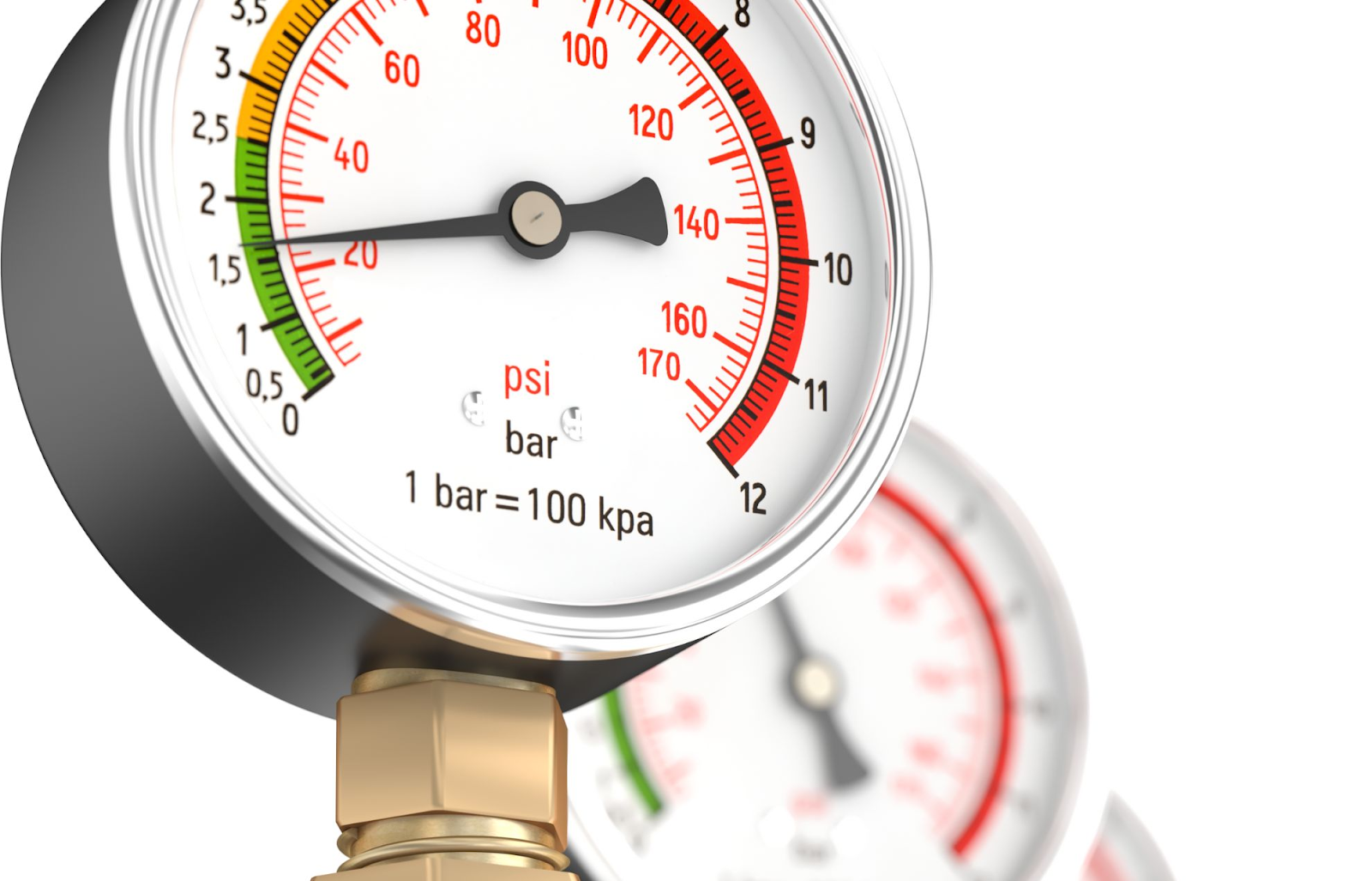
There are multiple devices that gauge pressure in various situations.
When an object is submerged in a liquid, pressure differences at various depths will create an upward force, or buoyancy, or upthrust, on the object.
More pressure will be pushing up underneath the object than the pressure pushing down on the object. This is the basis of Archimedes' Principle, which states that the upthrust is equal to the weight of the fluid that the object displaces.
Pressure is a concept that features in almost every branch of engineering and physics. It helps explain how we fly, how blood circulates in the body, how weather changes, and how we build and design our structures.