
On this page:
Introduction What Is a Planet? Classifying the Planets Orbital Motion of Planets What Is a Satellite? Orbital Speed and Altitude Satellites and Real Life Putting It TogetherThe Moon rises every night because it is locked in orbit around Earth. GPS tells you exactly where you are because satellites circle the planet overhead. Eight worlds travel around the Sun in paths they have followed for billions of years.
What keeps all of these objects moving in their orbits? What makes a planet different from a moon? And why do some satellites orbit close and fast, while others orbit far and slow?
These are the questions this lesson answers.
A planet is a celestial body that orbits a star, has enough mass for its gravity to pull it into a roughly spherical shape, and has cleared the neighborhood around its orbit of other debris.
That third condition is what separates a planet from a dwarf planet. Pluto, for example, shares its orbital region with many other icy bodies in the Kuiper Belt, so it doesn't qualify as a full planet under the definition adopted by the International Astronomical Union in 2006.
Our Solar System has eight planets: Mercury, Venus, Earth, Mars, Jupiter, Saturn, Uranus, and Neptune.
Planets in our solar system fall into two broad categories.
Rocky, dense, and relatively small. Mercury, Venus, Earth, and Mars belong to this group. They have solid surfaces, are made mainly of rock and metal, and have few or no moons. Their atmospheres, where they exist, are thin compared to the gas giants.
Enormous planets made primarily of hydrogen and helium. Jupiter and Saturn are the two largest, and they have thick, layered atmospheres with no solid surface. Uranus and Neptune are sometimes called ice giants because, in addition to gas, they contain large amounts of water, ammonia, and methane in icy or fluid form.
The key differences between these groups relate to their distance from the Sun during the Solar System's formation. The inner region was too hot for ice to survive, so only rock and metal condensed there. The outer, cooler region allowed ice and gas to accumulate, building up the giant planets.
Planets travel around the Sun in elliptical orbits: slightly oval-shaped paths rather than perfect circles. This was established by Johannes Kepler in the early 17th century through his three laws of planetary motion.
Kepler's Third Law: T² ∝ r³
Earth takes 365 days. Neptune, at 30 AU, takes about 165 Earth years.
The force that keeps planets in orbit is gravity. Isaac Newton showed that gravity follows an inverse square law. The gravitational force between two objects decreases with the square of the distance between them:
Newton's Law of Universal Gravitation: F = G × m₁ × m₂ / r²
Gravity provides the centripetal force needed to keep a planet moving in a curved path rather than flying off in a straight line.
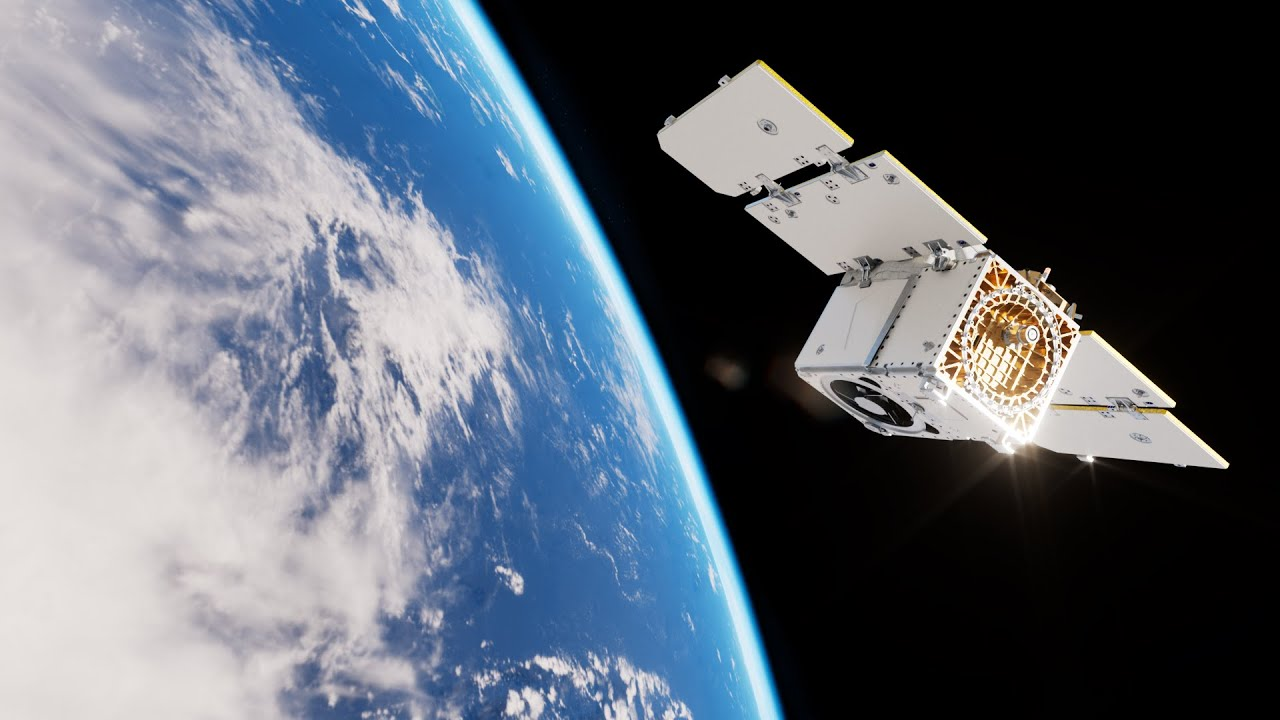
A satellite is any object that orbits a larger body. Satellites are of two types: natural and artificial.
Bodies that formed naturally and orbit planets. Earth has one moon, a rocky world about 384,000 km away. Its gravitational interaction with Earth causes ocean tides. Jupiter has over 90 known moons, including Ganymede, which is larger than the planet Mercury.
Moons orbit their planets for the same reason planets orbit the Sun — gravity provides the centripetal force that keeps them in circular or elliptical paths.
Human-made objects launched into orbit around Earth or other bodies. Since the launch of Sputnik in 1957, thousands of satellites have been placed in orbit, serving purposes ranging from communication and weather forecasting to navigation and scientific research.
The height at which a satellite orbits determines both its speed and the time it takes to complete one orbit.
Altitude: 200–2000 km
Speed: 7–8 km/s
Orbital period: ~90 minutes
Example: International Space Station
Altitude: 35,800 km above the equator
Orbital period: exactly 24 hours
Appears to hover over the same spot on Earth
Example: TV broadcasting and weather satellites
Orbital Speed Formula: v = √(GM/r)
G = gravitational constant
M = mass of the central body
r = orbital radius
As r increases, orbital speed decreases. Higher orbits mean slower speeds and longer orbital periods.
Artificial satellites affect daily life in ways most people never think about.
Planets and satellites are all governed by the same physics — gravity, orbital mechanics, and the balance between inertia and gravitational pull. Whether it's a planet carving its path around the Sun or a tiny GPS satellite tracing its orbit above your head, the same equations apply. That universality is one of the most elegant things about physics: one set of rules, working everywhere in the universe.