

On this page:
Introduction What Is Measurement? A Short History of Measurement Physical Quantities What Are SI Units? Base SI Units Derived SI Units Measuring Instruments and Least Count Accuracy and Precision Measurement Errors Zero Error Uncertainty in Measurement Prefixes and Unit Conversions Why Measurement Is ImportantLook around you. How tall is your door? How fast does a car move? How heavy is your school bag? Can you just guess the height of the door, the speed of the car and the weight of the bag?
Of course not.
In science guessing is not acceptable. To build technologies, to describe nature and to test ideas scientists need exact value. They calculate using measured values, that's why measurement is the foundation of all science.
In Physics, measurement is how we turn a vague observation into a precise fact. For example:
The door is tall… it's vague.
The door is 2 meters long…. It's precise.
Measurement is the process of comparing an unknown quantity with a known standard unit. That unit is used to find out how much of that quantity is present.
For example:
Have you noticed that every measurement has two essential parts? A numerical value + a unit. That unit is known as the Standard International Unit.
Thousands of years ago, people were using body parts to measure things, like:
Are you considering it reliable?
Definitely no, because everyone's body is different and it could cause problems in trade, construction, and science.
That's where the need for Standard Units arrives.
In the 18th century, scientists in France worked to replace the confusion of local units. They create a standard universal measurement system. They first defined the meter based on the size of the Earth, which later improved with better scientific instruments. This work takes them to the metric system based on powers of ten.
Over time, scientists of different regions agreed to follow the same standards. Therefore, in 1960 the modern International System of Units (SI) was officially adopted.
Today, this system is maintained by international scientific organizations so that all scientists measure in the same way, no matter where they are in the world.
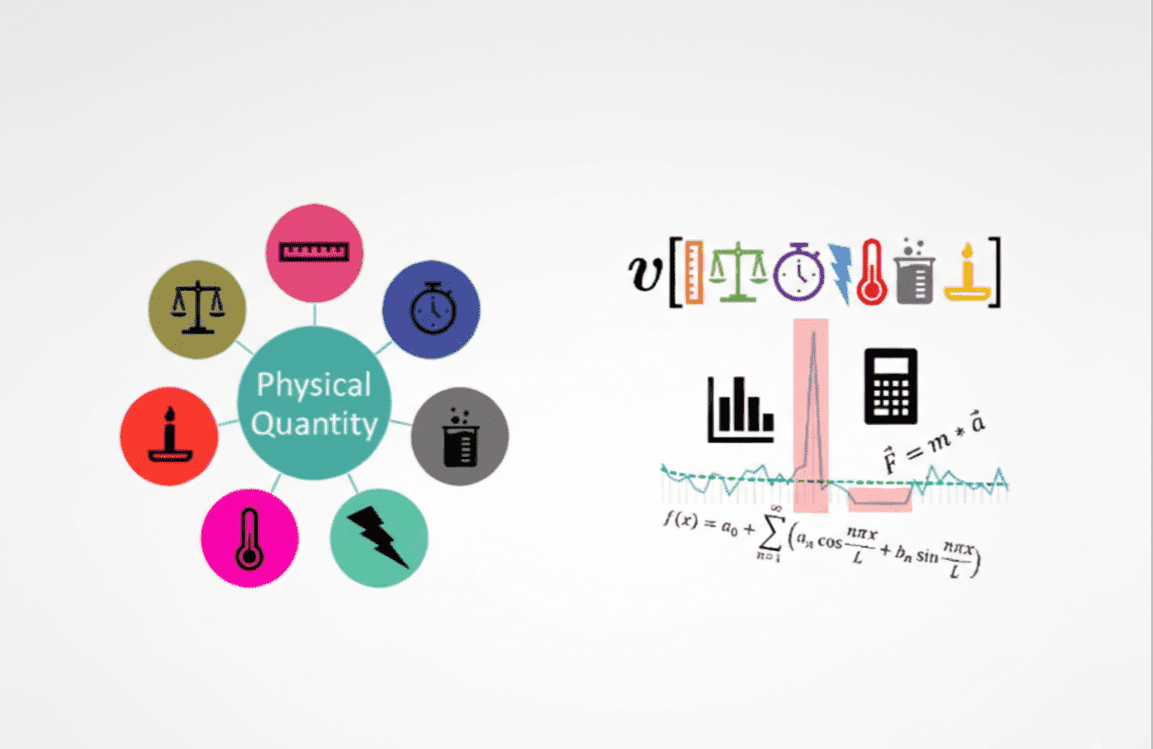
A physical quantity is any property of an object or event that can be measured and written with numbers and units.
For example when we measure the length of a road, calculate the time of experiment or find the temperature of water. These length, time and temperature are physical quantities.
Basic measurable quantities that do not depend on any other physical quantities. These are independent and form the foundation of all measurements.
7 base quantities: Length, Mass, Time, Electric current, Temperature, Amount of substance, Luminous intensity
Quantities that are calculated by combining two or more base quantities using mathematical relationships or formulas.
Example: speed is a derived quantity of distance over time.
SI units are the international standard units of measurement used in science to measure physical quantities in a consistent and uniform way all over the world.
"SI" is the abbreviation of Système International Unites. These units make sure that a measurement taken in one place means the same thing everywhere.
Example: 1 meter in Dubai = 1 meter in Japan = 1 meter in USA.
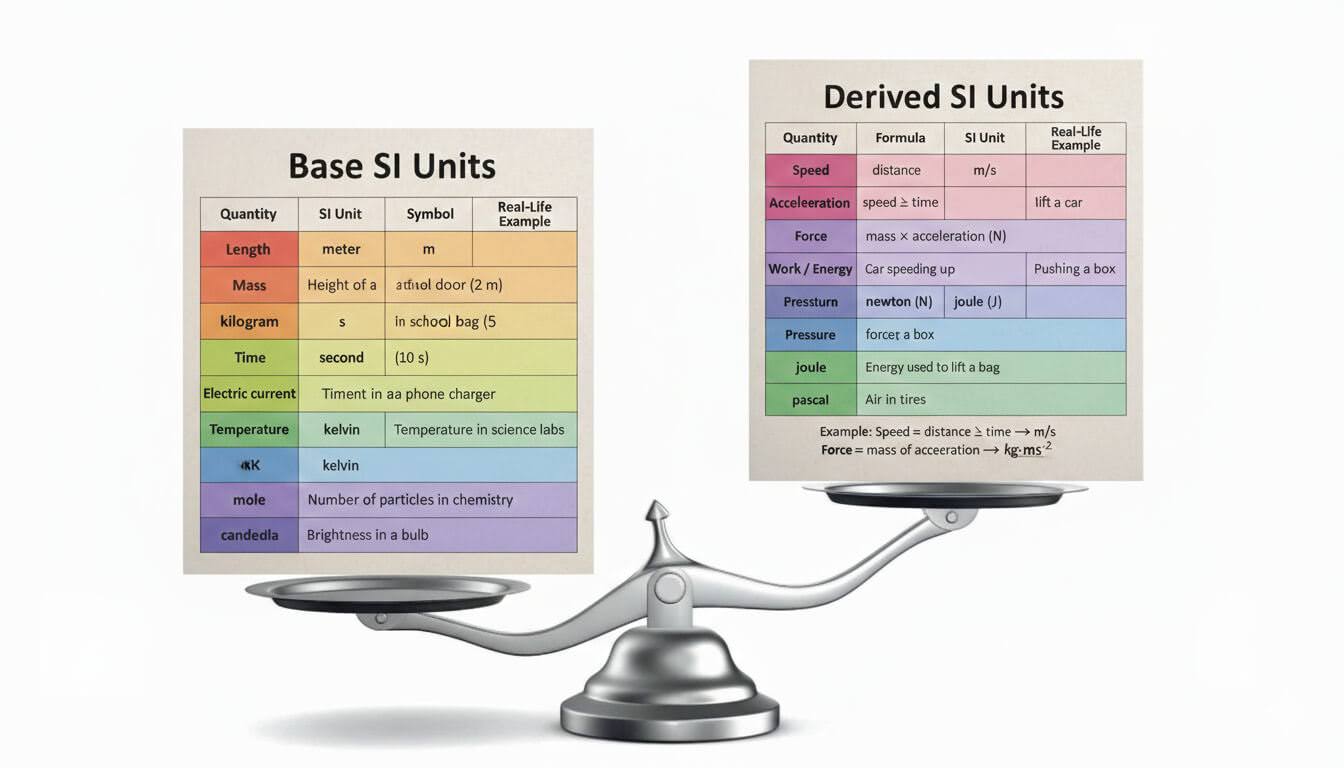
Base SI units are units used to measure basic physical quantities that do not depend on any other quantities.
| Quantity | SI Unit | Symbol | Real-Life Example |
|---|---|---|---|
| Length | meter | m | Height of a door (2 m) |
| Mass | kilogram | kg | Weight of a school bag (5 kg) |
| Time | second | s | Time of a race (10 s) |
| Electric current | ampere | A | Current in phone charger |
| Temperature | kelvin | K | Temperature in science labs |
| Amount of substance | mole | mol | Number of particles in chemistry |
| Luminous intensity | candela | cd | Brightness of a bulb |
Derived SI units are units that are formed by combining base units or fundamental units using mathematical formulas.
| Quantity | Formula | SI Unit | Real-Life Example |
|---|---|---|---|
| Speed | distance ÷ time | m/s | Speed of a car |
| Acceleration | speed ÷ time | m/s² | Car speeding up |
| Force | mass × acceleration | newton (N) | Pushing a box |
| Work / Energy | force × distance | joule (J) | Energy used to lift a bag |
| Pressure | force ÷ area | pascal (Pa) | Air in tires |
Example: Speed = distance ÷ time → m/s
Force = mass × acceleration → kg·m/s²
Measuring Instrument: A tool used to determine the value of a physical quantity by comparison with a standard unit. Different instruments are used for different quantities, such as a ruler for length or a stopwatch for time.
Least Count: The smallest value that can be measured accurately with that instrument. It determines the precision of the measurement; a smaller least count means more precise measurement.
Example: if a digital balance in your physics lab shows values up to 0.01 g, then its least count is 0.01 g.
When we take measurements in science, two very important ideas help us judge the quality of our data: accuracy and precision. These two words sound similar, but they mean different things.
The degree to which a measured value agrees with the true or accepted value of the quantity being measured.
The more a measurement closer to the true value, the more it's accurate.
Example: A metal ball's real mass is 100g, but our balance shows 99g. It's accurate because it's close to the true value.
How close repeated measurements of the same quantity are to each other, regardless of whether they are close to the true value or not.
Example: If you measure the same ball three times and get 95 g, 95 g, and 95 g, your measurements are very precise because they are consistent, but they are not accurate because they are far from the true value of 100 g.
A measurement error is the difference between a measured value and the true value. Errors can come from two ways, either due to human reaction time or instrument limitations.
An unpredictable variation in measurement results that occurs in no fixed direction.
Causes: Human reaction time, small changes in environment, tiny variations in reading instruments.
Example: Noting time of a falling object with a stopwatch—reaction time varies slightly each time.
To reduce: take several readings and find the average.
An error that occurs consistently in the same direction every time a measurement is taken.
Causes: Faulty or uncalibrated instruments, wrong experimental method.
Example: A weighing scale not zeroed, always showing +0.05 kg extra.
Repeating measurements will not fix systematic errors.
Zero error is a type of systematic error that occurs when a measuring instrument gives a non-zero reading even when the true value of the quantity should be zero.
Example: If a weighing scale shows 0.05 kg when nothing is on it, then every mass you measure will be 0.05 kg higher than the true value.
To get exact reading, subtract the zero error from observed reading.
Example: If scale shows +0.05 kg when empty and object reads 2.00 kg, then:
Correct mass = 2.00 − 0.05 = 1.95 kg
Uncertainty is a quantification of the range within which the true value of a measured quantity is expected to lie.
Uncertainty tells others how reliable the measurement is.
Example: If your ruler measures only to the nearest millimeter, you may write:
Length = 12.3 cm ± 0.1 cm
This means the real length probably lies between 12.2 cm and 12.4 cm.
Sometimes physical quantities are very large or very small. Writing many zeros is difficult and confusing, so scientists use metric prefixes.
Prefixes help us write values in a simpler and clearer form.
In the Forces and Energy, you will calculate quantities such as:
All of these depend directly on measuring:
For example, to calculate force using the formula F = m × a, both mass and acceleration must be measured correctly. If either value is wrong, the calculated force will also be wrong.