

Do you remember pinning a note on a fridge using a magnet? What about using a magnet for a compass? Or seeing a maglev train float on a set of tracks?
All of these are examples of magnetism, a basic force of nature.
The ancient Greeks, more than 2,000 years ago, found strange rocks that attracted iron. These rocks were found close to a region called Magnesia. That is why we call them magnets. Later, ancient Chinese sailors would use magnetic rocks as their compass to travel across seas.
The use of magnets shows that magnets are not just about fridge magnets. Magnetism is also used in electric motors, generators, computers, medical imaging machines, and many other devices.
Magnetism is considered an invisible force since it is a non-contact and distance force that attracts or repels certain materials. For example, a magnet can pull an iron object to it or push other magnets away without even touching them.
Magnetism also acts like gravity and electric force. For magnetism to work, contact is not needed.
Materials that are strongly attracted to magnets. Iron, nickel, and cobalt are examples of ferromagnetic materials.
Example: A magnet will pull steel scissors toward it.
Materials that are not attracted to magnets. Wood, plastic, glass, and paper are examples.
Note: Not all metals are magnetic. Aluminum is a metal but is non-magnetic.
Every magnet has two poles: North pole and South pole.
This is like electric charges, where like charges repel and unlike charges attract.
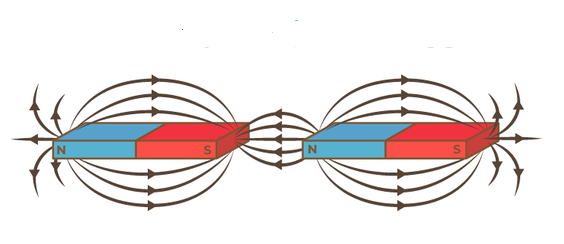
Magnets have a magnetic field around them, just like charged objects have an electric field.
The magnetic field is the area where a magnetic force is present.
Even though you can't see a magnetic field, you can see what happens when you get close to one. If you sprinkle iron filings on a piece of paper near a magnet, the filings arrange themselves in curved patterns, revealing the magnetic field.
The strength of a magnetic field is strongest near the poles and becomes weaker farther away.
Scientists use magnetic field lines to model the magnetic field's structure.
The Earth is a giant magnet with a magnetic field that extends thousands of kilometers into space.
Magnetism is caused by movements of molten (liquid) iron in the Earth's outer core. The flowing iron creates electric currents which produce the magnetism.
The Earth has a north magnetic pole and a south magnetic pole.
The magnetic and geographical poles do not line up. The geographic north pole is located in Northern Canada — not at the magnetic north pole.
A compass is a tiny magnet that is set up to rotate freely. The compass turns to line up with the Earth's north-south magnetic field.
For years, travelers and explorers have relied on this device to find directions. Sailors and hikers still use compasses to navigate.
Induced magnetism occurs when a piece of magnetic material (like iron) becomes temporarily magnetized when placed near a magnet.
Example: Hold a magnet next to a steel paperclip. The paperclip becomes magnetized and can attract more paperclips, creating a chain of temporarily magnetized clips.
When the magnet is removed, the paperclips lose their magnetism and fall off.
Stroke a nail in the same direction repeatedly with a permanent magnet. The end of the nail you stroke will have the opposite pole to the magnet being used.
Wrap a nail in wire and run an electric current through the wire. This creates an electromagnet (covered in more detail in future lessons).
Magnets can lose their magnetism through:
The examples of magnetism in everyday life are everywhere. Working with the concepts of magnetism opens up an understanding of the technology we use every day.