

On this page:
Introduction What Is a Wave? Transverse Waves Key Features of Transverse Waves Examples of Transverse Waves Longitudinal Waves Compressions and Rarefactions Examples of Longitudinal Waves Wave Properties: A Complete Picture Wave Graphs Energy Transfer in Waves Why This Classification Matters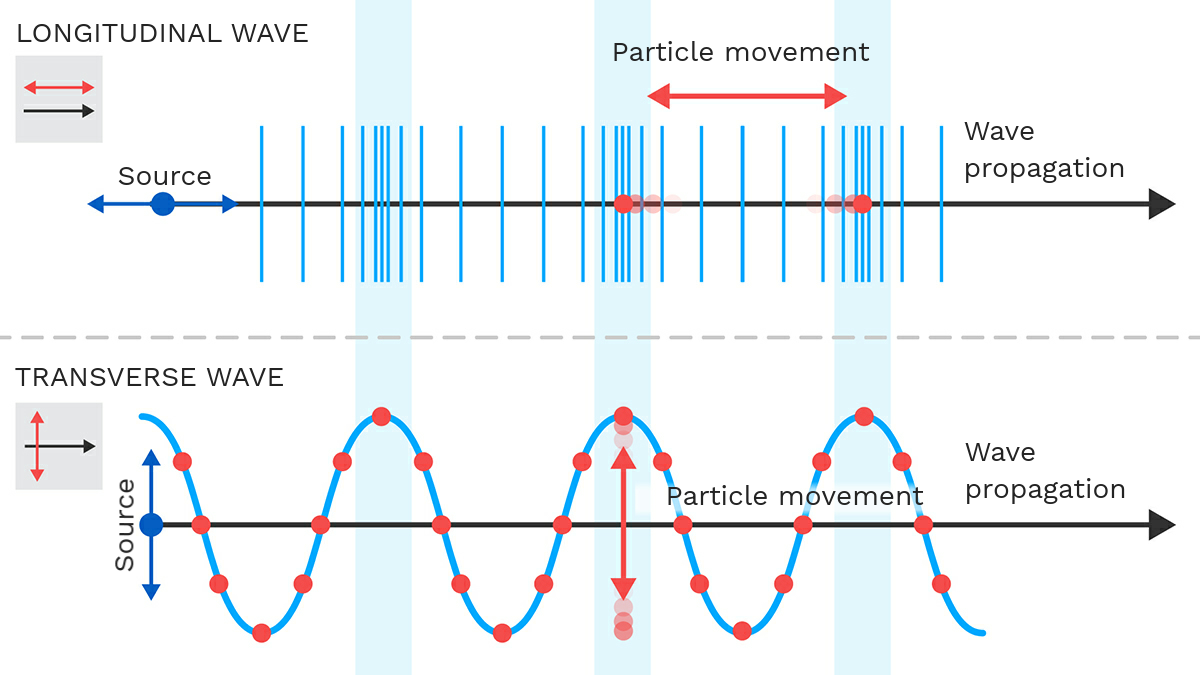
When a pebble is dropped into a still pond, the ripples that form create perfect circles that expand outward. When loud music is played, you may put your hand on the speaker; you feel the speaker vibrating.
All the above are examples of waves in one form or another. There are many techniques in physics, medicine, and engineering that help simplify and improve our everyday lives.
A wave is a disturbance that transfers energy from one location to a different location, and in doing so, does not cause the transfer of any matter.
This matter is a very important part of the definition. When waves travel across water, the water doesn't travel with the wave. What happens is that the individual water particles just move up and down as the wave passes and the energy moves forward while the matter stays roughly in the same place.
Different kinds of waves can be found in everyday life including light and sound waves, radio waves, and ocean waves. Waves can also be found beyond everyday life including microwaves and seismic waves.
Transverse waves are defined as waves where the vibrating medium's particles shift in a direction that is perpendicular to the direction of the wave's travel.
Perpendicular shift denotes a right-angled shift. If a wave travels horizontally to the right, the medium particles shift in the right-angled direction — up and down.
Transverse waves can be demonstrated through a rope. If one side of the rope is pulled to the side, waves travel along the rope. The rope will shift in an up and down direction while the wave moves forward.
Crests are where the waves are at maximum displacement, and troughs are where the waves are at minimum displacement. The extreme points of any wave will define the maximum position of any given particle from its rest position, and this is defined as the amplitude (A).
The energy carried by a wave is directly proportional to the amplitude (A). The distance (λ) that exists between two consecutive crests or troughs is defined as the wavelength.
All types of electromagnetic radiation including visible light, radio waves, microwaves, and X-rays, are transverse waves. Also, waves on the surface of water are transverse waves, as are the S-waves of earthquakes which are seismic waves.
Seismic S-waves can't move through the outer liquid core of the Earth. That's why S-waves are used by geologists to study the structure of the Earth.
In a longitudinal wave, the particles of the medium move in the same direction as the wave propagates.
In the same direction it is called parallel. So, if the wave moves to the right, the particles also move right and then back left, all along the direction of the wave.
The best example of this is a slinky spring. When you push one end of a slinky and then let go, the coils move a small distance forward and then back; that wave moves along the slinky and the coils do not travel, they just move back and forth.
Two different types of longitudinal waves form in the same way.
A compression is a zone where particles are packed together — high pressure and high density. On the contrary, a rarefaction is a zone where particles are spread apart — low pressure and low density. In a given wave, there are alternating compressions and rarefactions, and these waves travel through a given medium.
For longitudinal waves, the wavelength is the distance between two consecutive compressions, or between two consecutive rarefactions.
Common examples of longitudinal waves are sound waves. When a speaker vibrates, it causes forward and backward movements of the air particles and thus creates compressions and rarefactions that spread out.
Another example is the fastest earthquake waves, which are called longitudinal seismic P-waves and can move through solids, liquids, and gases.
Both wave types possess the same fundamental characteristics:
Transverse waves are straightforward to depict on a displacement-distance graph. This is because the particle displacement is up and down, and the graph will represent the wave just like it looks in space.
A displacement-distance graph reveals a wave snapshot at one specific time instance. The x-axis (horizontal) depicts distance along the wave while the y-axis (vertical) depicts particle displacement.
Displacement-time graphs illustrate the movement of a single particle over a duration of time. The graph has the same shape, but the x-axis represents time, and you can read the period — the time taken for a complete oscillation.
Longitudinal waves are more difficult to illustrate, but they can also be shown using the same framework, which would require plotting the displacement of the particle in the direction of the longitudinal wave.
All waves transport energy. The amount of energy transported by the wave is determined by the amplitude and frequency of the wave. Specifically, the energy carried by a wave is directly proportional to the square of the amplitude.
This explains the large and destructive energy in ocean waves, explains why loud sounds can damage the ear, and explains why high-energy radiation can destroy living tissues.
It is important to be able to determine if a wave is longitudinal or transverse, as this classification helps make predictions of wave behaviour. It is also the reason light can travel in a vacuum but sound can't.
It also explains the behaviour of earthquakes and the way scientists use seismic waves to study the structure of the Earth.
The movement of waves transports energy throughout the universe and across the vast void of space. Their movement describes the fundamentals of physics and everything that comes after.