

Imagine it is chilly outside and you have a steaming hot mug of tea. You hold the mug and feel the heat coming from the mug and the warmth of your hands. The mug and tea become colder and your hands get warmer.
But do you know how that energy is being transferred? It isn't jumping, not teleporting, and the energy is moving from the mug to your hands. Heat can move through a clear and specific mechanism.
Heat can be transferred through conduction, convection, and radiation. Every process of cooling or heating in nature or technology utilizes at least one of these three forms of transfer.
Heat transfer is a process of thermal energy moving from a hotter region to a cooler region. This is a phenomenon that happens in one direction naturally from hot to cold until the temperature equalizes.
Each of the three methods of heat transfer functions differently and is applicable under separate conditions.
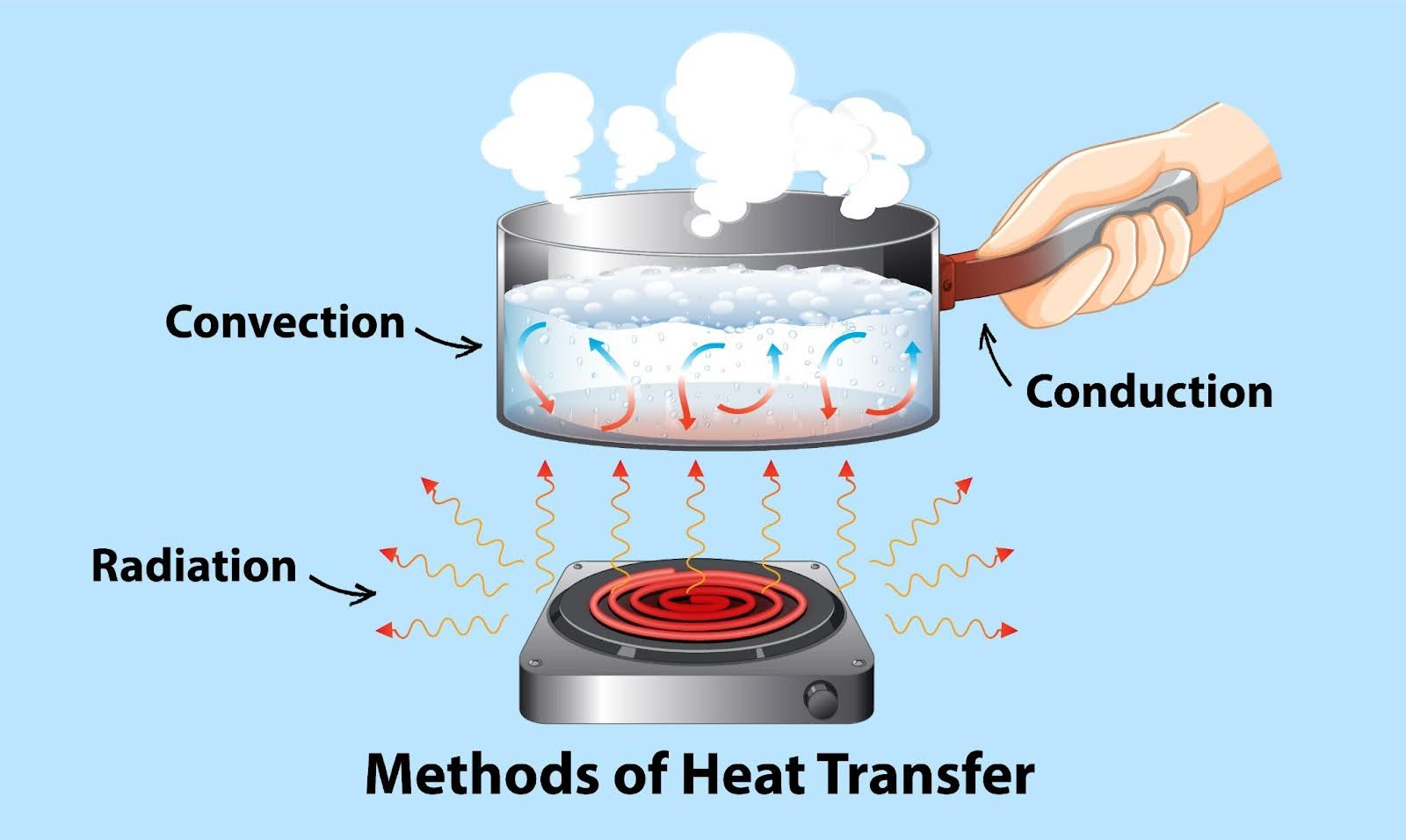
Conduction is a method of heat transfer that happens within a solid and relies on direct, particle-to-particle contact, and does not involve the movement of the solid as a whole.
When one end, or side, is heated, the particles in that region acquire more kinetic energy than the rest and they move or vibrate. They collide with their immediate particles, and as a result, the rest of the particles in that region also gain energy.
Conduction is particularly useful in metals because there are free electrons in the materials. When a metal is in contact with your skin, it quickly conducts heat away, and as a result, the metal feels cold to the skin. Fast-moving free electrons are also good at carrying energy.
Because we do not want the heat to reach us, the handles of pans are made of plastic and wood.
Building insulation, thermos containers, and winter clothing all rely on still air that is trapped in small pockets where the air is a poor conductor.
While conduction is effective in solids, in liquids and gases the transfer of heat is different. This is because the particles of liquids and gases are not in fixed positions. Instead, heat is transferred in liquids and gases the same way through convection.
Convection is the transfer of heat through a fluid (liquid or gas) by the movement of the fluid itself.
As a fluid heats up, the particles near the heat source gain energy and move faster, causing the particles to spread apart, and the fluid expands. The less dense fluid rises to the float. The cooler fluid sinks to heat, rises, and the process continues. This is called a convection current.
Boiling Water: When boiling water in a pot, the water that is at the bottom of the pot is heated by the flame, rises, and is replaced by the cooler one from the higher position. The cooler water is then heated, and the cycle continues. The liquid as a whole is heated due to this convection.
Room Heaters: The placement of room heaters is near the floor. The heats move across the ceiling, cools, and sinks down the walls. The air is heated at the floor while the cool air at the walls and the cycle continues. The room is heated by convection current.
While conduction requires direct contact and convection requires a fluid medium, radiation requires neither. Convection is the only method of heat transfer that can occur across a vacuum.
Radiation involves the transfer of heat energy through electromagnetic waves, primarily infrared radiation, and does not require any medium.
All radiation has a thermal component to it because of the movement of the charged particles within it. The hotter an object is, the more radiation it emits, and the shorter the wavelength of that radiation.
This is the principle for why wearing dark clothes in the summer is a bad idea; the darker the clothes, the more the sun is absorbed. Conversely, white or light clothes keep you cool as they reflect sun rays.
The operation of a vacuum or thermos flask is a classic example of engineering that minimizes the three heat transfer mechanisms.
The walls of the flask consist of two layers of glass or steel, and in the middle there is a vacuum that prevents conduction and convection, as these two mechanisms cannot occur when there is no matter to transfer.
| Method | Medium | Mechanism |
|---|---|---|
| Conduction | Solids (mainly metals) | Direct contact, particle vibration |
| Convection | Fluids (liquids and gases) | Movement of fluid, circulating currents |
| Radiation | No medium required (vacuum) | Electromagnetic waves (infrared) |
Most real-life scenarios involve all three methods. Room fires heat the space via radiation (you feel warmth on your face), convection (the hot air rises and circulates), and conduction (the grate and surrounding bricks heat up via direct contact).
The heat transfer is mainly considered theoretical. However, it is the basis of all modern technologies that involve heating, cooling, and energy efficiency.