
On this page:
Introduction The Starting Point: Electromagnetic Induction How a Generator Works What Spins the Generator? The National Grid Transformers: The Key to It All Step-up and Step-down Transformers Step-by-Step Journey of Electricity Energy Losses in the Grid Why This Matters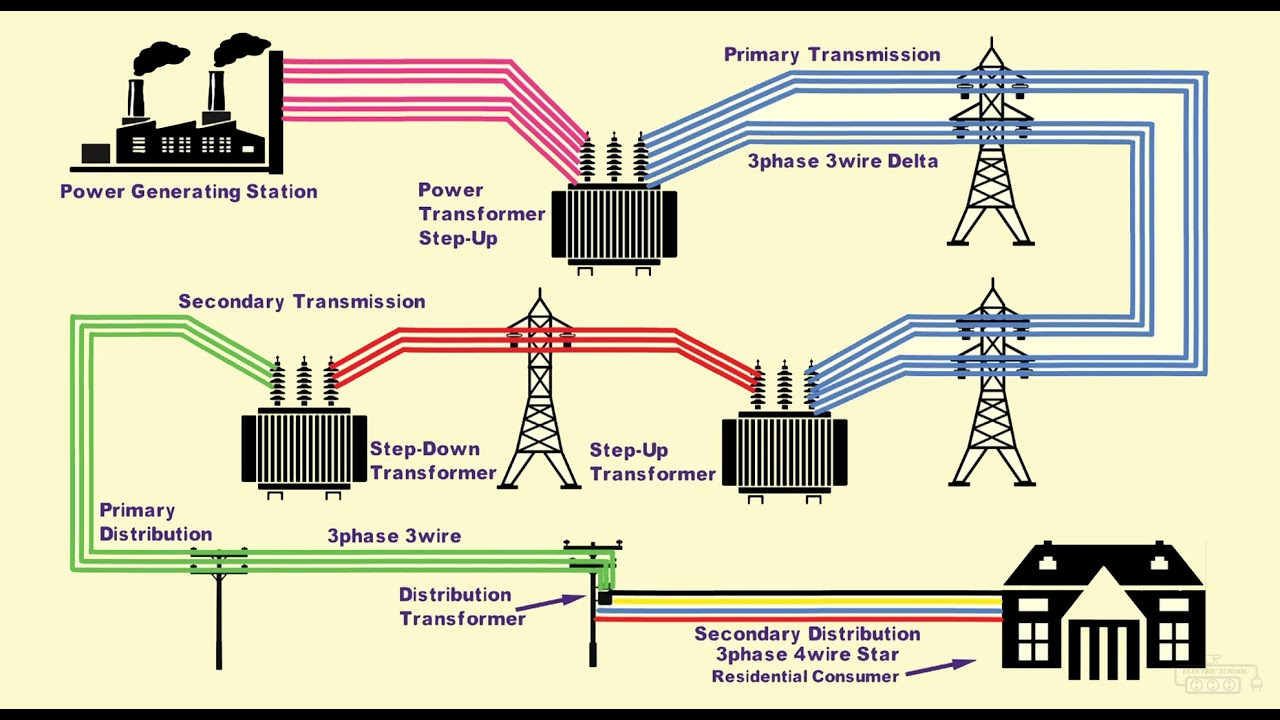
Right now, somewhere not too far from where you're sitting, enormous coils of wire are spinning inside powerful magnets. That spinning is the reason your lights are on, your fan is running, and your phone is charging.
Most people use electricity every single day without ever thinking about where it actually comes from or how it travels hundreds of kilometers to reach their homes. Once you understand this journey, you'll never look at a power socket the same way again.
Everything begins with a discovery made by Michael Faraday in 1831. He found that when a conductor moves through a magnetic field or when a magnetic field changes around a conductor, a voltage is induced in that conductor. If the conductor is part of a complete circuit, this voltage drives a current through it.
This phenomenon is called electromagnetic induction, and it is the single most important principle behind generating electricity on any large scale.
The key conditions for electromagnetic induction are simple. You need a conductor, you need a magnetic field, and you need relative motion between them. Remove any one of these three, and induction stops.
The size of the induced voltage depends on three things: how strong the magnetic field is, how many turns the coil has, and how fast the conductor moves through the field. Increase any of these, and you get a larger voltage.
A generator is a device that converts kinetic energy into electrical energy using electromagnetic induction.
Inside a generator, a rectangular coil of wire is placed between the poles of a strong magnet. When the coil is made to spin, its wires continuously cut through the magnetic field lines. This constant cutting induces a voltage, and since the coil keeps rotating, the direction of the induced current alternates with every half turn.
This is why generators naturally produce alternating current, or AC. The output voltage follows a smooth sine wave, rising to a peak, falling back to zero, reversing, reaching a negative peak, and returning to zero again, completing one full cycle.
The faster the coil spins, the higher the frequency and the greater the peak voltage. A stronger magnetic field or more coil turns also increases the output voltage.
A generator on its own does nothing. Something has to spin its coil. That something depends on the type of power station.
Once electricity is generated at a power station, it needs to travel to homes, hospitals, schools, and factories, sometimes hundreds of kilometers away. The network of cables and equipment that carries electricity from power stations to consumers is called the national grid.
Here's the challenge. When current flows through a wire, some energy is always lost as heat due to the resistance of the wire. This is described by the equation:
Where I is the current and R is the resistance of the cables. The cable resistance cannot realistically be reduced to zero, so the only practical way to reduce energy loss is to reduce the current.
But here's the important bit. Power is also given by:
So if you increase the voltage while keeping the power the same, the current decreases. Lower current means dramatically less energy wasted as heat in the cables.
This is why electricity is transmitted at very high voltages, typically hundreds of thousands of volts, across the national grid. Reducing the current even slightly has a huge effect on losses because the loss depends on I².
To transmit at high voltage and then deliver at a safe, usable voltage, you need transformers. A transformer is a device that changes the voltage of an AC supply.
It works through electromagnetic induction. A transformer has two coils wound around a shared iron core. The primary coil is connected to the input voltage, and the secondary coil delivers the output voltage.
When AC flows through the primary coil, it creates a changing magnetic field in the iron core. That changing field passes through the secondary coil and induces a new AC voltage in it. The ratio of voltages depends on the ratio of turns in the two coils:
Where Vp and Vs are the primary and secondary voltages, and Np and Ns are the number of turns in each coil.
One critical point: transformers only work with AC, not DC. This is because DC creates a constant magnetic field, which cannot induce a voltage in the secondary coil. Only a changing field, produced by AC, causes induction. This is one of the biggest reasons why the national grid uses AC rather than DC.
Every transformer in this chain is doing one job: making the transmission as efficient as possible by keeping current low during travel and then making the voltage safe at the destination.
No real system is perfectly efficient. Even with high-voltage transmission, some energy is still lost. The main sources of loss in the grid are:
Engineers work to minimize these losses by:
The system of electromagnetic induction, generators, and transformers is one of the greatest engineering achievements in history. It took ideas from a physics laboratory and turned them into a global infrastructure that powers billions of lives. Understanding how electricity is made and moved gives you the foundation to think critically about energy sources, efficiency, and the future of sustainable power.