

On this page:
Introduction What Is Force? Classification of Forces Newton's First Law of Motion Newton's Second Law of Motion Newton's Third Law of Motion Action-Reaction Examples Difference between Mass and Weight Friction Force Resultant Force Why Newton's Laws Matter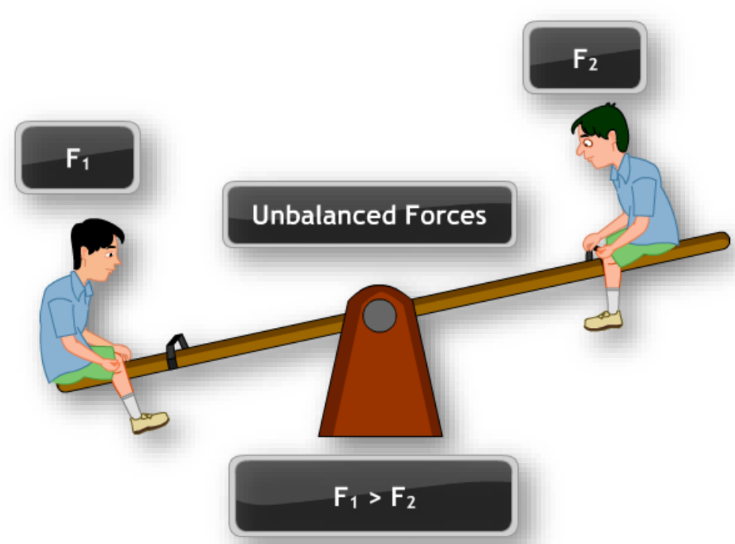
Have you ever wondered why a football stops rolling on grass? Why do we jerk forward when a bus suddenly stops? Why do rockets need powerful engines to escape gravity?
The answers to these annoying questions can be best understood by Newton's three laws of motion.
Physics is the study of the natural and physical world and how everything works. The best way to understand the world around you is to study how different forces work and how the world around you is.
When two objects interact and either change the motion of the objects or the physical shape of an object, an event called a force occurs. A force has a specific amount of direction and magnitude.
When gravity is acting on an object, that is a force. When you slide a box, and it slows down due to friction, that is a force acting on the box.
The international standard unit of measurement for Forces is the Newton. To put it simply, one Newton can be described as the amount of force needed to accelerate a one-kilogram mass by one meter per second squared.
The letter F is used as the "force" symbol in physics, and since it is a vector quantity, it must have a magnitude and a direction.
The IB MYP curriculum splits the types of forces into two main classifications:
These forces require physical interaction between two objects in order to take effect.
These forces occur without physical interaction between the two objects.
Three of the several mechanical laws were made by Sir Isaac Newton, and his first law states that:
A body continues to remain at rest, or in motion at a uniform velocity, unless and until a net external force acts on the body.
The first law of motion introduces inertia.
The first law says that the body can resist a change of motion. A body at rest will remain at rest, and a body in motion will remain at the same velocity unless an external force acts on the body.
The inertia of a body is determined by the mass of the body. More mass means more inertia, and more inertia means more external force is required to change the state of rest or motion.
Examples of this principle of inertia are:
When a situation is described as balanced forces, it means that there are no changes in the movement of an object because these forces have resulted in a net force of zero. Hence, the object will either not move or continue to move at a velocity which is constant.
Newton's second law gives a precise form to the relationship of force, mass, and acceleration in the following manner:
An object will accelerate in the direction of the net force, and the mass of the object will be inversely proportional to the amount of acceleration produced as a result of the net force. Therefore, acceleration and force will be in the same direction.
The representation will be:
Where:
This equation clearly defines relationships between these variables, hence it can be manipulated to give other relationships, such as:
The relationship defined by Newton's second law is fair. While keeping the mass constant of an object, if you apply a force of a greater value than the previous value, the amount of acceleration will be greater.
Mass greatly impacts F=ma. If you double the mass and keep the force constant, the acceleration is reduced by a factor of 2.
Examples: Consider a tennis ball and a bowling ball. If both balls are thrown, the bowling ball will move significantly slower. This is because a tennis ball has less mass and therefore is able to accelerate more.
This is also the case with trucks, which have really powerful engines. This is because a lot of force is needed to give the same acceleration to a large mass (the truck) compared to a small mass (a small car).
When calculating resultant force, remember that force is a vector. If you have many forces acting on an object, you must consider the directions of the forces. If multiple forces are acting in the same direction, you will add them together. If forces are acting in the opposite direction, you will subtract them.
Newton's third law states that:
When object A pushes on object B, object B will push back on object A with an equal force, but in the opposite direction.
This is often summarized as 'for every action, there is an opposite and equal reaction'.
Action-reaction forces have defining characteristics:
Understanding Forces: When action and reaction forces take place, they DO NOT cancel each other out because these forces act on different objects. Forces only cancel each other when they act on the same object.
There is consistently confusion amongst pupils regarding the weight and mass of an object.
Mass is defined as the amount of matter in an object. It is measured in the form of scalar quantities in units of kilograms (kg). It is the same no matter where in the universe the object is measured. Additionally, mass is the way in which an object's inertia is measured.
Weight is defined as the force of gravity acting on an object's mass. Weight is also measured in the form of vector quantities in units of newtons (N). Weight is influenced by the strength of gravity where the object is situated, and by the point where it is located.
The relationship between mass and weight is expressed as:
Where:
Near the Earth, g is approximately equal to 9.8 N/kg or 9.8 m/s² and is typically rounded to 10 N/kg.
Example calculation:
Notice the mass stays 60 kg, but the weight changes because the gravitational field strength is different.
Friction is a contact force opposing motion and acts between surfaces that are in contact.
Friction depends on the type of surfaces in contact. Rough surfaces produce more friction.
Friction has its pros and cons:
Resultant force is the vector sum of all of the individual forces that are acting on a subject. Different forces, when acting on the same subject, produce a resultant force, and those forces can be said to be unbalanced.
When the resultant force is zero, all the forces acting on the subject are equal, balanced, and the subject is not accelerating.
In order to understand the motion of things in the universe, these three laws are the most important building blocks of classical mechanics.
These laws guide all observed movements, from a train in motion to a leaf falling. Harnessing engineering laws turns simple observation into predictive analysis, giving us the ability to rationalize and manipulate the world.