
On this page:
Introduction What is a force? How is force measured? Types of Forces Contact Forces Non-Contact Forces Effects of Forces Balanced and Unbalanced Forces Friction - The Opposing Force Is Friction Useful or Harmful? Pressure The Importance of Pressure Moments and Turning Effect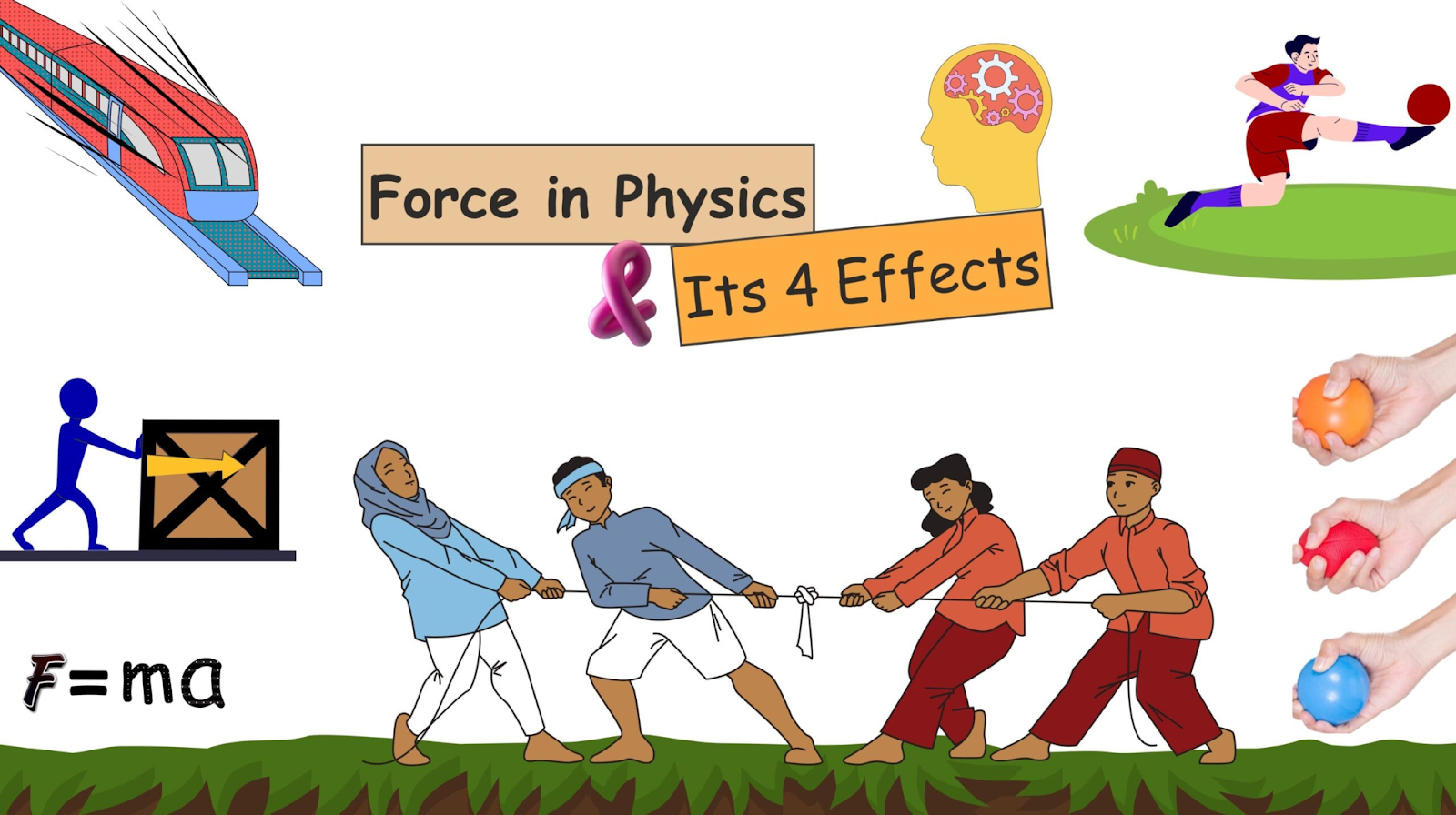
What happens when you push a door open? When you kick a football? When you pull a drawer?
In each case, you are doing something similar.
You are using force.
Force helps us move all the things that are around us; it makes cars move, it helps us stay on the ground, and it also helps us write with a pen. If we do not understand the force, we do not understand how any of the things in the world work.
A force is any push or pull that is applied to an object. This force can change the object's motion, its shape, or the direction it is facing.
Consider this: when you push a shopping cart, you are using a force to make it move. When you catch a ball, you are using a force to stop its motion. When you squeeze a sponge, you are using a force to change the shape of the sponge.
Each force has two important properties:
This is the reason force is also called a vector quantity. To fully describe a force, you need both size and direction.
Force is measured in newtons. This is named after Sir Isaac Newton, the man who gave us the laws of motion.
The symbol for Newton is N.
Consider these forces:
In a laboratory, we measure forces using a device called a spring balance or a force meter.
Depending on how forces act on an object, we can classify forces around us into two broad categories.
Contact forces describe the type of force that only works when two objects touch each other.
Common examples include:
Applied Force - This is the force you apply directly to an object. If you push a book across the table, you're putting a contact force.
Friction Force - This is the force that resists the movement of two surfaces. If you slide a box on the ground, the friction force is the opposing force. More on friction will come.
Normal Force - This is the supportive force coming from a surface. If you put a book on the table, the table will push up on the book with a normal force to prevent it from falling down.
Tension Force - You can feel this force at work anytime a rope, string, or cable is pulled. For example, when you pull a bucket from a well, tension is acting along the rope.
Non-contact forces can act on objects without touch. Fascinating, isn't it?
Let's take a look at what forces can do to objects.
Effect 1: Force Can Change Motion
A force can start, stop, or change the speed of a moving object.
Examples:
Effect 2: Force Can Change Direction
Force doesn't just affect speed. They also make an object turn or change its path.
For example:
Effect 3: Force Can Change Shape
You can temporarily or permanently change an object's shape.
For example:
Here's something fascinating. Multiple forces can act on the same object at the same time. What happens then?
Balanced Forces
When two or more forces acting on an object cancel each other out completely, they are called balanced forces.
The key point is: balanced forces do not change the motion of an object.
An example of a situation where opposing forces are balanced: You exert a force of 50 N on the wall, and the wall exerts a force of 50 N back onto you. The wall does not move because the forces are balanced.
Another example: There is a book on a table. Gravity pulls the book downwards. The table applies an equal force upwards. The book is not moving.
When opposing forces balance out, the following happens: A stationary object will not move. An object that is moving will move at a constant velocity.
Unbalanced Forces
When opposing forces on a singular object do not completely cancel each other out, this is known as unbalanced forces.
Unbalanced forces cause a change in motion. The following are some examples of unbalanced forces.
Unbalanced forces are unbalanced in the sense that there is a difference in forces; one is greater than the other.
Newton's first law of motion applies.
This law states that an object will remain at rest, and an object in motion will remain at the same speed unless an unbalanced force acts on the object.
This property is called inertia - the reluctance of a body to change its state of motion or rest.
Real-life examples: When a vehicle is stopped suddenly, the passengers lurch forward as their bodies try to keep moving. A tablecloth can be pulled quickly from under dishes without disturbing them.
Friction is that force that always seems to work against us. But is it really an enemy?
Friction is the force that opposes any relative motion of a solid sliding against another.
What Causes the Friction?
Even seemingly smooth surfaces are rough as you go down to the microscopic level. When surfaces slide against each other, the bumps interlock to oppose motion.
Types of Friction
Useful Effects:
Damaging Effects:
Reducing Friction: Friction can be unwanted, and for us to reduce it, we can use oil or grease as lubricants. Also, the use of ball bearings in machines can reduce friction. Smoother surfaces can decrease friction, and the shapes of objects can be streamlined to reduce air resistance.
Increasing Friction: When we need friction, surfaces can be made rougher, the force pushing surfaces together can be increased, and we can use frictional materials, such as rubber.
Sometimes, it is just not about how much force you used, but how you used it. Pressure is the force acting per unit area of a surface.
The unit for measuring pressure in the international standard (SI) unit is the pascal (Pa), in which 1 Pa = 1 N/m².
Examples:
Walking on Soft Snow: Why can you walk on soft snow with snowshoes but sink without them? Snowshoes spread your weight over a large area, reducing the pressure on the snow and allowing you to walk on it.
What is the reason behind a sharp knife cutting better than a blunt knife? Because the sharp edge has a smaller area, which translates to more pressure for the same applied force.
A pointed nail has a tip that is designed to focus the applied force over a very small area, creating extremely high pressure, allowing the nail to easily penetrate wood.
When high pressure is needed:
When low pressure is needed:
Have you noticed that opening a door is easier when you push it from the handle that is farthest from the hinges? This is due to what we call the moment, or turning effect of force. The moment of a force is the turning effect produced by a force about a pivot point.
Unit: newton-meter (N·m)
Moments Examples:
All the technology and devices around you are designed by engineers and scientists who understand the fundamentals of physics.
Understanding design and carrying forces helps to create:
Understanding forces and moments helps us understand the world. They are in everything you do, and everything around you.