

On this page:
Introduction What Are Energy Sources? What is Non-Renewable Energy? What are Fossil Fuels? Coal Oil (Petroleum) Natural Gas What makes fossil fuels our predominant source of energy? Types of Nuclear Fuels Sources of Renewable Energy Solar Energy Wind Energy Hydroelectric Energy Geothermal Energy Biomass Energy Tidal and Wave Energy Environmental Impact of Energy Sources Climate Change and Greenhouse Gases Air Quality Exhaustion of Non-Renewable Resources Damage to Ecosystems The Path Forward: Sustainable Energy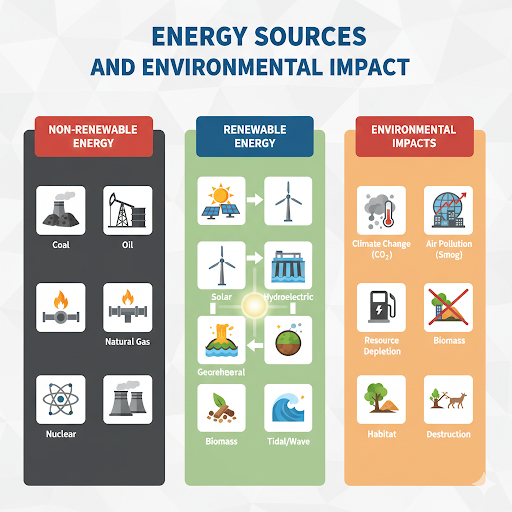
When you wake up in the morning, you turn on the lights. You cook breakfast on the stove, and the gas and the electricity help you. You take a vehicle that runs on petrol or diesel, then you go to school. You also use your gadgets that have electric energy. Have you ever thought about where this energy comes from?
You have to wonder, energy doesn't just exist. We have to take from the environment, change it, and make it usable, then find a way to move it where it's needed. Also, the choices you make about where to use them have a big impact on the future of the planet.
An energy source is anything from which we can get usable energy. Energy sources can be found in sunlight, flowing water, wind, buried fossil fuels, and even in the atoms. It is true that not all energy sources are the same. Some can be used up quickly, and to form others, it can take millions of years. Some energy sources produce harmful pollution, and there are energy sources that produce no or very little pollution.
We can better analyze energy sources by looking at them as either renewable or non-renewable.
Non-renewable energy is energy that is used at such a high rate that it can never be replaced during a human lifetime. These sources of energy took millions of years to form, but we are far outpacing their rate of buildup, leading to eventual shortages.
The most common sources of non-renewable energy are fossil fuels and nuclear fuels.
Fossil fuels are energy sources that consist of the remains of living things that died millions of years ago. These remains, buried under rocks for millions of years, decayed through heat and pressure and were transformed into the different types of fossil fuels: coal, oil, and natural gas.
Coal was formed mostly from plants that existed in swamp and forest areas around 300 million years ago. After their death, the plants were piled in massive numbers. During a later geological period, heat and pressure transformed this thick accumulation into coal.
Coal is primarily used at power stations to generate electricity. Generating steam to spin a turbine is how electricity is produced, and burning coal generates the heat to create steam.
Most forms of crude oil are derived from the remains of small marine life, specifically plankton. These organisms fell to the ocean bottom, and with the passage of time, numerous layers of sediment covered their remains. Heat and pressure from the overlying sediments transformed these remains into crude oil.
The crude oil then undergoes distillation to produce various other products, which include gasoline and diesel for vehicles, and kerosene to be used as fuel for jet airplanes. It also provides raw materials for the manufacture of plastics and medicines, among many other items.
Natural gas, like crude oil, was also formed from remains of the same organic materials; its formation was contemporaneous with the formation of oil. It consists predominantly of methane and causes the least pollution of the fossil fuels since burning it releases the least amount of carbon dioxide as compared to oil and coal.
Natural gas can be used for heating, cooking, making electricity, and can also be used as an industrial fuel.
They are energy-dense, meaning a small volume can store a large amount of energy. It is also easier to store and transport. An elaborate system of infrastructure is used for their extraction, processing, and transport, and when compared to some other sources of energy, they are always available and provide energy as required at the moment.
Despite the above-mentioned advantages, their use is accompanied by an array of disadvantages that threaten the existence of living organisms on the planet.
Nuclear energy has uranium as its source. Uranium is present in some rocks and is a radioactive element. Unlike fossil fuels, which gain energy through a chemical combustion process, nuclei in a nuclear fuel are broken through a process called nuclear fission.
In a nuclear power station, a controlled chain reaction is used to split uranium atoms. This greatly increases heat, which is then used to boil water to produce steam, which then spins turbines to produce electric energy.
However, nuclear energy has a strong disadvantage in developing technology. The radioactive waste produced is highly perilous for thousands of years. The danger is a major obstacle to the safe storage of the waste. The rare nuclear accidents can be disastrous, and the same Chornobyl and Fukushima accidents illuminated the possibility of a large danger.
Renewable energy sources are resources that can be renewed naturally over a human lifetime. Regardless of the amount we consume, as long as the sun keeps shining, these resources will not be depleted.
Because the sun will not run out in our lifetime, it is safe to consider these sources sustainable, as they will never be depleted, no matter how much we consume.
Solar energy comes from the sun in the form of electromagnetic radiation. As the Sun has been shining for billions of years and will continue for billions of years more, the Sun will always be a reliable source of energy.
Solar panels (or photovoltaic cells) are able to turn sunlight directly into electricity. Conversely, sunlight in solar thermal systems is used to heat the water of homes and buildings.
Advantages: Once solar panels are installed in homes, they become a free and reliable source of energy. Since solar panels use clean energy and produce no pollution, we can consider solar energy as free of cost and clean.
Disadvantages: It can only be collected in the presence of sunlight and can be affected by the weather conditions. It is also expensive to manufacture solar panels.
Wind is defined as moving air, and moving air is created by the uneven heating of the Earth's surface by the Sun. Wind turbines, in contrast, capture moving air and convert it to electrical energy.
Advantages: Modern wind turbines are incredibly efficient and can produce a considerable amount of energy. The fuel (wind) is also free, and wind energy produces no pollution.
Disadvantages: Wind is also extremely unpredictable. It is also not a continuous resource, and in its absence, wind turbines become unusable. It also takes up a considerable amount of space, has a detrimental effect on the population of local bird species, and can create a disturbance with its noise in the surrounding community.
Hydroelectric power depends on changing the gravitational potential energy of water. A dam creates water of potential energy. When water is released from the dam, the potential energy is converted to kinetic energy and generates electricity through the spinning blades of a turbine.
Advantages: Hydroelectric power is also dependable and is easily controlled. Engineers can choose what amount of water is released to create hydroelectricity. Large storage dams also have the ability to store water for irrigation and to control flooding.
Geothermal energy is stored heat from the earth. The heat is very close to the surface in some locations and is accessible through drilling.
The steam and hot water from underground can either turn a turbine to generate electricity or be used to heat buildings. Relying on geothermal energy is practical as it produces very low amounts of pollution.
Advantages: Geothermal energy is highly dependable and can be used at any time compared to other energy sources, as it does not rely on sunlight or wind.
Disadvantages: However, in more geologically active areas like Iceland, parts of California, and New Zealand, it is less of a practical option for biomass. Drilling can also create small quakes.
Biomass is any organic material recently derived from living material. The fuel can be wood, crop waste, animal dung, and energy crops.
When biomass is burned, the energy released is energy captured recently from sunlight through the photosynthesis process. Burning biomass does contribute to the release of carbon dioxide, but when new plants grow, they absorb carbon dioxide. This creates a cycle that, if managed sustainably, could potentially be carbon-neutral.
Disadvantages: Nonetheless, burning biomass causes air pollution. Growing energy crops takes away space from the production of food.
The movement of the oceans has tremendous amounts of energy. Tidal energy captures the predictable and consistent rise and fall of the ocean levels due to the moon's gravitational pull. Wave energy, on the other hand, captures the ocean's waves and therefore, the kinetic energy of these waves.
Both energy sources are reliable, and tidal energy is particularly predictable. The only downfall is that tidal energy is still in its early stages of development and is extremely expensive. Tidal and wave energy installations can have a negative impact on the oceans and their living creatures.
The type of energy we utilize impacts the environment. Some of the effects are on the quality of the air we breathe, the climate of the planet, the living beings in the ecosystems, and on human beings.
Coal, oil, and natural gas are fossil fuels that contribute to the burning of carbon. Carbon is a gas that is released and causes the greenhouse effect. The greenhouse effect is a phenomenon that traps heat in the atmosphere of the Earth.
The heat that is trapped by carbon and other gases causes Earth's temperatures to rise. Human activities or actions have added over 40% around the world to the levels of CO₂ found in the atmosphere over a period of 150 years. Because of these actions, the Earth continuously suffers from an increase in global temperature.
Climate change causes the following effects: melting of the polar ice caps, rising sea levels, an increase in the frequency and severity of weather events, breakdown of the ecosystem, and a reduction in the availability of food and water.
Of the fossil fuels, coal releases the most CO₂ per unit of energy, and then oil, and natural gas emits the least number of GHGs. When used, renewable energy sources emit little or no greenhouse gases.
Air quality is affected by the burning of fossil fuels since it releases a number of gases in addition to carbon dioxide. These other gases include sulfur dioxide, nitrogen oxides, and particulate matter. These pollutants lead to the formation of acid rain, respiratory diseases, and the overall reduction of air quality in an urban environment.
Air pollution causes millions of premature deaths each year, thus making it one of the most serious and pressing public health problems.
Oil and fossil fuels are non-renewable resources and, as such, are limited. Given the current level of mining and burning, there are estimates ranging from 50 to 150 years until oil, natural gas, and coal are completely depleted. When these non-renewable resources are used, there will be no possibility of their recovery.
In contrast to fossil fuels, renewable resources will be available for as long as the natural processes continue.
Damage to the environment by mining and drilling for fossil fuels, along with oil spills, also occurs. The 2010 Deepwater Horizon oil spill released millions of barrels of oil into the Gulf of Mexico, devastating the ecosystem there.
Most would think that renewable energy is harm-free. In fact, large hydroelectric dams flood entire valleys, which will harm habitats. Wind farms can be large, and that can harm bird populations. Solar farms take up a lot of real estate, too.
Being educated on these sources of energy will help to shape your and the world's future.
We have to step away from the use of fossil fuels and move towards renewable sources. For all means of the word, we have to be able to sustain the needs of future generations and allow them to meet their needs.
It's been said that "We can't build our way out of this problem, we have to move from technology to behavior, and that means a change in our energy-consuming habits."
The energy sources that you will learn about from the physics that you study today will help tackle the biggest problem that the world is facing: how to provide the world with clean energy and sustain it.