

On this page:
Introduction What are electromagnetic waves? The Electromagnetic Spectrum Radio Waves Microwaves Infrared Radiation Visible Light Ultraviolet waves X-rays Gamma Rays Properties Common to All Electromagnetic Waves Ionizing vs Non-Ionizing Radiation The Importance of the Electromagnetic Spectrum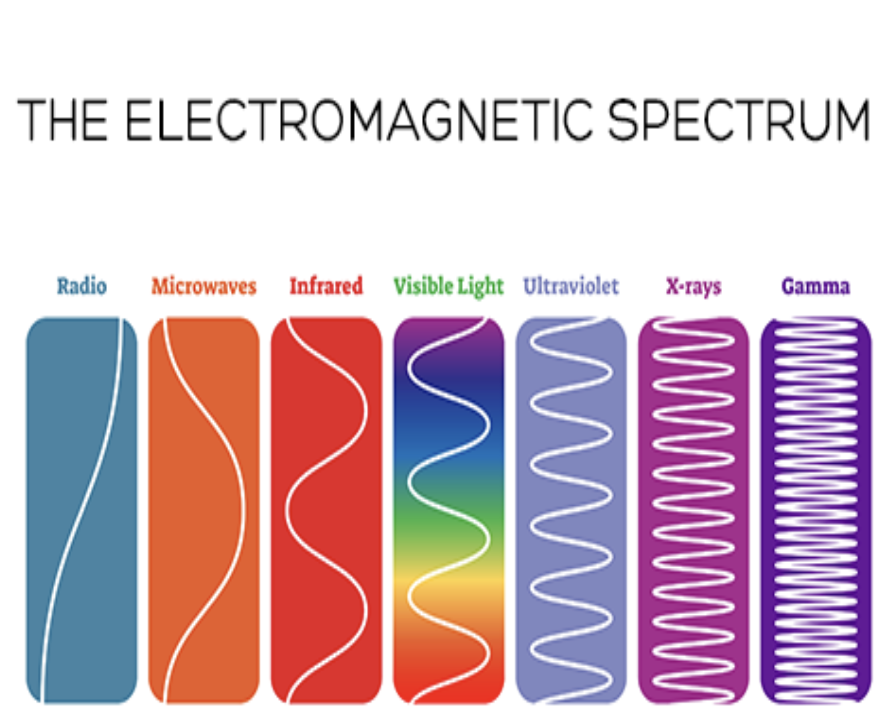
As you read words such as radio waves, infrared radiation and visible light, these are possibly absorbed by your body from warm objects near you. Your phone may also be getting X-rays.
Every Wi-Fi router sends data via microwave radiation, and every warm object in the room is emitting either radio, infrared, or visible light radiation.
Electromagnetic waves are all around you and make up the light spectrum. Electromagnetic waves consist of the same components, all while differing in frequency and/or wavelength.
Electromagnetic waves are transverse waves made of oscillating electric and magnetic fields.
In these waves, the electric and magnetic components are perpendicular to one another as well as to the direction of the wave components.
Electromagnetic waves can travel through a vacuum because they do not need a medium. This is why we can see sunlight and starlight even though they travel through billions of kilometers of empty space.
All waves in a vacuum travel as fast as one another, and this speed is a universal constant.
Photons in a vacuum travel at a speed of c = 3 × 10⁸ m/s, and this speed is true for both light and all other electromagnetic waves.
However, when electromagnetic waves travel through mediums, such as water or glass, their speeds are reduced.
Electromagnetic waves are classified into categories based on their frequencies, and the collective range of these waves is called the electromagnetic spectrum.
The waves range from very low frequencies, such as radio waves, to high frequencies, such as gamma rays. The frequencies that fall in between include microwave, infrared, and ultraviolet.
Radio waves occupy the lowest frequency of all electromagnetic waves, and they have the largest wavelengths, which range between 1 mm to hundreds of kilometers.
Furthermore, radio waves carry the least amount of energy in a photon compared to all other types of electromagnetic waves.
Applications: Radio waves are utilized in broadcasting such as AM and FM stations, as well as television transmission, and aid in communication with airplanes and ships. They can diffract easily around hills and buildings, thus they can transmit signals to areas with no direct line of sight to the transmitter.
Microwaves have a wavelength ranging from 1mm to 1 meter. They are utilized in satellite communication, mobile phone networks, radar systems, and are the reason microwave ovens are made.
In microwave ovens, waves cause water molecules to rapidly and continuously vibrate and rotate, so the food is heated throughout, and not only at the surface. This improves the speed at which food is heated relative to traditional ovens.
Microwave signals are utilized in radar systems to identify weather systems as well as ships and aircraft. A pulse is sent and reflects off the target. The time it takes to come back and the direction it is coming from indicate how far the target is and its exact coordinates.
Infrared cameras find their application in hospitals for finding inflammations in patients' bodies, also used in fire rescue missions to find people trapped under piles of rubble, as well as in building surveys to assess insulation and find unexplained heat loss.
Infrared waves are located just behind the visible red light range, having wavelengths of 700nm to 1mm. TV remote controls send and receive signals by using near-infrared. Like in the case of TV remotes, infrared technology is used in fire detectors.
Visible light is that part of the light spectrum that has wavelengths, ranging from about 400 to about 700 nanometers, that the human eye can detect. The full electromagnetic spectrum offers more options but visible light represents a small portion of it.
Each of the wavelengths corresponds to a certain frequency. The frequency is highest for violet light and lowest for red light. The components of white light can be separated by prisms and water drops to form rainbows.
All optical devices such as cameras, microscopes and projectors depend on visible light. Basically, the whole of the optics and the field of fiber optic communications as well as photography depend on visible light.
Ultraviolet waves are electromagnetic waves with shorter wavelengths than visible light. Their wavelengths vary from approximately 10nm to 400nm which means they have higher frequencies. Higher frequencies means more energy per photon.
Large amounts of ultraviolet radiation are emitted by the Sun. The radiation is partially trapped by the ozone layer. However, enough UV light gets to the surface to cause sunburn, damaging DNA in skin cells which in turn increases skin cancer risk.
UV exposure can also cause the skin to produce Vitamin D. Production of Vitamin D is necessary for the health of the bones. UV light is also important in the sterilization of medical equipment and in the treatment of water to kill bacteria and viruses.
The security features of bank notes also glow under UV light. Such bank notes are made with special inks that absorb UV light and emit visible light.
X-rays have higher frequencies than UV light. Their wavelengths are shorter than those of UV light and range from about 0.01nm to 10nm. Due to the high energy that these waves carry, they can penetrate soft tissue but are also absorbed by more dense materials.
The characteristic of X-rays described above is also utilized in medical x-ray imaging. X-rays traverse the body to either a detector or to a piece of photographic film. More X-rays are absorbed by bones and teeth, so they become lighter on the image.
Rotating x-ray beams are used in CT (computed tomography) scans to show detailed 3D images of internal anatomy by providing cross-sectional images of the body. X-rays are also employed in airport security scanners to see the contents of baggage, in the inspection of welds and castings, and in crystallography.
Of all electromagnetic radiation, Gamma rays exhibit the shortest wavelengths and highest frequencies. Their wavelengths are less than 0.01 nm. They are highly penetrating and possess great energy, which helps them in passing through several materials and also causes ionization of the atoms that they collide with.
Gamma rays originate from nuclear reactions and radioactive decay. In medicine, they find application in the focused beam method of gamma-ray irradiation to destroy tumours, and in the sterilization of surgical instruments and food, since they eliminate germs and viruses.
Gamma-ray emissions in nuclear medicine use gamma-emitting radioactive tracers. These tracers are injected into patients, and images of the organs are captured from outside the body to view the function of the organs.
In PET scanners, radioactive tracers are used, and gamma rays are emitted from these tracers to capture images of the brain and other organs to assess their metabolic activity.
All forms of electromagnetic waves have the same speed approximately 3 × 10⁸ m/s in a vacuum.
They also:
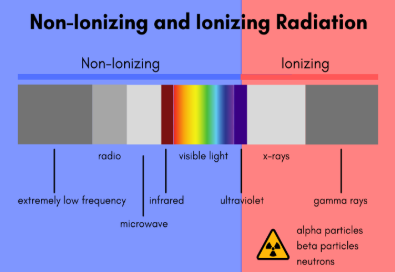
By energy, the electromagnetic spectrum is divided into ionizing and non-ionizing radiation.
Ionizing radiation includes UV rays, X rays, and gamma rays. They possess a high level of energy sufficient to detach electrons from atoms. This is the reason why excessive exposure to these rays is damaging to biological molecules, as it causes even DNA damage.
Non-ionizing radiation, which includes radio waves, microwaves, infrared, and visible light, impacts atoms and does not cause ionization.
These types of radiation are considered to be less dangerous, although high-strength microwave and infrared radiation has the potential to cause heating injuries to body tissues.
Humanity primarily uses the electromagnetic spectrum to navigate, visualize, communicate and comprehend the cosmos. With the help of radio telescopes, we can photograph remote galaxies. Earth's surface temperature is calculated by infrared satellites.
The violent activities of black holes are revealed by x-ray observatories. Medical imaging utilizes all of the above and saves countless lives.
The electromagnetic spectrum consists of different waves, from radio waves to gamma rays, which all derive from the same fundamental phenomena, differentiated by energy and frequency.