

On this page:
Introduction How are electricity and magnetism related? Magnetic Fields Around a Current-Carrying Wire Solenoid Fleming's Left-Hand Rule Magnetic Fields and Current-Carrying Wires Electric Motors Electromagnetic Induction Faraday's Law Lenz's Law A Generator Transformers The Importance of This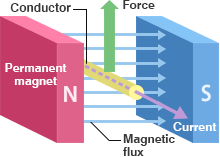
Real-life examples of the laws of electromagnetism, generators, different types of motors, and transformers are simply explained for MYP students. Faraday's law and Lenz's law are presented as well.
When was the last time you charged your phone? Or even on your ceiling fan? Invisible electromagnetic force is 'working' while you do all of the above.
No, it is not magic. It is physics.
Electricity and magnetism can be looked at as two different things. But they are two sides of the same coin. And once you see that, you will be looking at the world differently.
For decades, electricity and magnetism were treated independently, like two different things. That was until Ørsted Hans, in 1820, while experimenting, reported that a compass deflects in the presence of a current-carrying wire.
That single observation changed the world.
It demonstrated that an electric current generates a magnetic field. If a charge is 'moving', it causes magnetism. Later on, Michael Faraday expanded this idea. He posed an interesting question: if creating electricity causes magnetism, then will magnetism cause electricity?
Yes, yes, it will. This discovery powered nearly all the electrical technology we use today.
As electric current flows through a wire, circular magnetic fields are created around the wire. The fields wrap around the wire in a series of invisibly expanding circles.
The fields are aligned in accordance with the Right-Hand Thumb Rule. If you were to point your thumb in the direction of the current, your fingers would curl in the direction of the fields.
When you wrap a wire into a coil, this coil is called a solenoid. The fields from each loop combine, creating a strong and uniform field that runs through the center just like a bar magnet with a north pole on one end and a south pole on the other.
This is how you create an electromagnet. Unlike other permanent magnets, electromagnets can be turned on and off just by controlling the current flowing through them. This is one of the many reasons they are incredibly useful in machines, hospital equipment, and scrap yards.
Now things are getting interesting. Wires with electric currents in them are placed in an external magnetic field, and they are forced to move. This is also how electric motors work.
To find out the direction of the force, you can use an experiment called Fleming's Left-Hand Rule.
To do Fleming's Left-Hand Rule, you will need to put out your left hand in a fist, and then have your thumb, index finger, and middle finger pointing in different directions.
In this scenario, the index finger is going to point in the direction of the magnetic field, the middle finger is going to point in the direction of the current, and the thumb is going to point in the direction of the force on the conductor.
For this experiment, the force is going to depend on the strength of the magnetic field, the size of the current, and the length of the wire segment that is inside the field. If you have a stronger field, a bigger current, or a longer wire, then the force is going to be increased.
Electric motors use the force on a current-carrying conductor in a magnetic field to do work. This situation can be described as an electric motor converting electrical energy to mechanical (kinetic) energy.
Inside a basic motor, there is a rectangular coil of wire positioned between two magnets. When electricity current goes through a coil, one of its sides gets pushed up, while the other gets pushed down. This creates enough of a turning motion to allow the coil to rotate.
A split-ring commutator switches the current direction every half turn, meaning the coil will keep spinning in one direction, instead of rocking back and forth.
There are motors in every tool we use, such as drill machines, blenders, electric cars, washing machines, and fans.
Let's completely change the perspective on the topic.
Faraday realized that when a magnetic field changes around a coil, a voltage is generated in that coil. If the coil is within a closed circuit, the generated voltage results in a current flow.
This is referred to as electromagnetic induction, and the voltage generated is called induced electromotive force (EMF).
A magnetic field that remains the same = no activity.
In order to induce an electric current, the magnetic field that is within the coil needs to be altered, either through repositioning the coil or the magnet or through altering the strength of the magnetic field.
The more quickly you move a magnet through a coil of wire, the greater the voltage is produced in the coil; however, pulling the magnet out of the coil will cause it to deflect in the opposite direction.
This principle of inducing voltage is the basis of how electricity is generated in your home. This principle is what Faraday's law describes.
Faraday described his discovery in a clear law:
The magnitude of the induced EMF in a coil is directly proportional to the rate of change of magnetic flux through the coil.
This means that if you change the magnetic field quickly, you will induce more voltage in the coil, and if the coil has more turns, the more voltage it will have. Each loop will cause its own EMF to be induced. Now, because of Faraday's law, we have Lenz's law.
Lenz's Law tells us about the direction of the induced current.
The induced current always flows in a direction such that it opposes the change that caused it.
When a magnet is moved towards a coil, the coil generates a current that creates a magnetic field that pushes the magnet away. Conversely, if the magnet is moved away, the current from the coil generates a magnetic field that tries to pull the magnet back.
When you move the magnet, the energy used to do that work gets converted into electrical energy by the coil. Essentially, you are losing energy and gaining electrical energy in the coil.
A generator is basically an electric motor used in the opposite way. Instead of using electricity to create movement (like the motor), a generator is used to create electricity.
In a generator, a coil is placed in a magnetic field and is allowed to rotate. As the coil spins (based on the ellipse), electricity is generated. Because of this, generators produce alternating current (or AC).
In wind farms, hydroelectric plants, and fossil fuel power plants, this same principle is used. The source of energy used is different, but the principle of electromagnetic induction is always the same.
Transformers are devices that can increase or decrease the voltage of an alternating current using electromagnetic induction.
This is made up of two coils,
When a primary coil has current passing through it, a magnetic field is created. This created magnetic field is what induces a voltage through the secondary coil.
The number of coils and the input and output voltage produce different ratios:
For a step-up transformer, the secondary coil has more turns and is able to produce a larger voltage, but for a step-down transformer, the secondary coil has fewer turns and is able to produce a smaller voltage.
A transformer can only transform an alternating current. This is because a direct current provides a constant magnetic field and won't induce any voltage. This is because there is no changing magnetic field.
Because current in the wire generates heat, it is preferable to use high voltage to transmit power over long distances. This is what step-up transformers do. They send power and reduce the voltage so that it is low enough to be used in homes and schools.
When using electricity, the process of electromagnetic induction occurs on the way to you. From the power station generators to street transformers to the motors in your appliances, they all use the same physics principles Faraday learned in his lab with a coil and a magnet.
Knowing and understanding the principles of electromagnetic fields and induction is more than just understanding to pass your exam. It shows you the technology that understands modern society.