

On this page:
Introduction What Is a Field? Electric Fields Like charges repel, opposite attract Where Do Charges Come From? Electric Field Lines Strength of Electric Fields Conductors and Insulators Magnetic Fields Magnetic Poles Magnetic Field Lines Earth's Magnetic Field Electricity and Magnetism Making Baby Electromagnets The Uses of Electromagnets What is Motor Effect? Electromagnetic Induction Why This All Matters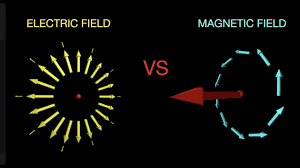
Have you ever thought of how sticking a magnet to your fridge makes them stick? Or how pulling a sweater off makes your hair stand up? These things aren't magic - they are powerful electric and magnetic forces! Today we are going to explore these things a little more to see how they are done.
Fields are very important in physics. But first, we need to understand what a field is.
A field is a part of a given space that exerts influence on an object without direct contact. Instead of physically pushing something with your hand, a field can push or pull objects without contact.
This can feel very strange. Invisible things working to move an object? It sounds a little wacky. But imagine the force of gravity. Gravity isn't something you can see. But it still holds you to the ground. Fields work the same way.
When an object is charged, an electric field is formed, and it can be felt by other charged objects. Electric fields can be formed by positive and negative charges.
For an easier understanding, there is a straightforward rule that covers almost everything in electricity:
Like charges repel. Opposite charges attract.
With this, two charges that are positive will push each other away, but a positive and a negative charge will pull each other in.
In every atom, there are both negative and positive kinds of charges. The nucleus is positive and is called protons and the electrons that orbit the nucleus are negative. Atoms are usually balanced, but things can happen that will result in an imbalance.
For example, an object can become negatively charged and another object can become positively charged if electrons move from one object to another. This is what is happening when you rub a balloon on your hair.
When the electrons move to the balloon, it will go negative while the hair will be positive. That is the reason why your hair will attract the balloon.
Scientists use some lines to visualize electric fields. They use field lines to visualize and show electric fields, and show the direction of the force of a positive charge in that field.
The same rules apply to drawing electric fields. Lines begin at positive charges and end at negative charges. The closer the lines are to each other, the stronger the field. The more spread apart the lines are, the weaker the surrounding field is. Lines never cross.
From a single positive charge, there are lines going out in every direction, like a star. A single negative charge will have lines going in from every direction.
Electric field strength shows how strong the field is at a certain part of the field. It is defined as the force felt divided by the amount of positive charge at that same part.
The equation used to describe electric field strength is:
Electric field strength (E) is measured in newtons per coulomb (N/C), F is measured in newtons, and q is measured in coulombs.
The stronger the field, the more charges will feel the force and move inside the field.
Materials that allow electric charges to move freely are called conductors. Copper and aluminium, which are metals, are good conductors because the outer electrons of metals can move freely.
Non-conductors are what the other materials are called. They include rubber, plastic, and glass. That is why electrical wires consist of copper and are plastic covered. The plastic covering keeps you safe from the electric current in the copper wire.
A region in which magnetic forces can be felt is called a magnetic field. This region can be around a magnet, or it can be created by a moving electric charge.
Every magnet has two poles, namely the north and the south pole. The rules guiding magnetic poles are similar to those guiding electric charges.
Similar poles repel. Dissimilar poles attract.
Two north poles or two south poles repel each other. A north pole and a south pole magnet attract each other.
Just like electric fields, magnetic fields can be visualized using field lines, except this time, the lines are formed in closed loops. The field lines come out of the north pole of the magnet, travel around the external part of the magnet, and re-enter the south pole. Once inside the magnet, the field lines continue from south to north, completing the loop.
Once again, the area where the lines are closest to each other indicates a stronger magnetic field. The strongest parts of a bar magnet are found near both poles.
Earth is quite literally a giant magnet. As a result of Earth's molten iron core, a magnetic field is created and is present all around Earth. Earth's magnetic field is what causes compass needles to point north. In reality, the compass is pointing to Earth's magnetic south which is located near the Earth's geographic north.
Electric and magnetic fields go hand in hand. When an electric charge moves, a magnetic field is created around the charge. This occurs in a charged wire. A magnetic field is created around the wire. This phenomenon is called electromagnetism.
Making an electromagnet is simple. You can use a battery, a piece of wire, and an iron (or steel) nail. If you wrap the wire around the nail and connect the wire to the battery, a magnetic field is created around the nail, and the nail becomes magnetized. Once the wire is disconnected from the battery, the field collapses, and the nail is no longer a magnet.
Since electromagnets can be easily controlled, they have many uses. The most simple and common application of an electromagnet is in scrapyard cranes. The crane uses an electromagnet to grab and lift heavy metal pieces. The operator can easily grab and drop the pieces by turning the electromagnet on or off.
The Motor Effect is the phenomenon responsible for the operation of an electric motor. Electric motors can be found in everyday appliances such as fans, cars, and washing machines. The Motor Effect is a phenomenon whereby every wire carrying current is subjected to a magnetic field. The magnetic field will exert a force on the wire in a direction depending on the force exerted on the current and the magnetic field.
The opposite phenomenon also exists. Wires can create a current by either moving through a magnetic field or by having a magnetic field move around the wire. This phenomenon is called electromagnetic induction and is the principle by which power stations and generators create electricity.
As a result, electricity used by motors is transformed into physical movement, while generators perform the opposite operation and transform physical movement into electricity, using the same principle of operation.
The use of electric and magnetic fields is not limited to the textbook. The technology behind your smartphone, your speakers, the MRI scan in the hospital, and the power stations that deliver electricity to your home rely on electric and magnetic fields. Once you realize that these invisible fields contain true power, the technology around you will make a lot of sense.