

On this page:
Introduction The Formula of Density The Formula Intuitively Composition and Structure Densities of Common Materials How to Find Volume Density and Floating or Sinking Why Ships Float Layering and Density of Liquids Temperature Affects Density Understanding Density in Technology and Daily Life Why should we care about density in the first place?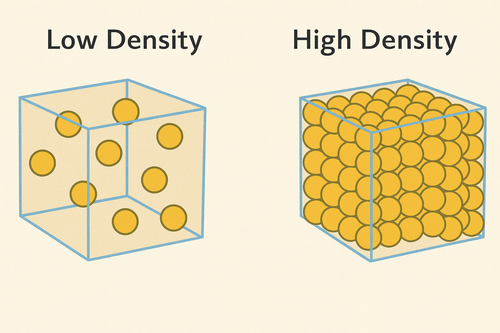
You may have picked up a small rock and noticed that it is heavier than a big piece of foam. This difference in feeling is a result of thinking about one thing - density.
Density gives us an idea of how much mass is present in a given volume. In other words, it is a measurement of how closely packed the particles of a given material are. If lots of particles are in a small volume, then the material has high density. If the particles are spread out and lie loosely in a large volume, then that material has low density.
To visualize this, think of two boxes of the same size. One is filled with sand, and the other is filled with air. The box filled with sand will feel heavier. This is because the sand has more matter in it than the air in the same volume. So, sand is denser than air.
This simple concept is what makes ships float, why oil is able to float on water, why hot air balloons rise, why you sink in water, and why corks float. Density can be found almost everywhere.
To determine density, you need the following equation:
Or in symbols:
Where:
Density is usually expressed in SI units kg/m³; however, in practical situations, you will also come across g/cm³, particularly when you are dealing with a smaller object in the lab.
Also, remember that 1 g/cm³ is equal to 1000 kg/m³.
Before we calculate, let us build intuition first.
So mass and volume work together when it comes to density. You need to have both to determine density, and you also need to have both to determine mass and volume; one alone is not enough.
Different materials have different densities. Here are some values worth knowing:
Before using the density formula, you need to find the volume of the object. The way you find volume depends on the shape of the object.
If the object is a solid shape like a cube, rectangular block, or cylinder, you can use a formula from geometry.
For solid shapes that have no formula, a technique called water displacement can be used. First, you partially fill a measuring cylinder with water and note the volume. Then, gently lower the solid shape into the water and note the new volume reading. The difference between the two readings is the volume of the object. This technique was used by Archimedes many years ago. It is still used today.
The most common use of density is to determine whether something will float or sink in a liquid.
Objects that float in a liquid are less dense than that liquid. Objects that sink in a liquid are denser than that liquid.
The density of most wood is lower than that of water (1 g/cm³). So, a wooden block will float. Steel nails sink because steel is denser than water.
But a steel ship can float. A block of steel would sink because steel is denser than water, but that's not true for a ship. A ship is not a solid block of steel, but a hollow structure. So, when you take the total mass of the ship and divide it by the total volume it occupies, including the hollow interior containing air, the average density of the whole ship is less than that of water. That is why it floats.
The average density of a given structure shows that design, shape, and construction are just as important as the raw materials used to create it.
When liquids are mixed, the different densities of the individual liquids cause the liquids to separate into layers. The liquids separate from least to most dense, meaning the least dense liquid goes to the top. The most dense liquid sinks to the bottom.
A common observation of this phenomenon is the mixture of oil and water. Water has a density of 1 g/cm³, and oil is between 0.8 and 0.9 g/cm³. This means that, because oil is less dense, it will float on top of water. This is also the reason why cooking oil sits on top of your salad dressing and why oil spills float on top of the water.
If you take a glass and pour in honey, water, and cooking oil, you will see three distinct layers. The honey will be at the bottom, because it is the most dense of the three liquids. The water will be in the middle, and the oil will be on top.
The density of a substance is greatly affected by temperature and is not always a fixed value. When the temperature of most substances is increased, the individual particles are heated. This causes the particles to move faster and to spread further apart. The result is an increase in volume while there is no change to the mass of the substance. Because density is defined as mass divided by volume, an increase in volume will result in a decrease in density. It is true for most substances that heating causes the substance to be less dense.
When substances are cooled, particles slow down and pack closer together. This causes the volume to decrease and density to increase. Therefore, cooling generally increases the density of substances.
However, the cooling of substances does not apply to the cooling of water. Water is the only substance that actually expands rather than contracts when transitioning from its liquid to solid state. This means that ice is less dense than liquid water because ice takes up more volume than the same mass of liquid water.
The above statement is a representation of the behavior of density altering with temperature. This is the reason why ocean currents are a thing, why lava lamps operate in the manner that they do, and why warm air rises while cool air sinks.
The understanding of density is more than just an exercise in academia. It is something that engineers use every time. In construction and building, the choice of materials depends on their densities. Aluminum, for instance, is used in the manufacture of aircraft because it is strong yet relatively low in density. This makes it possible for the aircraft to weigh less and to become more fuel efficient.
In medicine, the use of density differences is found in bone scanning techniques. The reason the bones of a patient appear different in an X-ray is that bone is denser than the surrounding soft tissue.
Geologists have structured the layers of the Earth according to the materials found in each layer. For example, the core of the Earth is composed of metals, mostly iron and nickel. These materials are the densest, and, during the formation of the Earth, the core formed as these materials sank to the center. The crust is made of lighter materials such as silicate rocks. The entire structure of the Earth demonstrates the concept of density.
Even in the kitchen, density proves to be important. Baking is more of a science than cooking, and an understanding of density is critical to the process. Each ingredient has a unique density, and the way its molecules change based on applied heat can change the entire structure of the baked good.
Though the three components of density are mass, volume, and, of course, it is a clean relationship, it is a powerful tool for the scientist. In the field, it is used to identify unknown materials. Density explains the behavior of liquids in motion and also the weather. The design of buildings and machines is based on an understanding of density.
The study of density is a precursor to understanding larger concepts such as fluid pressure, buoyant forces, and material science. The more comfortable you get with density, the more you will realize the interrelation of the concepts in physics.
It is one of the foundational ideas that quietly shows up everywhere, once you know how to look for it.