

On this page:
Introduction Electric Current Current Formula Types of Current Voltage Resistance Ohm's Law Power Power Formula Energy Formula How each concept connects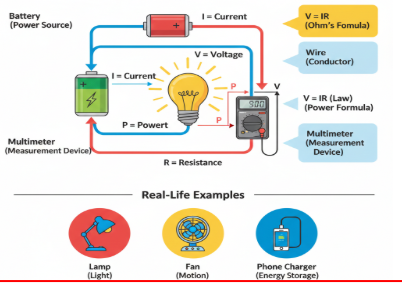
Electricity Is Everywhere
As you read this, your device is using electricity. Your phone is charging, your fan is spinning, your lights are turning on. All of this is due to three things. Current, voltage, and power. These words are not just in textbooks. They describe situations happening all around you, all the time. When you learn about these concepts, you will look at wall sockets differently.
Picture a wire as a pipe, and electricity as the water flowing through the pipe. As the water flows through the pipe, there is a flow of electric charge through the wire. This flow of electric charge is called electric current.
Electric current is the flow of electric charge through a conductor over a period of time. The charges that move in a metal wire are called electrons. Electrons carry a negative charge, and when they move in a single direction, the current flows.
The symbol for current is I, and the international standard unit is called the ampere, which is abbreviated to A. It is named after the French scientist André-Marie Ampère.
The relationship between current, charge, and time is expressed in the following equation:
In this equation:
This means that if 10 coulombs of charge pass through a wire in 5 seconds, the current would be 10 ÷ 5 = 2 A. That's pretty simple to figure out, right?
Here's a little trivia: In real wires, electrons move from the negative side of the battery to the positive side, and instead of saying current moves from the positive side to the negative side, we say it moves from positive to negative.
This is what is known as conventional current direction, and it is the direction we use to represent current in circuit diagrams.
Not all current flows in the same way, and there are two types of current:
Let's think about two connected water tanks; if one is higher than the other, the water will flow from the higher to the lower one, and that is what drives the flow. In electricity, what drives the current is called the voltage.
Voltage is the difference in electric potential between two points in a circuit. In simple terms, it is what causes the flow of electric charges in a circuit. In the absence of a voltage, there is no reason to move the charges.
The SI unit of voltage is the volt, which is abbreviated as V. It is named after the Italian scientist Alessandro Volta.
When the voltage produced by a battery or other device is called electromotive force (EMF). When talking about a circuit, there is a potential difference (PD). Both of these terms are measured in volts.
For example, an AA battery has a voltage of 1.5 V. The output from a phone charger is approximately 5 V. Depending on the country, the main electricity in your house has a voltage of about 220 - 240 V.
If the voltage in a circuit is increased, it means that more energy is given to the charges, and more force is given to the current to flow through the circuit.
Resistance is why we cannot have unlimited current flow.
As charges pass through a wire, the wire itself offers resistance to charge movement, and this obstruction is called resistance.
Resistance is symbolized by R and is measured in ohms (Ω).
A thin wire has more resistance than a thick wire, and a longer wire has more resistance than a shorter wire. Copper is used to make wires because it has a very low resistance. In contrast, the rubber used to insulate wires is very high in resistance.
Ohm's Law shows how current, voltage, and resistance relate to each other.
This shows that:
If the resistance is 10 Ω for the bulb and I connect the bulb to a 20 V source, then the current flowing is: I = V ÷ R = 20 ÷ 10 = 2 A.
Some devices use more electrical energy, like a microwave, which heats food faster than a small night lamp. This is because it has more power than the night lamp.
In a circuit, electrical power is how quickly a device uses energy. It is represented by P. It is measured in watts (W). This unit is named after James Watt.
Electric power can be calculated using the following equation:
Where:
In this case, the device operates at 12 V, which means the power consumed is: P = 12 × 3 = 36 W
By Ohm's law, we can also express power in two other forms:
All three formulas provide the power; you can pick any based on other values available.
Power and energy are linked. Power indicates the rate at which energy is consumed. Energy indicates the total amount consumed.
The formula to find the energy consumed by an appliance is shown below:
Where:
An example: At home, energy used by devices is measured in kilowatt-hour (kWh) on your energy bill. One kilowatt-hour represents a 1000 W (1 kW) appliance working for 1 hour. As your appliances and devices consume more kWh, your bill will be higher.
The four terms: current, voltage, resistance, and power are all parts of the same concept.
If a light bulb is rated 60 W and is connected to 240 V, it means that the bulb is drawing a current of 60 ÷ 240 = 0.25 A and it has a resistance of 240 ÷ 0.25 = 960 Ω.
Everything is interlinked, and you can use the same equations for each value.
These three concepts are the basis of everything in electricity. Whether it is designing safe circuits, overloading sockets that can start a fire, or energy-efficient devices that save you money as well as the planet.