
On this page:
Introduction States of Matter What is Evaporation? Factors Affecting Evaporation Evaporation Causes Cooling What is Condensation? Examples of Condensation Boiling vs Evaporation The Water Cycle Latent HeatLet's say you grab a cold glass of water on a hot day and walk outside with it. You'll notice that after a few minutes, little water droplets cover the outside of the glass. You clearly didn't pour water on the glass, and no one splashed it. How did they get there?
Now consider the situation with wet clothes. After a few hours, if all goes to plan, the clothes are finally dry. The water you see on the clothes didn't drain away, it all just somehow disappeared. How did that happen?
Both of these examples in everyday life, explains the two processes called evaporation and condensation. You can consider these processes as two sides of the same coin. They also show us the way in which energy travels and how we can harness it in the environment around us.
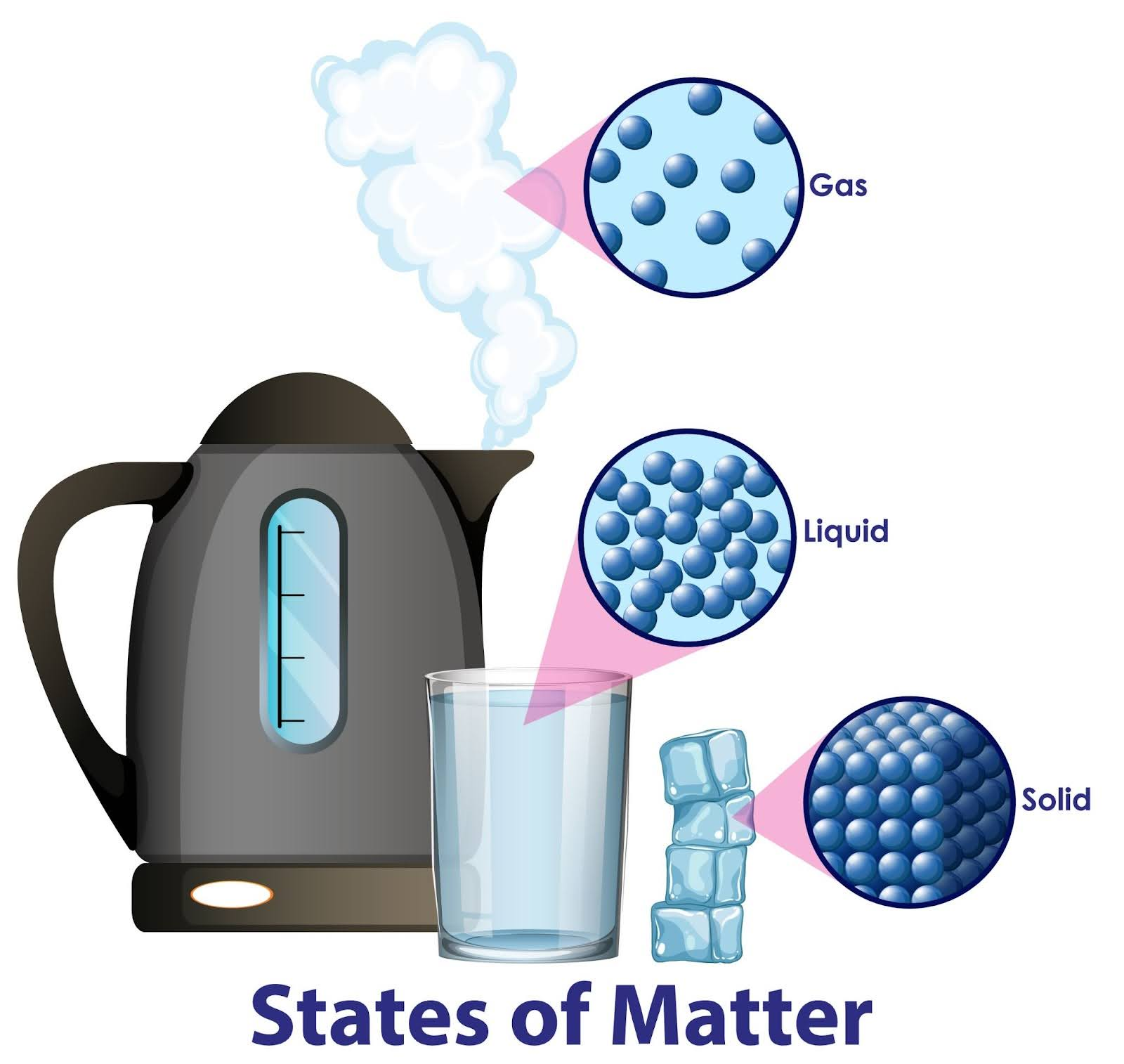
Matter exists in three common states: solid, liquid, and gas. The difference between them comes down to how much energy the particles have and how they are arranged.
Changing states means crossing the boundary between these arrangements, and that always involves energy.
Evaporation is a process by which a liquid changes into a gas at a temperature below its boiling point, from the surface of the liquid.
This last detail is important. Evaporation occurs only at the surface, and can occur at any temperature, even one below the boiling point.
This is because in a liquid, the particles do not all move at the same speed. While most of the particles may be moving at a relatively slow speed, if a particle is near the surface of the liquid, and is moving quickly enough, it can escape from the liquid and become a gas.
There are several different factors that influence the speed of evaporation.
The rate of evaporation largely depends on the temperature of the liquid. Higher temperatures provide more energy to more particles so more of them will escape.
Example: Wet clothes will dry more quickly on a warm day than a cool day.
The area of the liquid surface also affects the rate of evaporation. A larger area will lead to a more rapid rate of evaporation.
Example: A large puddle will evaporate more quickly than a similarly volumed, deep, narrow container.
The humidity of the air surrounding the liquid also affects the rate of evaporation. If the air above the liquid is saturated with water vapor, evaporation will occur at a reduced rate because less water vapor can evaporate into the air.
Cooling is one of the more significant consequences of evaporation and it carries real physical significance.
When the most energetic and fast-moving particles escape from a liquid, the average energy of the remaining particles decreases. This decrease in average energy also decreases in temperature.
This is also the principle used by refrigerators and ACs, where the heat absorbing refrigerant liquid is introduced into the cooling unit and it evaporates, absorbing heat from the environment.
Condensation is the process by which a gas changes into a liquid when it loses enough energy. This is called condensation. It is the opposite of evaporation.
A cold drink, the cold mirror after a hot shower, or even the cold grass in the morning can easily demonstrate condensation. The water vapor in the air is liquid.
The dew point is the temperature to which a given mass of air containing water vapor must be cooled in order for water vapor to condense into liquid water. When the air is cooled to the dew point, condensation occurs.
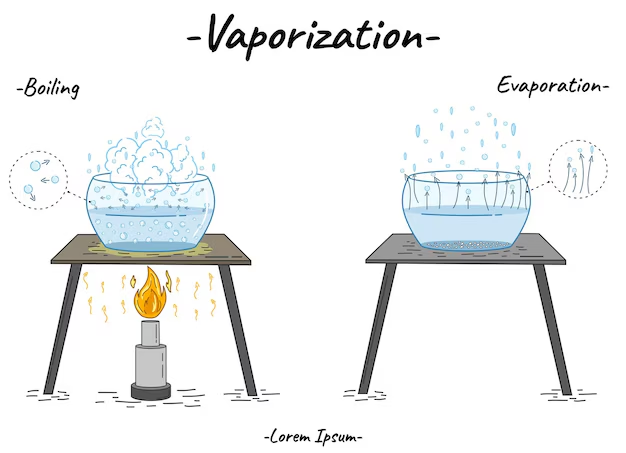
Most students will mistake boiling and evaporation for the same process. While they are related to one another, they are two different processes.
When water is boiling, you can see bubbles on the surface of the liquid. These bubbles are called vapors, and they are formed from the liquid below the surface, not at the surface of the liquid.
Although both processes involve changing a material from liquid state to a gaseous state, the mechanisms and the conditions differ.
The sun's energy heats water in the oceans, rivers, and lakes and changes it into water vapor. This vapor rises into the atmosphere and cools. Once the water vapor cools, it condenses, and forms clouds.
When condensation reaches a certain threshold, it results in precipitation in the form of rain or snow. This water then returns to the oceans and the cycle continues.
When a substance changes state, it absorbs or releases energy without changing temperature. This process is called Latent Heat.
The latent heat of vaporization is the energy required to change a liquid to a gas at a constant temperature of 1 kg.
Q = m × L
Q = energy (Joules)
m = mass (kg)
L = latent heat (J/kg)
Example: When water evaporates from your skin, it absorbs latent heat from your body, which is why you feel cool.
Example: When steam condenses on your skin, it releases latent heat, which is why steam burns are so severe.