
Everything around us is made of atoms. The air you are breathing, the water in the glass next to you, and the seat is made of atoms in different arrangements.
For most of human history, it was believed that the atom was the smallest thing possible. The word comes from the word indivisible. The Greek word atomos, meaning uncuttable.
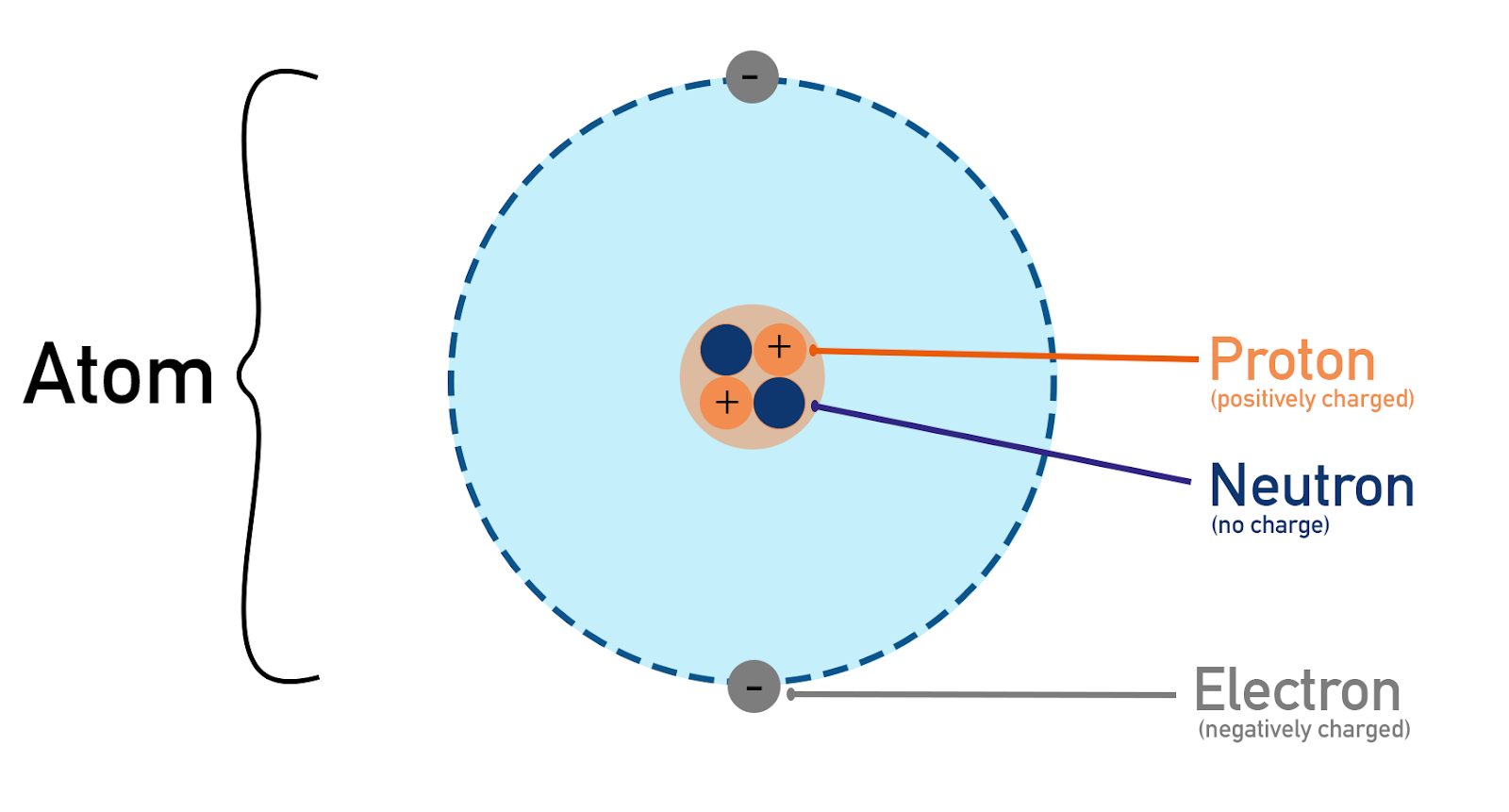
An atom has 2 main parts: a tiny, dense central nucleus and a much larger region that surrounds it that contains the electrons.
Sitting at the very center of an atom is the nucleus, which is about 100,000 times smaller than the atom itself, but still contains almost all of the mass of the atom. For example, if an atom were the size of a football stadium, the nucleus would be the size of a marble.
The nucleus is surrounded by a cloud of electrons, which are arranged in a series of shells, forming energy levels at varying distances from the nucleus.
The volume occupied by these electrons is actually enormous relative to the volume of the nucleus, which means that most of an atom is just empty space.
Three of the most well known particles that exist in the atom are protons, neutrons, and electrons.
| Particle | Location | Charge | Relative Mass |
|---|---|---|---|
| Proton | Nucleus | +1 | 1 u |
| Neutron | Nucleus | 0 | 1 u |
| Electron | Orbitals/Shells | -1 | ~1/2000 u (≈0) |
Protons are located in the nucleus and are positively charged. In relative terms, the charge of a proton is +1 and in absolute terms, it is +1.6 × 10⁻¹⁹ coulombs. In terms of mass, a proton weighs about 1.673 × 10⁻²⁷ kg, which is given the relative mass of 1 atomic mass unit (u).
Neutrons, like protons, can be found in the nucleus of an atom. Since they do not carry any charge (neutral), they have a relative mass of 1 u, more or less similar to that of a proton.
Electrons orbit around the atom's nucleus in different energy levels (shells). An electron carries a negative charge of -1 (in relative terms). The mass of an electron is so small that it is often considered to be zero. For this reason, the relative mass of an electron is 1/2000, which is rounded to zero in many cases.
The number of protons in an atom is equal to the number of electrons. Since they carry opposing charges, the mass of the nucleus (positive charge) and the electrons surrounding it (negative charge) cancel out, allowing the atom to be neutral.
Atomic Number (Z) = number of protons found in a nucleus.
For carbon to be carbon, it must have 6 protons. For an atom to be gold, it must have 79 protons.
Mass Number (A) = total number of protons and neutrons present within the nucleus.
Since electrons possess an almost nonexistent mass, the mass number serves as a close approximation of the mass of the entire atom.
Number of protons = Z
Number of neutrons = A − Z
Number of electrons = Z (in a neutral atom)
All atoms are written in a nuclear notation as follows:
AZX
Where X denotes the chemical symbol, A denotes the mass number (in superscript) and Z denotes the atomic number (in subscript).
Example 1: Carbon-12 is written as 126C
This indicates: 6 protons, mass number 12, neutrons = 12 − 6 = 6, electrons = 6 (neutral atom)
Example 2: Uranium-235 is written as 23592U
This represents: 92 protons, neutrons = 235 − 92 = 143
Atoms of the same element have the same number of protons. Variants of the same element that differ in neutron quantity are termed isotopes.
All isotopes of an element have the same number of protons and electrons, giving them the same chemical properties. What changes is their mass and nuclear properties.
A neutral atom has an equal number of protons and electrons. Atoms can lose or gain electrons, forming charged particles called ions.
Formed when an atom loses electrons
More protons than electrons
Charge: +1, +2, or higher
Example: Na⁺, Ca²⁺
Formed when an atom gains electrons
More electrons than protons
Charge: -1, -2, or higher
Example: Cl⁻, O²⁻
Ions are critical in chemistry, electricity, and biology. For example, the functioning of the nervous system depends on the transport of sodium and potassium ions across cell membranes.
With the development of each successive model of the atom, experimental discoveries would overturn the preceding model.
Rutherford's Gold Foil Experiment: He fired alpha particles toward a thin sheet of gold. Most particles went straight through, but a small number were deflected, and some even came straight back. This proved that an atom contains mostly empty space with a small, dense, positively charged nucleus at the center.
The masses of atoms are so small that both chemists and physicists use relative atomic mass.
The standard is defined as one twelfth of the mass of a carbon-12 atom. On this scale, a single proton and a single neutron each have a relative mass of approximately 1.
For naturally occurring isotopes of an element, relative atomic mass is the weighted average of the isotopes present, according to the abundance of each isotope.
Example: Chlorine has two significant isotopes, chlorine-35 and chlorine-37, so the relative atomic mass is 35.5 as an average.
The nucleus contains many positive protons, so one would expect the nucleus to fly apart due to electromagnetic repulsion.
The strong nuclear force is the attractive force between protons and neutrons that is effective only at short ranges within the nucleus.
Because of the strong nuclear force, nearby nucleons overcome the electromagnetic repulsion and bind the nucleus together.
Atomic structure is the core of every discipline, including chemistry, nuclear physics, materials science, and medicine.
Every chemical reaction, every compound, every element's properties, along with the principles of nuclear power and medical imaging, are derived from the arrangement of neutrons, protons, and electrons inside an atom.
The knowledge of atomic structure is not a topic of physics alone — it is core knowledge of modern science.