

On this page:
Introduction What actually is current? DC Current Where does DC come from? Where is DC used? Representing DC on a graph Alternating Current (AC) The Origin of AC The AC Cycle What appliances use AC? Why is AC used for power plants? Power Transmission Process Differences Between AC and DC AC and its peak voltage and RMS voltage AC to DC – Rectification Safety Why This Matters in Physics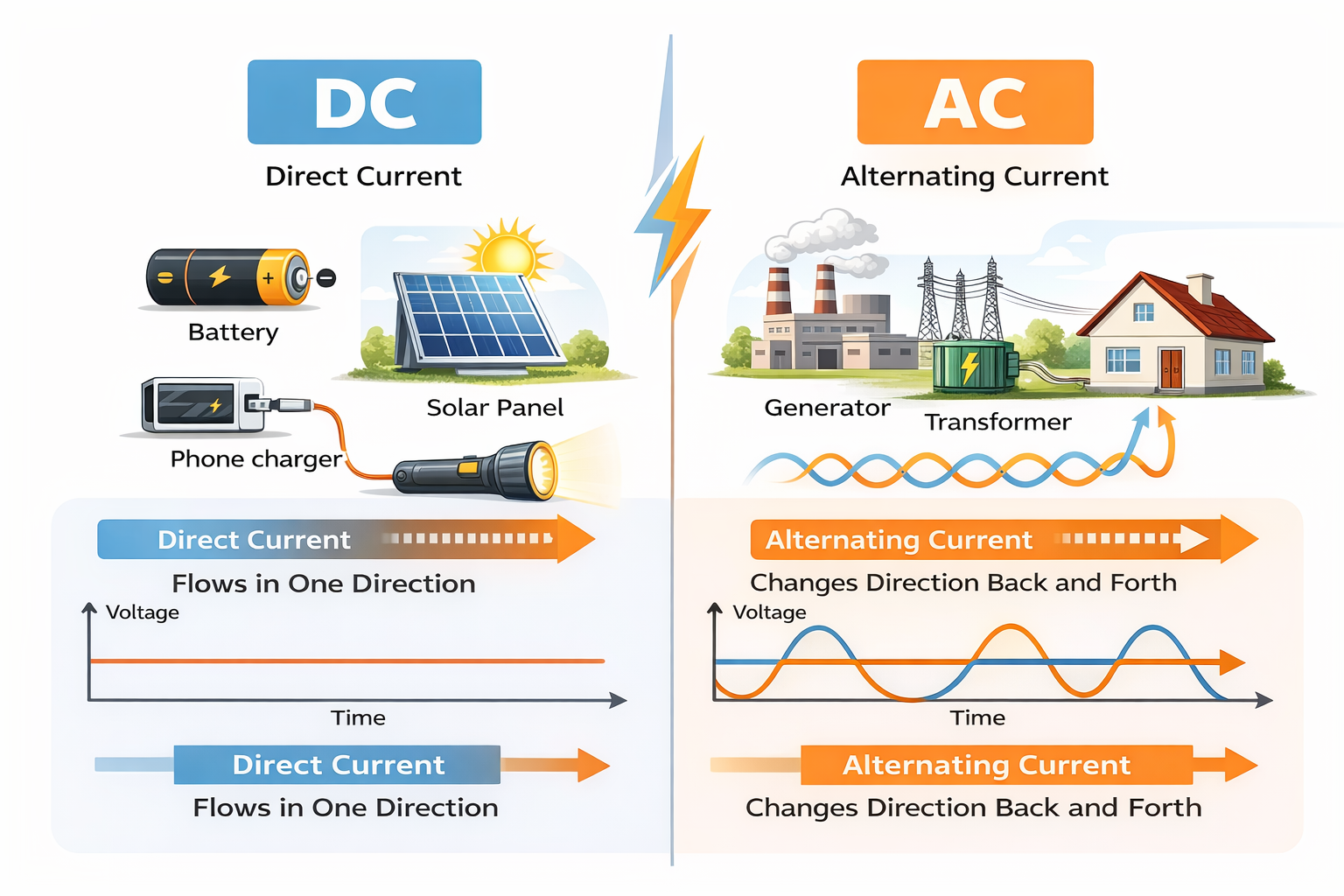
Most common AC and DC examples. AC charging your phone and DC turning on a torch. They power your devices; their function and purpose are quite different.
AC and DC explain how electric power is manufactured, distributed, and consumed in every school, home, and city.
Current is the flow of electric charge. It is the movement of electrons in a wire, and is only present when the flow of electrons is continuous.
Current is measured in amperes (A), using an ammeter.
AC is from the movement of electrons in one direction and back.
DC is when electrons are flowing in one direction.
Direct Current (DC) describes a steady flow of electric current in one direction along a conductor, meaning it doesn't change direction or flow backward.
A comparison to water flowing through a pipe helps illustrate this: if the water flows in one direction and never reverses, it behaves like a direct current. Similarly, electrons will always travel from the negative terminal of a battery, through a circuit, and return to the positive terminal. The direction always remains the same.
DC is sourced from batteries. It does not matter what type of battery it is (e.g., AA batteries used in remote controls, or the lithium batteries in mobile devices) - they all release current in one, unchanging direction.
DC can also be sourced from solar panels; they convert sunlight into DC.
DC is used in all portable electronic devices. The following devices utilize DC to help operate their internal circuits:
DC is needed for the internal circuitry of the devices to function correctly; they require a consistent voltage.
If a graph of voltage (y-axis) over time (x-axis) is used to represent DC, the result will be a horizontal, straight line.
AC - or alternating current - is a current that reverses its direction of flow at regular intervals or periodically. These currents do not go in just one direction but rather go back and forth numerous times in a single second.
This motion creates a wave pattern and draws a smooth and continuous sine wave that appears above and below zero on a graph.
AC is a direct product of generators that are in power stations. As a coil of wire rotates within a magnetic field of a generator, the flow of induced current continually reverses. This is called electromagnetic induction, which, in its nature, creates alternating current.
Frequency is the term used to denote the number of complete cycles in a given amount of time and is quantified in hertz (Hz).
All electrical devices are designed to operate at a given frequency; to ensure the effective use of the national grid, the frequency is kept at a very stable level.
Any appliances plugged into the wall typically use AC. This includes your refrigerator, washing machine, air conditioner, microwave, ceiling fan, and electric kettle.
Power plants transmit AC via the national electrical system to your home.
This is one of the most important questions in this topic, and the answer includes transformers.
Transformers are devices used to increase or decrease voltages. If you look closely, you'll find that the primary designer of all devices is AC case voltage. Since transformers work with AC, DC remains passive.
In high voltage transmission, all the current is capacitive, and therefore, there is an extreme reduction of energy. This is typically formulated as a power transmission equation, attributed to the Englishman Joule.
And energy transported = I²R. This shows that energy reduction down the wire is extreme.
Here is a summary of the process:
This whole system only works for AC current. If direct current (DC) was used, it would not be possible to use transformers. Additionally, it would be very inefficient to transmit electricity over long distances.
This is why the historical competition, known as the "War of Currents", was won by AC. The competition was between Nikola Tesla, who supported AC, and Thomas Edison, who supported DC. Tesla's AC system was indeed more practical for large-scale electricity distribution.
Because alternating current (AC) voltage is always changing, one must describe it using two different methods.
The two can be expressed as:
When your teacher or an electrician tells you the voltage of a household mains supply and tells you it is 230 V, they are referring to the RMS (Root Mean Square) value. Therefore, the peak voltage of that household supply is about 325 V.
Why do we need RMS values? Because, for AC circuits, power calculations require RMS values, not peak values.
While a lot of devices that plug into AC outlets run on AC, there are a number of devices that run on DC by converting AC into DC, like phone chargers for example. Rectification is the process of converting AC to DC.
This process of converting AC to DC is done by diodes, a component that allows current to only flow in one direction. By placing a number of diodes in a specific way to form a bridge rectifier, one can convert an AC waveform to a differing current flow, which is then smoothened to produce a constant DC output by the use of capacitors.
This is the reason why phone chargers are not a simple wire; they do the rectification and other circuitry in order to change the current flow.
The use of AC and DC current can be very dangerous. Even more so, the use of AC current at mains voltage is very dangerous because of the way they quickly alternate, and because of that, they could interfere with someone's heart rhythm, which would not be a problem with the same voltage on a DC current.
AC mains systems use proper insulation, earthing, fuses, and circuit breakers in order to keep the systems safe.
Knowing about AC and DC is connecting many important concepts of physics like electromagnetic induction, energy, power, voltage, and design of the circuit. Whenever you design a circuit, calculate electrical power, or describe a national grid, you rely on the difference between these two types of currents.