

On this page:
Introduction The Periodic Table as a System Periods: Rows of the Table Groups: Columns of Similar Behavior Significant Families of Elements Size Trends of Atoms Formation and Size of Ions Pattern of Electronegativity Metallic and Non-metallic Character Patterns of Reactivity Importance in Chemistry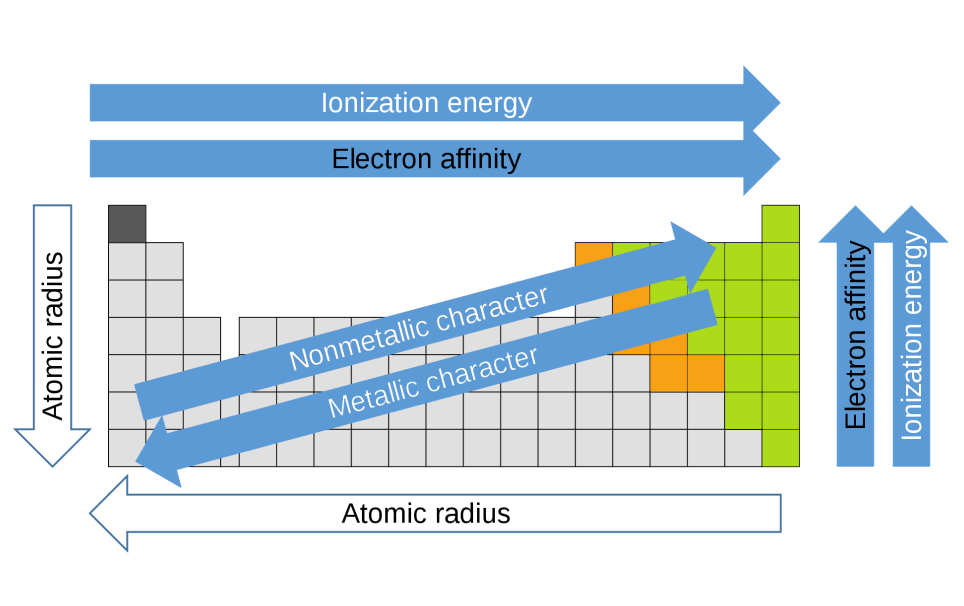
When you look at a chemistry book, the first thing that you will see is the periodic table. It is easy to see it as a boring table of symbols. But, in fact, it is a well-designed table that organizes all the elements.
Every element in the table has a place, and the table shows how the elements/atoms are formed and the reactions that they undergo during a chemical reaction.
Chemistry is easier when you see the trends in the table. There are periodic trends that are shown in the table, and these trends will explain how reactive or stable an element is and why certain elements are the same.
The periodic table organizes elements based on their atomic number (the number of protons in the nucleus). With rising atomic numbers, the elements' properties vary predictably.
As a result of table arrangements, chemists can analyze elements in relation to one another and gauge how similarly these elements behave. For example, elements are grouped if they exhibit comparable chemical behavior due to their similar outer electron configuration.
Each row of the periodic table is called a period. While moving from left to right in a period, each element contains one more proton and one more electron than the preceding element.
At the beginning of a period, there are usually reactive metals. As you go to the end, you get non-metals, and finally, noble gases, which are very stable.
Groups are the vertical columns of the periodic table. Elements in the same group behave in a similar manner because they have the same number of valence electrons.
Because outer electrons are similar, elements in a group typically:
This is the reason they are called chemical families.
| Group | Name | Key Features |
|---|---|---|
| Group 1 | Alkali Metals | 1 valence electron; lose 1 electron easily; form +1 ions; react vigorously with water |
| Group 2 | Alkaline Earth Metals | 2 valence electrons; form +2 ions; harder and denser; very useful in construction |
| Group 17 | Halogens | 7 valence electrons; gain 1 electron in reactions; form salts with metals |
| Group 18 | Noble Gases | Complete outer electron shells; rarely take part in reactions; useful in lighting and cooling |
The large block in the center of the periodic table contains the transition metals. These elements have special properties that make them extremely useful in daily life and industry.
Applications of transition metals involve: iron in construction, copper in electrical wiring, gold and silver in jewelry, and platinum as industrial catalysts.
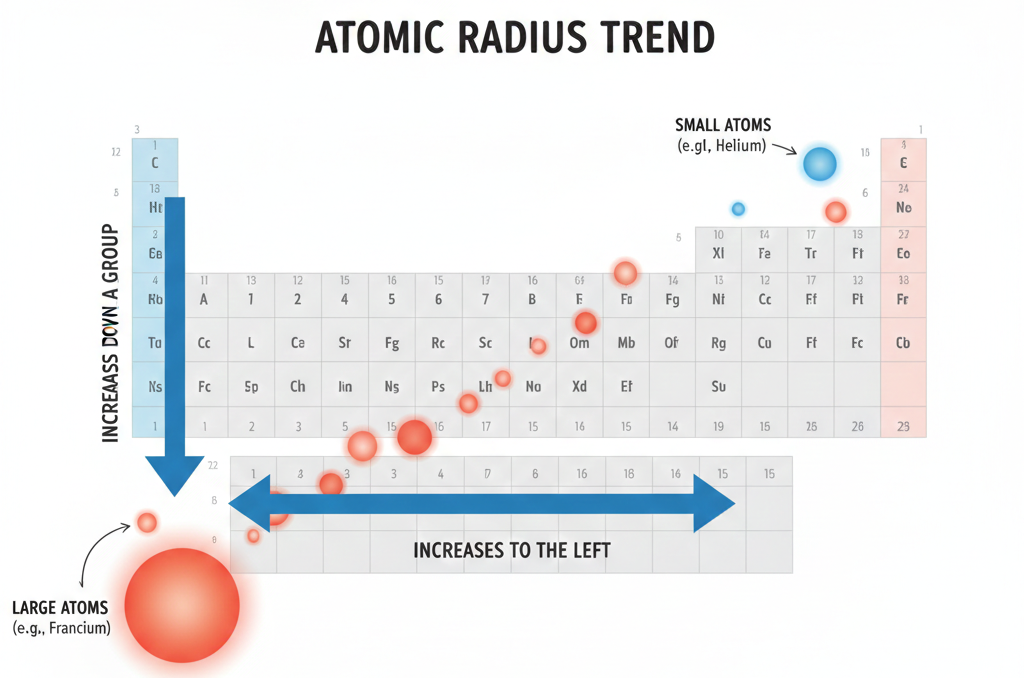
Atoms have defined sizes. The metric used to measure the size of an atom is called the atomic radius. The atomic radius is not constant throughout the periodic table.
These atomic patterns explain why elements at the bottom of the groups are larger, and elements at the right side of the table are smaller than those on the left.
Atoms can become ions by gaining or losing electrons.
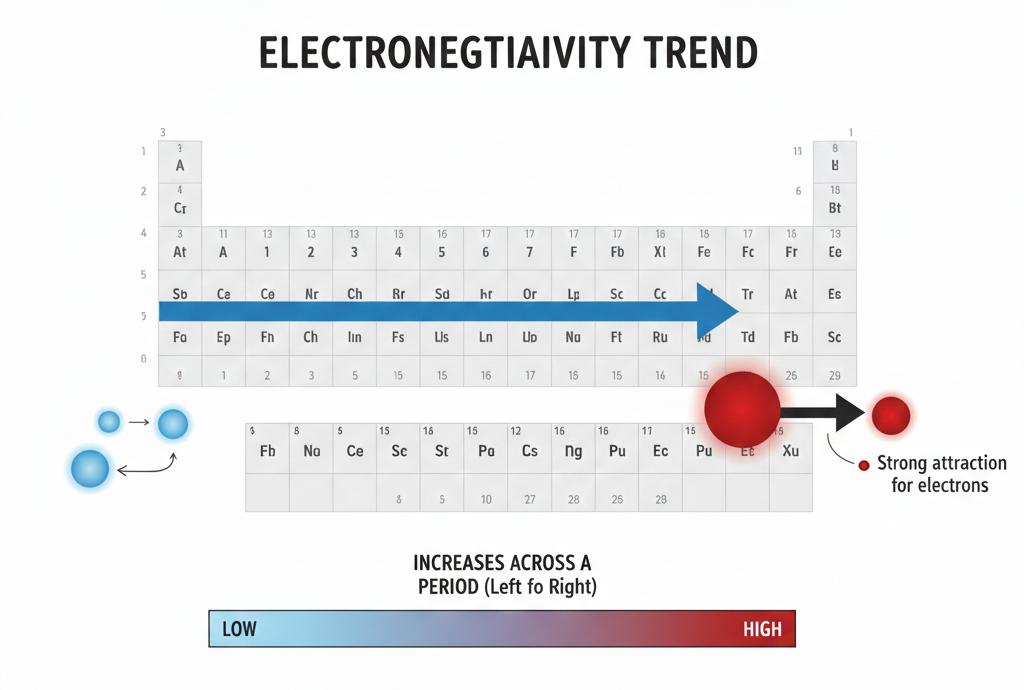
Electronegativity is the tendency of an atom to attract electrons when it forms a bond.
This explains why non-metals attract electrons, why polar bonds form, and why fluorine is the most electron-attracting element.
The position of an element in the periodic table helps to determine its metallic and non-metallic nature.
| Character | Trend Across a Period | Trend Down a Group |
|---|---|---|
| Metallic | Decreases | Increases |
| Non-metallic | Increases | Decreases |
The reactivity of an element is determined by how easily it loses or gains electrons.
These patterns describe:
The periodic table is a system that organizes the knowledge of chemists and how matter behaves. Trends, periods, and groupings give students the power to understand chemical properties through the structure of the atom.
The knowledge of this topic supports your understanding of:
The periodic table is the book of chemistry. Once the patterns are learned, it becomes simple to explain reactions, predict properties, and show how chemistry is related to everyday things and processes.