

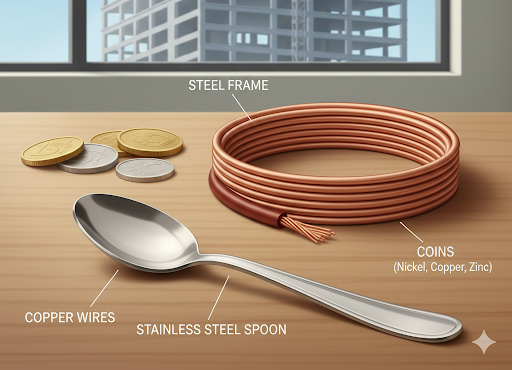
Look around you. Metal objects are everywhere. Metal utensils on the table, metal wires that carry electricity to your house and even the metal coins in your pocket. Metal structures that support large buildings are also present. All of the mentioned objects use metals that belong to the transition metals group. Metals are also present in your body and perform several important functions.
But do metals behave the same way? Consider the following questions:
In chemistry, when studying metals, they are not just categorized as "hard and shiny". Their behavior, reactivity and roles in chemical reactions differ. Transition metals are of great importance due to their exceptional properties. They are used in industries, technologies and even in biological systems.
These metals can be found at the center of the periodic table in its middle block. A few are:
These are called "transition metals" because they are the metals closest to the metals and non-metals on the periodic table. They are also in the middle of the table and are in between all the very reactive metals on the left and the non-metals on the right. They combine the different characteristics of these two groups.
Most simply put, transition metals are a series of metals that exhibit unique chemical and physical properties in comparison to the other metals, such as sodium or calcium.
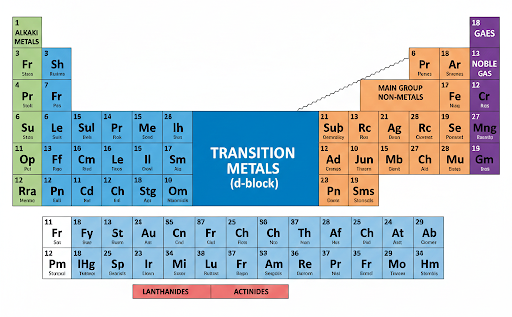
Transition metals are positioned inside the d-block of the periodic table. This section is right in the middle of the table and is positioned between the alkaline/alkaline earth metals on the left and the non-metals/metalloids on the right.
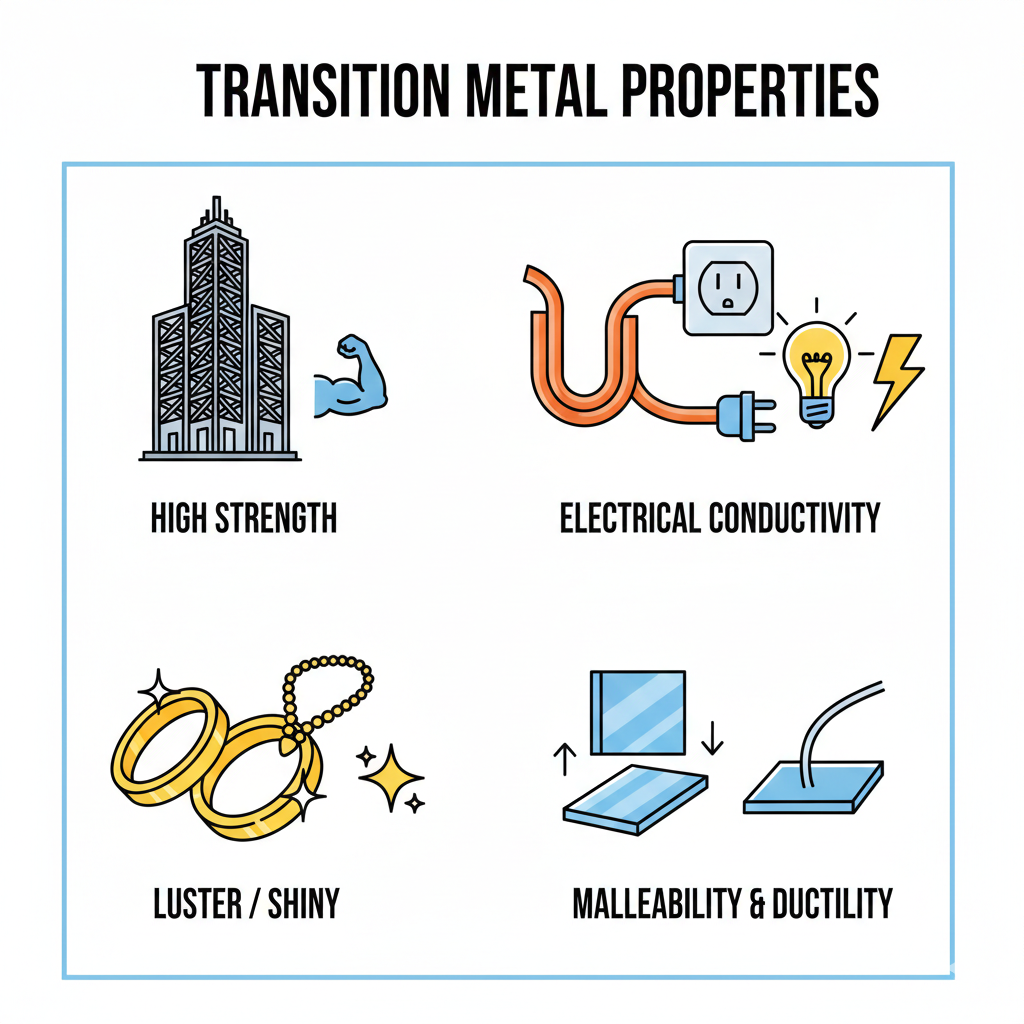
Transition metals have a multitude of similarities that make them beneficial materials for use in everyday life and in industry.
Unlike sodium or potassium that explode violently, transition metals are less reactive, and they still participate in a wide range of chemical reactions.
They can form compounds with non-metals like sulfur, chlorine, and oxygen. Iron, for instance, combines with oxygen and produces the compound iron oxide, which we commonly refer to as rust.
They can form a variety of different ions. This capability enables them to have chemistry that is rich and varied.
They often take on a catalytic role in chemical reactions. This means they can accelerate a chemical reaction without being consumed in the process.
They form compounds that have color — one of the more fascinating characteristics of transition metals.
Transition metals exhibit the trait of possessing several oxidation states, defined as the charge of an ion within a compound.
A good number of compounds of transition metals are colorfully attractive.
Metal ions have electrons that absorb certain wavelengths of light. The light that is not absorbed is what gives the substance its color.
A lot of the time, the transition metals are catalysts. A catalyst is a substance that increases the rate of a chemical reaction and isn't consumed in the reaction.
| Catalyst | Reaction |
|---|---|
| Iron | Production of ammonia |
| Platinum | Combustion in the car |
The transition metals are also able to form what are known as complex ions. A complex ion consists of a metal ion and a number of molecules or ions, known as ligands. These formations are special and have unique traits.
Everywhere you go, there are transition metals:
An alloy is a combination of two or more elements of which at least one is a metal. Transition metals give better and stronger alloys. For example, steel is made of iron and a few other metals.
Some of the transition metals are important for our survival:
Life processes cannot occur in the absence of these elements, although the required quantity is very small.
Metals can react with air and water, which can lead to corrosion. A common example is iron rusting. Corrosion is a process that weakens metals.
Transition metals share several important characteristics that make them central to both chemistry and industry:
This allows us to understand how to: