The Mole Concept and Chemical Calculations
Let's consider a small grain of salt. It looks small, right? An incredible number of invisible particles are contained within that grain. In chemistry, we avoid the difficulty of counting individual atoms manually. Instead, we use a clever "counting unit" that enables us to handle large quantities of individual particles, which we call a mole.
Chemistry calculations would be extremely impractical and confusing without the mole. The mole provides a way for chemists to measure matter, make comparisons between substances, and "forecast" real-life chemical reactions.
What Is The Mole?
The mole is a standard unit that provides a measure of the quantity of a particular substance. It provides answers to the question of how many particles (atoms, molecules, or ions) comprise a specified sample.
- The mole serves as a convenient means of bridging the microscopic realm of atoms to the macroscopic world of grams.
- With the mole, chemists are able to "count" atoms by means of weighing.
- Chemical equations show the relationships between reactants and products in a chemical reaction.
Avogadro's Number
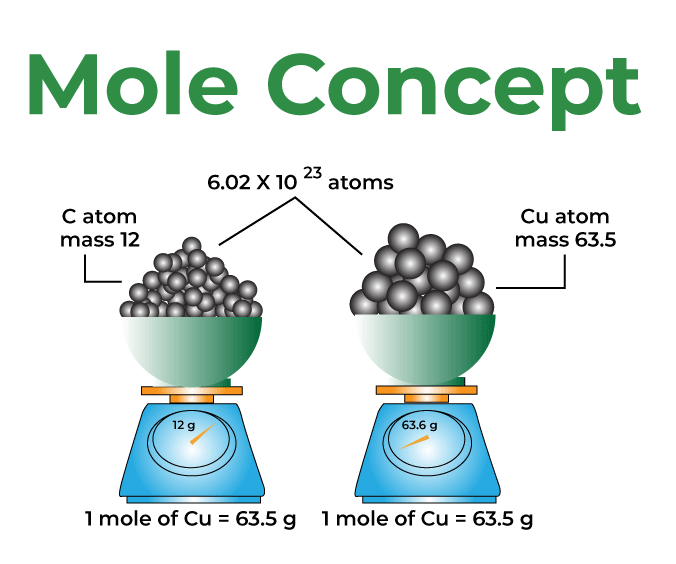
One mole of a substance contains the same number of particles; this fixed number is called Avogadro's Number.
6.02 x 10²³ particles per mole
Therefore,
- 1 mol of carbon has 6.02 x 10²³ carbon atoms, and
- 1 mol of water has 6.02 x 10²³ water molecules.
Counting unit in chemistry. A mole is a simple and powerful unit of count in Chemistry.
Atomic and Molar Mass
Atomic Mass
Every element has an atomic mass, which is the average mass of a single atom of the element in atomic mass units (amu).
Molar Mass
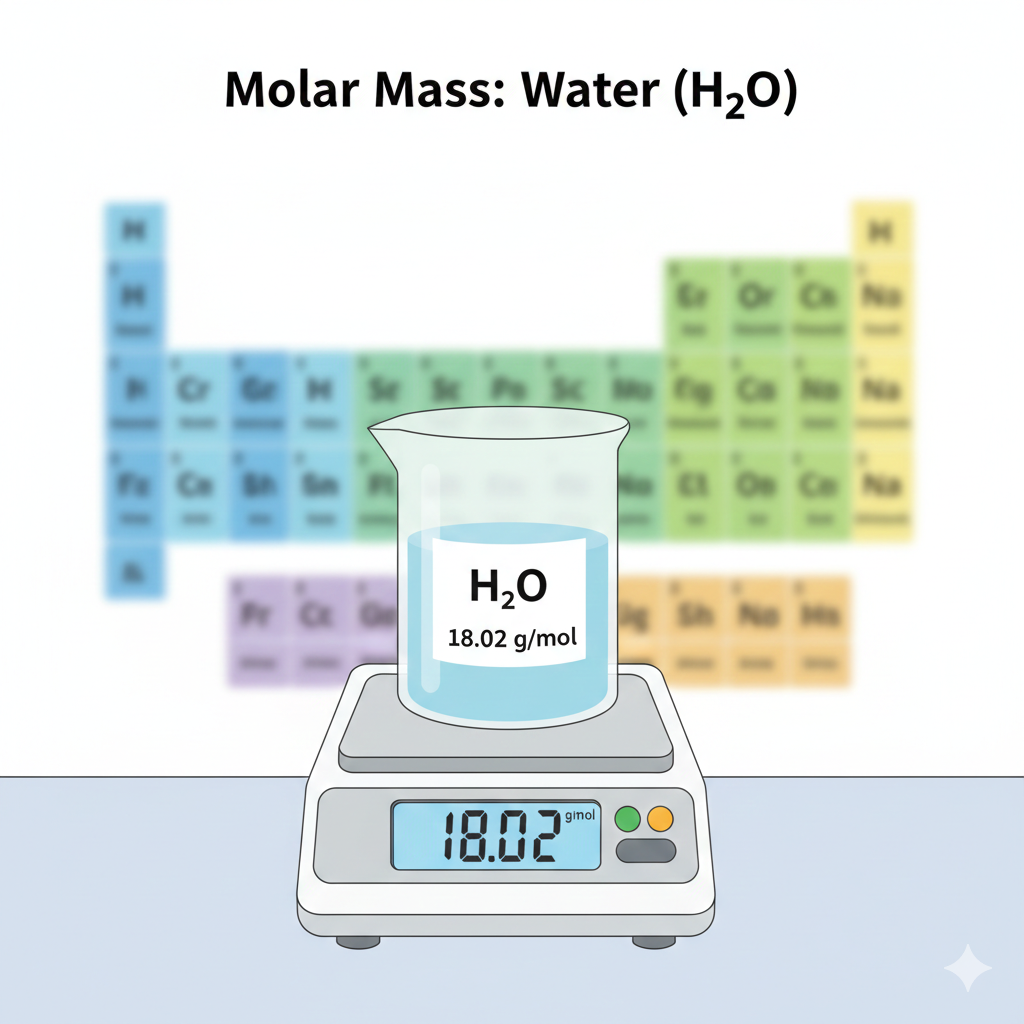
Molar mass is the mass of one mole of a substance, given in grams per mole (g/mol).
The molar mass of an element can be read directly from a periodic table, and for a compound, it can be calculated by adding the atomic masses of all atoms in the chemical formula of the compound.
Example idea (no questions): An element's molar mass is 12 g/mol, then a mass of 12 grams corresponds to one mole of that element.
From Mass to Moles (and Back)
Most chemical calculations require some form of cross multiplication between mass and moles. This is achieved through the use of molar mass.
- Mass is an indication of how heavy a sample is.
- Moles quantify the number of constituent particles.
Mass is measured in the laboratory using a balance. Then, you use molar mass to determine how many moles of that substance you possess. This is a critical step in experiments, reactions, and the preparation of solutions.
Why this is necessary:
- Chemicals react based on the number of their constituent particles and NOT on their mass.
- Two substances can have an equal mass, yet possess drastically different amounts of individual particles.
Chemical Equations and the Mole
Think of a chemical equation like a recipe. It details what ingredients react and what new dishes are created. In chemistry recipes (or equations), we are not writing in narrative form. We are writing in particle and mole form.
What balanced equations indicate:
- Who are reactants and who are products.
- The mole ratio of the substances.
- The amount of each reactant and product.
2H₂ + O₂ → 2H₂O
More information:
- The numbers (coefficients) in the equation indicate mole ratios.
- These ratios are essential for predicting the outcomes of a chemical reaction.
- In a chemical reaction, the form of atoms is not destroyed. They are rearranged to form new products.
This aligns with the law of conservation of mass, which states that matter is not created or destroyed in a chemical reaction.
Simplifying the Limiting Concept
In a chemical reaction, one reactant will always get consumed first. This one reactant will limit the amount of new products that can be created.
Key concepts:
- The product amount created is determined solely by the limiting reactant.
- The amount of one or more of the reactants will not affect the overall amount of products created.
This chemical process is helpful in the chemical industry to minimize waste.
In laboratories and factories, knowing which substance is limiting in reactions can save time, money, and resources.
Percentage Composition of Compounds
Percentage composition tells us the literal percentage of mass of each element in a compound.
Why is this necessary?
- It demonstrates the ratio of elements in a given substance.
- It assists in demonstrating purity and in the recognition of compounds.
- It is applicable in the fields of medicine, food science, and material science.
For instance, a medicine can only be deemed effective and safe if it contains the designed percentage of an active ingredient.
Solutions, Concentration, and the Mole
A solution is formed when a substance is dissolved in a liquid, and it is the liquid in which the substance is dissolved that is referred to as the solvent.
In a solution, the concentration is the measure of the amount of dissolved substance, referred to as the solute, that is contained in a given volume of the solution.
In chemistry, concentration is predominantly measured in moles.
This is necessary because:
- It provides a basis for the comparison of different solutions.
- It is used to determine the strength of the solution.
- It is applicable in the field of experiment, medical solutions, and chemical production.
Accurate and safe results are guaranteed by the precise measurement of moles and volume.
Why the Mole Concept Matters in Real Life
The mole is not just a concept taught in classrooms. It is encountered in numerous real-life situations:
Medicine
the preparation of precise drug doses.
Treatments
To keep an equilibrium of the quantity of chemicals.
Industry
To manufacture fertilizers, plastics, and fuels. To diminish the quantity of waste.
Environment
To measure the quantity of contaminants in the air and water. To study chemical changes in nature.
Without the mole concept, modern chemistry, and technologies would not work.
Main Ideas to Remember
- It is important to understand that chemical calculations and the mole concept help scientists transition from dealing with subatomic particles to working with macroscopic, measurable quantities. It is the mole concept that bridges the gap between theoretical calculations and practical laboratory work or real-life situations.
- The mole concept is used to measure and count particles.
- The connection between mass in grams and amounts in moles is termed as molar mass.
- The chemical reaction equations express the reactions of different substances using mole ratios.
- The precise execution of chemistry calculations translates to the effective performance of chemical and physical experiments and the reliable implementation of their practical applications.
These concepts enable you to better understand and analyze the behavior of subatomic particles in the world, as well as support your future studies in the field of chemistry.