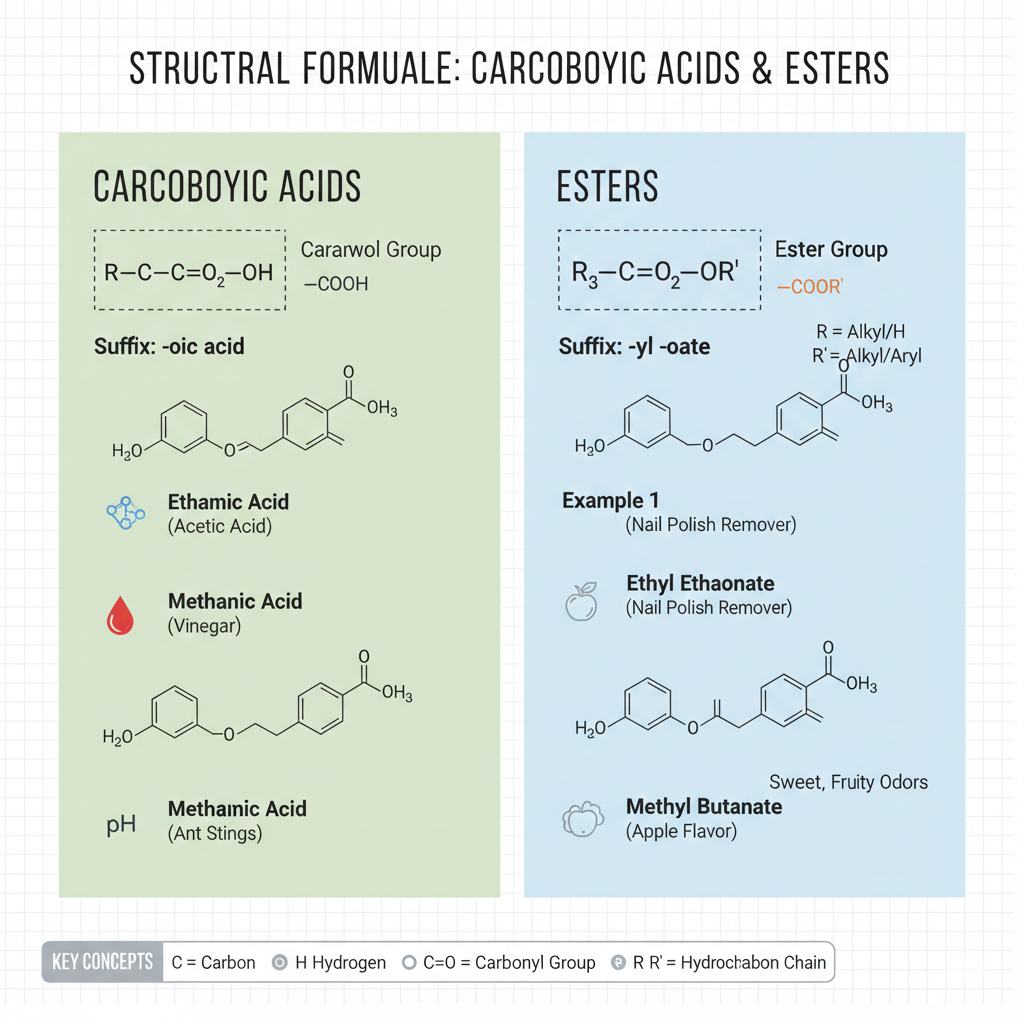
Structural Formulae – Carboxylic Acids & Esters
Perhaps you have a nail polish remover and perfume in your kitchen cupboard, or maybe you have even vinegar or fruit flavoring. Even though these items look ordinary, they have common organic compounds. The taste and smell of these compounds exhibit distinct, clear structural patterns.
In Chemistry, they don't just stop at naming a substance. They go further to explain how the atoms are connected. This is where structural formulae come in. They allow the chemists to "see'' the entire molecule. They help to explain how and why some substances behave the way that they do.
In this lesson, the focus will be on the two most important groups of organic compounds: carboxylic acids and esters. By the end of this lesson, you will have a clear ability to describe the structures of these compounds, understand the major characteristics of these compounds, and the everyday uses they are associated with.
Organic Compounds and Functional Groups
The compounds in organic chemistry are based on the element carbon. Carbon's ability to bond with both itself and other elements in a multitude of ways produces a large variety of possible molecular structures.
A functional group is a specific group of atoms in a molecule that determines the properties and reactions of that molecule.
Here are some examples of common functional groups:
- Alcohol: –OH
- Carboxylic acid: –COOH
- Ester: –COO–
Features and Structure of Carboxylic Acids
Carboxylic acids are organic compounds containing a carboxyl functional group, i.e., -COOH.
A carboxyl functional group comprises a
- Carbonyl group (C=O) and a
- The hydroxyl (–OH) functional group is attached to the same carbon.
General structural formula: R–COOH
In this case, R is the hydrocarbon chain (e.g., CH₃–, C₂H₅–).
Examples of this include:
- Methanoic acid: H–COOH
- Ethanoic acid: CH₃–COOH.
- Propanoic acid: C₂H₅–COOH.
- The span of the -COOH group is located at the terminal position of the carbon chain.
- The C=O and O–H are portions of the same functional group.
- The presence of O–H in these compounds makes them acidic.
Features of Carboxylic Acids
Structure and functional groups of carboxylic acids account for their certain properties:
Physical properties
- The smaller the acid, the more pungent the smell.
- Small acids are more soluble in water than large acids and even more soluble than similar-sized alcohols.
- Strong hydrogen bonding in carboxylic acids raises their boiling points above those of their corresponding alcohols of similar molecular size.
Chemical properties
- Carboxylic acids are weak acids and can release H⁺ ions in water.
- When they react with metal, they generate hydrogen gas, while with bases, they form salts along with water.
Use in Real Life:
- Ethanoic acid is found in vinegar.
- The sour taste of a lemon comes from citric acid.
- Lactic acid is found in sour milk and is produced in the body during exercise.
Naming Carboxylic Acids
The names of the carboxylic acids are based on the prefix of the corresponding alkane:
Methane → Methanoic acid
Ethane → Ethanoic acid
Propane → Propanoic acid
The names always end in "-oic acid".
This provides a framework for you to name linkages, especially while sketching structural formulas.
Main Structural Features Of Esters
- Esters contain a carbonyl (C=O) and an oxygen that connects to another carbon chain.
- Esters are not acidic (as are carboxylic acids) since they lack the -OH group characteristic of acids.
- A -COO- group sits between two carbon chains.
How are Esters Formed?: Esterification
This process is called esterification.
Describe What Happens
In the reaction of a carboxylic acid and an alcohol, an ester is formed, and water is released.
Overall,
Acid + Alcohol = Ester + Water
Why is Important Here?
The acid's -COOH group and the alcohol's -OH group rearrange to form the -COO- linkage.
This explains why esters possess unique structures and why they are distinct from both acids and alcohols.
The reaction, of course, involves more conditions, like a catalyst and heat, but the key focus is the atomic rearrangement, which leads to the formation of a new structure.
Properties Of Esters
This difference in functional groups explains why esters behave differently from carboxylic acids.
Physical Properties
- Esters have a characteristic odor that is sweet or fruity. Esters are usually liquids, and they boil at lower temperatures than carboxylic acids. Most esters are not very soluble in water.
Chemical Properties: Esters are not as reactive as carboxylic acids. Esters can undergo hydrolysis, which is a type of reaction where the compound is broken down by the addition of water, yielding an acid and an alcohol.
Everyday Applications: Esters are used in flavoring foods (like those that taste like bananas, pineapples, and strawberries), perfumes and other scented products, paint, nail polish remover, plastics, and fibers.
Carboxylic Acids vs Esters
Even though esters are derived from carboxylic acids, they have different structures and properties.
Carboxylic Acids
General structure: R–COOH
Sour and acidic taste
More soluble in water (smaller ones)
Contain –OH group (acidic)
Esters
General structure: R–COO–R′
Neutral taste, fragrant smell
Low solubility in water
Lack –OH, have –COO–
This shows that a slight structural change can bring about significant changes in properties.
Why are structural formulae important?
In everyday chemistry, structural formulae are important because they show how different substances interact and how they behave in different circumstances.
The ideas from this lesson can be seen in face value, food technology, and the flavor preserving substances.
- Organic acids will be in the health section and will include medicines and acids found in the human body.
- The section on the environment will include a discussion of natural acids that are found in the soil and water.
- The section on industry will include substances that are used for making plastics, solvents, and perfumes.
A change in the structure of a molecule brings about a change in the smell, taste, reactivity, and usefulness of the molecule.
This is how important structure is in chemistry.
Big Picture: Linking Structure to Function
A good example of structure determining function in chemistry is carboxylic acids and esters.
- The –COOH group indicates that a compound will be acidic and therefore it will have a sour taste.
- The -COO- group will tell you that a compound will smell pleasant, and will be used in making perfumes.
A slight modification in structure will result in a large change in the properties.
More studies in Chemistry will introduce you to more functional groups. Reading and writing structural formulae will be important in building confidence in organic chemistry.
To sum up: Different parts of a molecule are represented in structural formulae. Carboxylic acid compounds are due to the -COOH group, which makes them sour and acidic. -COO- group will ensure you of esters, which are pleasant to smell and taste. The chemistry that explains the structure of these compounds is the same that explains the chemistry of the world around us.