

On this page:
Introduction Matter Three States of Matter Solids Liquids Gases Comparison of States of Matter Changes of State Physical Properties of Matter Density Chemical Properties of Matter Physical vs Chemical Changes Diffusion The Importance of Understanding the Properties of Materials and Their UsesStart observing everything around you. Steam from your hot cup of tea. A liquid smoothly flows to the bottom of a bottle. The chair you are sitting on, the air you breathe, and even your own body are made up of countless tiny particles.
All are made up of these tiny particles, matter. Matter comes in different forms and behaves differently, yet all of them follow the same universal principles.
Matter forms the basis of everything in chemistry. Once you have a firm grasp of the principles of matter, you will be able to explain a lot of the natural and common day-to-day phenomena.
Studying matter will help us understand the world. Matter is everything that has mass and volume.
We will not go into a long and thorough detailed explanation of the concepts since the basics have already been established. In this instructional, the main concentration is on the different states of matter and their properties.
Matter is anything that has mass and occupies space.
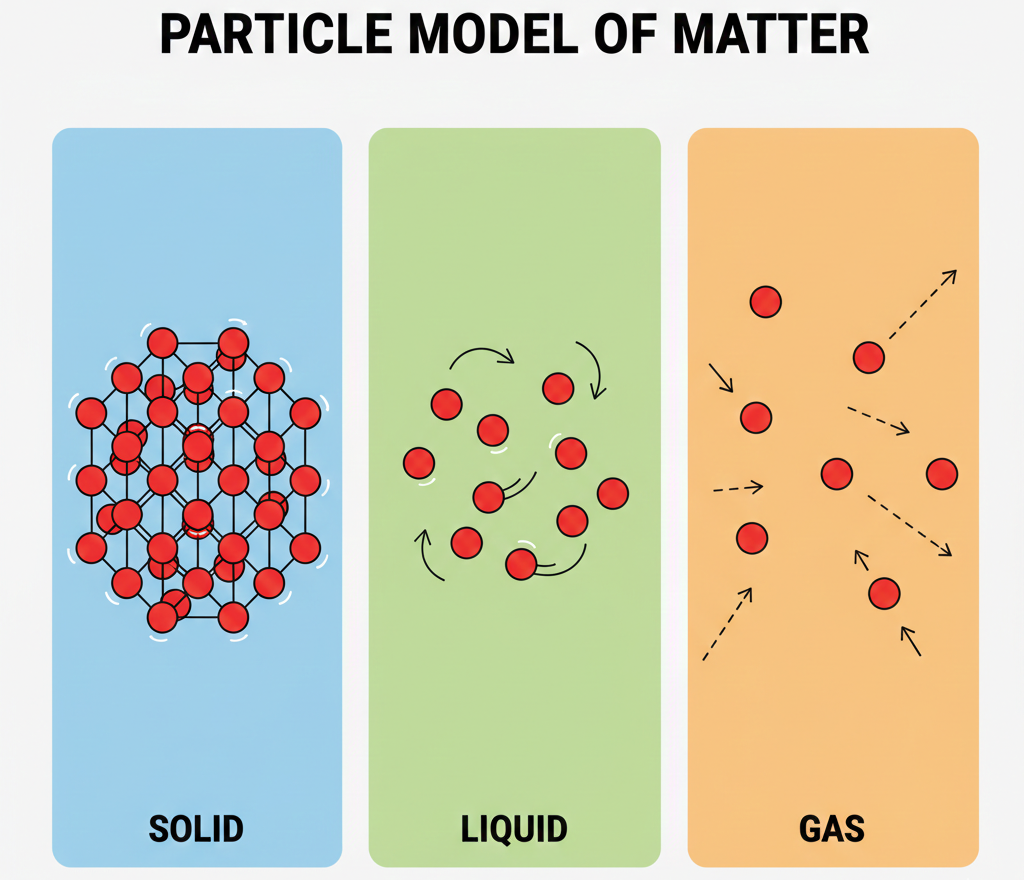
The Particle Model focuses on breaking down matter into its ultimate constituents, the particles that make everything up. Matter is made up of an enormous number of tiny particles. These particles are too small to see and are always moving. The particles attract each other and thus the arrangement and movement of the particles play a major role in determining the state of matter a substance is in, and its properties.
The model helps to answer the following questions about matter, such as why:
There are 3 primary states of matter:
Plus matter/fog, which is not commonly considered a state of matter. All the states of matter behave differently based on the arrangement of the particles in them.
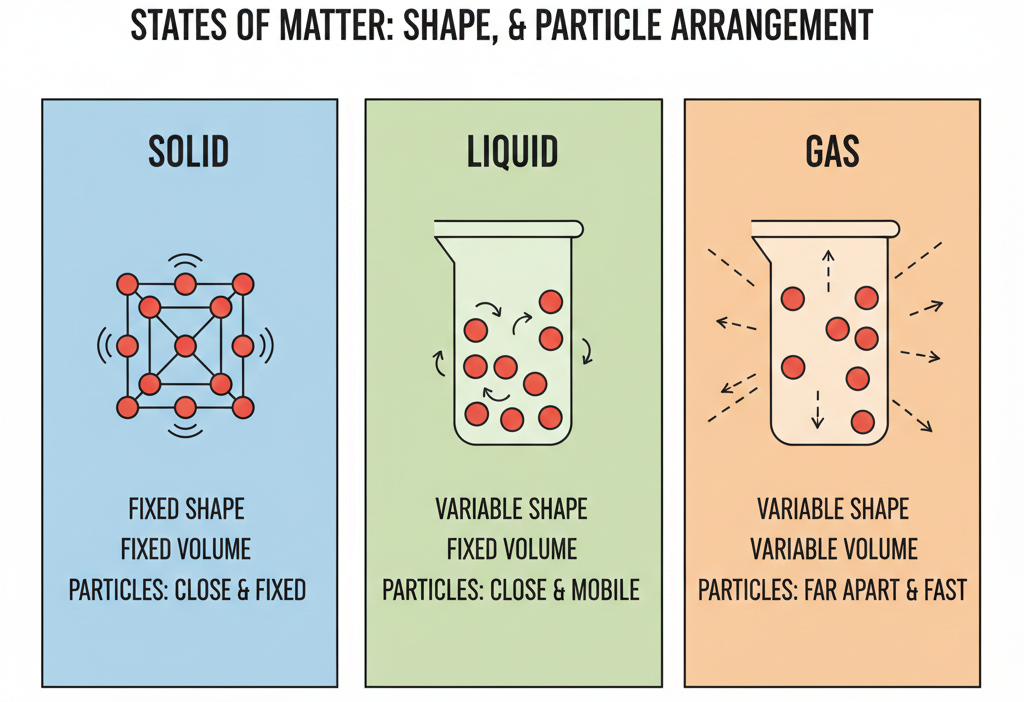
Solids have a clearly defined structure in which the particles are arranged in a fixed position, and thus have a defined volume.
Examples: Ice, stone, wood, metals
Due to their stability and strength, solids are highly useful in making tools and constructions.
In liquids, the particles are close, but they are not fixed. They are able to slide past one another.
Examples: Water, oil, milk, and juice.
Because liquids can easily pour and flow, they are great for cooking, drinking, and transportation!
In gases, the particles are extremely far apart and move about very freely at great speeds.
Examples: Air, oxygen, carbon dioxide, and helium.
Because gases spread very quickly, they are the reason smells travel and balloons can float.
| State | Particle Arrangement | Particle Movement | Shape | Volume | Compressibility | Examples |
|---|---|---|---|---|---|---|
| Solid | Particles are tightly packed in a fixed structure | Vibrate in place | Fixed | Fixed | Very low | Ice, stone, wood, metal |
| Liquid | Particles are close but can slide past each other | Flow around each other | Takes the shape of a container | Fixed | Low | Water, oil, milk, juice |
| Gas | Particles are far apart and spread out freely | Move rapidly in all directions | Fills the container | Changes to fill the container | High | Air, oxygen, carbon dioxide, helium |
Matter can change from one state to another when energy (heat) is added or removed, meaning the arrangement of the particles changes, but the substance itself does not change.
Energy absorbed is when changing to a higher-energy state, and energy released is when changing to a lower-energy state. This explains heating, cooling, refrigeration, and natural processes like the water cycle.
Changing a physical property does not alter the substance itself.
All of the above facilitate the identification of different substances.
When it comes to density, elaboration of substances can be achieved. A measurement of how much mass a substance has within a given volume is its density.
Anything that has a lower density than water is known to float.
Anything that has a density that is greater than that of water is known to sink.
One of the important applications of density is in the design of ships, the separation of substances, and the recycling of materials.
When substances are changed to form different substances, we describe the chemical properties of matter.
Rusting of iron due to the presence of air and water is a classic example
When a chemical change does not occur, and the substance is in the same state, it is called a physical change.
New substances are formed during chemical changes.
Physical changes are often reversible, while chemical changes are usually not.
Diffusion is the movement of particles from an area of high concentration to an area of low concentration. It occurs due to the constant motion of particles in all states of matter.
In gases, diffusion occurs quickly, in liquids it occurs slowly, and in solids it occurs very slowly.
Examples include the spreading of perfume in a room or the spreading of ink in water.
Strong and durable materials like metals are used in construction, while flexible materials like plastics are used in containers. Glass is used in windows because it is transparent, while elastic rubber is used in tires.
Knowing these materials allows designers, engineers, and scientists to design safe, efficient, and useful materials.
The Importance of studying the States and Properties of Matter is the building foundation of chemistry, since everything in chemistry is based on it.
It is essential for:
Once you understand the states and properties of matter, everyday things around you start making sense.