

On this page:
Introduction What is a Mixture? What are Solutions? Solubility and Dissolving What Is a Colloid? The Tyndall Effect Forms of Colloids What is a Suspension? Types of mixtures: Solutions, Colloids, and Suspensions Separation Methods Importance in everyday life and science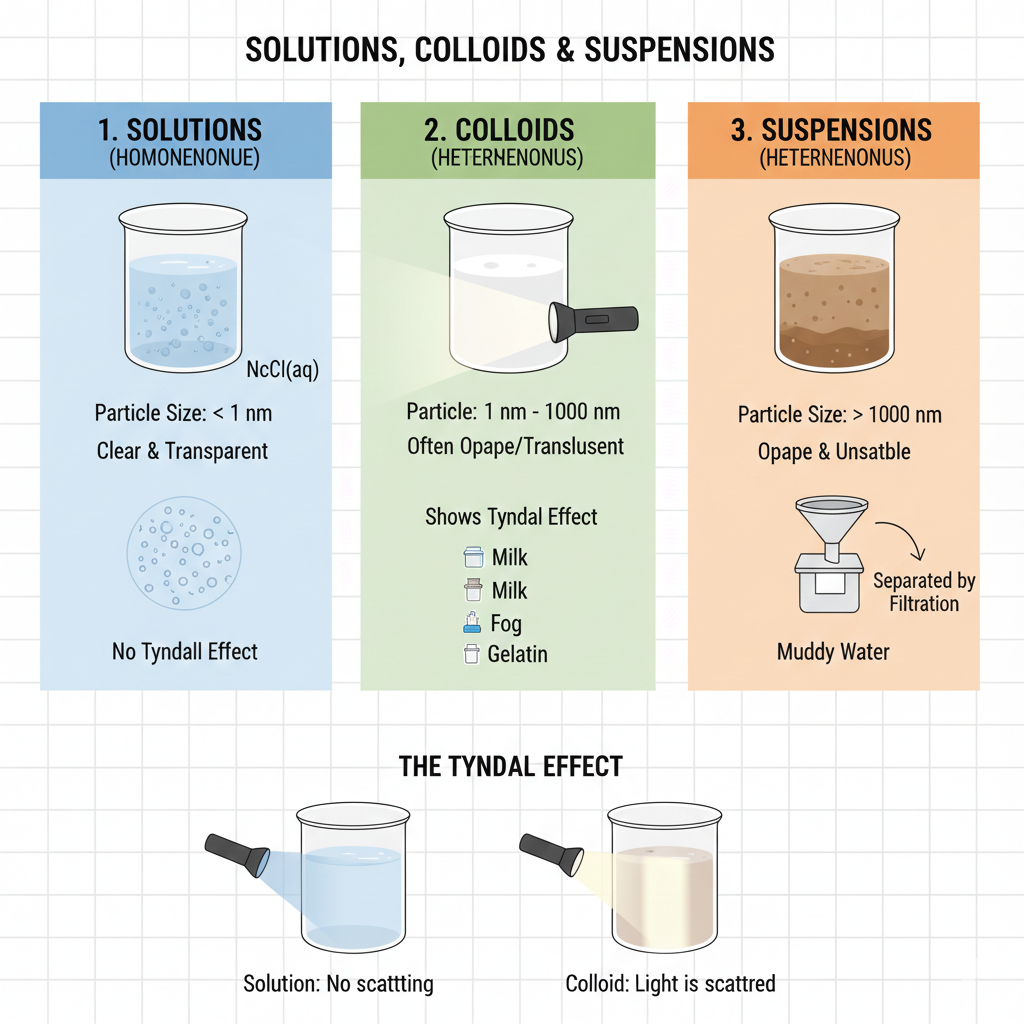
Chemistry is the study of matter and the changes that matter undergoes. There are simple mixtures when you pour a cup of water, when you shake a bottle of milk, and when you mix soil with water. What you cannot see, and is true of all of these mixtures, is that the particles in these mixtures behave in very different ways.
Chemistry studies the reasons behind the separation of some liquids and the clarity of some compared to others. These differences can be due to the size, distribution, and stability of the particles that make up the liquid. For that, liquids are classified into solutions, colloids, and suspensions. These classes allow us to characterize the diverse materials we encounter in our lives and environment.
A mixture is a combination of two or more substances that occurs without a chemical reaction, and the mixture retains the individual properties of each substance. The components of a mixture can be separated using physical means.
In a mixture:
Some examples of mixtures are:
Mixtures are found everywhere, whether in nature, at home or in the laboratory. Before understanding solutions, colloids, and suspensions, understanding mixtures is essential.
Solutions are a type of mixture where the ingredients combine equally, and they look the same from any ratio or angle. One ingredient has completely dissolved the other. Solutions have two components:
Consider dissolving salt in water:
Solutions possess several characteristics:
Several examples of solutions from daily life include:
Solutions are vital in chemistry as reactions occur mostly in solutions, especially in biological and industrial interactions.
Solubility is the capability of a chemical to be completely dissolved in a solvent. The rate of solubility is also dependent on other substances that are dissolved. Some of the factors that influence the dissolving capability are:
When a solution reaches a point where no more solute can be dissolved, the solution is said to be saturated. The degree of solubility is of great importance in the formulation of drugs, beverages, and detergents.
A colloid is a heterogeneous mixture in which the size of the dispersed phase is between that of a true solution and that of a suspension. Colloids generally have a milky or hazy appearance.
In a colloid:
Colloidal Dispersions Scattering Effect: The centered beam light reflects the beam. The other particles in the colloidal dispersion beam feel light.
The Tyndall Effect explains the following scenarios:
Light Scattering Effect is not seen in solutions because the particles of the light-scattering sample are too small to scatter light.
When assessing the form of a colloid, the state of the medium and the dispersed particles are taken into consideration.
Types of Colloids. At least four states of matter are represented in the above examples of colloids. Their use in food, medicine, and household products is explained by the various forms of colloids.
The following are examples of colloids in each state:
A suspension is a form of mixture that is heterogeneous in nature. A suspension is characterized by a mixture of solid particles that can be seen clearly and which do not dissolve. These solid particles in a suspension mixture will settle down and form a layer at the bottom of the suspension if the suspension is left undisturbed.
The following is a description of the major characteristics of suspension:
Examples of suspensions include muddy water, chalk and water mixture, and flour and water mixture.
When a suspension is stirred, a mixture of particles will settle out. This process is called sedimentation.
These three categories of mixtures can be distinguished from one another by three properties:
These have been helpful to describe mixtures we see/ use in everyday occurrences.
The physical processing methods to separate each of these mixtures are:
These methods are commonly used in labs and for water purification and food processing.
Solutions, colloids, and suspensions help to understand the world around the following examples:
In food and drinks:
In medicine:
In the environment:
Understanding these examples will help you deal with various branches of chemistry, like reaction rates, solubility, separation techniques and materials science. Knowing how particles behave in a mixture helps to embrace the chemical processes in nature and technology.