

On this page:
Introduction What Are Redox Reactions? Oxidation and Reduction (Simplified) How to Recognize Oxidation and Reduction in Chemical Reactions The Importance of Oxidation Numbers Oxidizing and Reducing Agents Energy Changes in Redox Reactions Redox Reactions in Daily Life Corrosion as a Redox Process Electrochemical Cells and Redox Balancing Redox Reactions Redox Reactions and the Environment Redox Reactions and Safety Redox Reactions in MYP Chemistry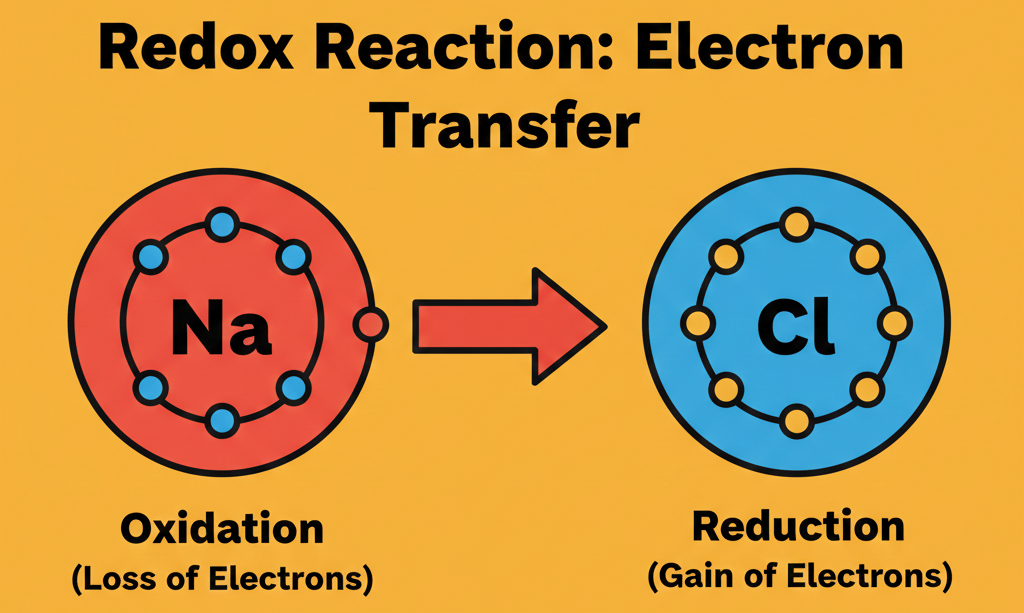
Have you ever wondered why iron rusts, how batteries power your phone, or why fruit turns brown after cutting? These chemical changes can all be explained by redox reactions. Even though we can't see electrons, the transfer of electrons is occurring every time there is a spark, a color change, or a coating of metal.
Chemistry is the study of the movement of electrons, not just the mixing of different chemicals.
Redox reactions also explain the changes of a substance in both physical form and energy.
Redox reactions fuel life, technology, and industry.
In MYP Chemistry, redox reactions teach you the changes in matter at the particle level. They integrate laboratory simulations and processes like corrosion, respiration, and energy generation.
Redox reactions are a type of chemical reaction characterized by the transfer of electrons from one substance to another. The term redox is a hybrid of reduction and oxidation, as both processes occur simultaneously.
Both changes are interconnected. and cannot happen individually.
The shift of electrons causes substances to alter their chemical composition. This explains the formation of new products, the possibility of energy being released and the varying degrees of reactivity in different chemical reactions.
Oxidation and reduction may sound complicated, but they can be understood using one fundamental principle:
Oxidation Is Loss (of electrons)
Reduction Is Gain (of electrons).
In chemical reactions, if one compound is oxidized, then another must be reduced. This is how charge is balanced, and the conservation of matter law is applied.
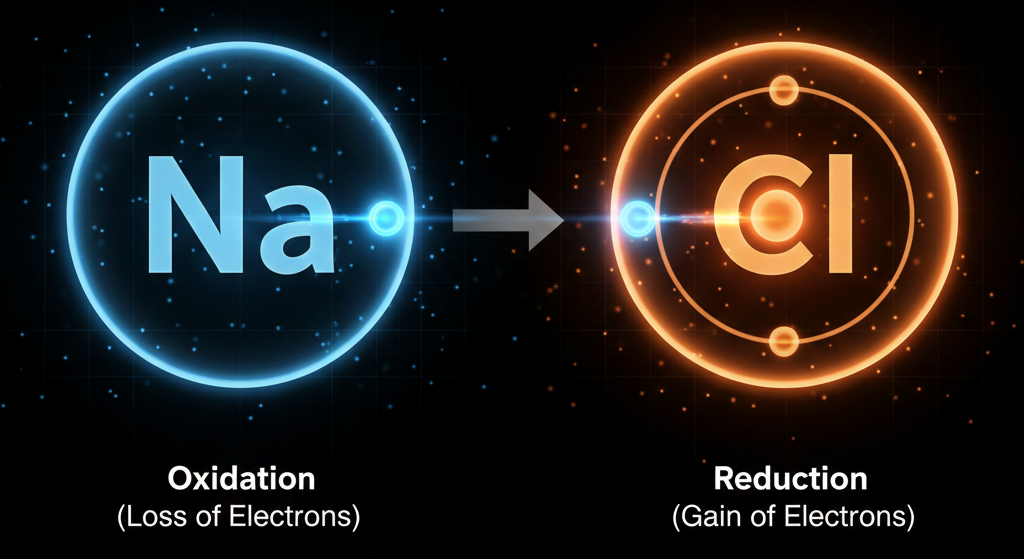
To figure out what substance is being oxidized or reduced, you must concentrate on the transfer of electrons.
In every chemical reaction, both of these processes must occur simultaneously.
in the reaction where a metal combines with oxygen to form a metal oxide:
This fundamental principle simplifies the task of tracking changes that may take place in intricate chemical reactions.
Oxidation number is a quantity assigned to an atom in a molecule to indicate the number of electrons that an atom has gained, lost, or shared in forming a chemical bond with that atom. This is useful to recognize redox changes more efficiently.
Oxidation states provide a way of monitoring the flow of electrons in a redox reaction.
Knowing the oxidation states, chemists are able to determine which atom has changed in a chemical reaction, as well as the number of electrons that are transferred.
Every redox reaction involves two distinct roles: oxidation and reduction.
These agents dictate the way in which electrons are transferred.
Understanding these roles explains why certain substances are more reactive than others, e.g. why oxygen is a strong oxidizing agent and metals are often reducing agents.
There is a close link between redox reactions and energy changes. Whenever there is movement of electrons, there is generally an energy release or absorption.
Energy changes are also the reasons some reactions are spontaneous, or others require external energy.
Out of many examples, combustion reactions can be seen to be redox reactions that release a high amount of energy. On the other end, electrochemical cells are a good example of redox reactions that trap energy and release it in the form of electrical energy.
Redox reactions are common in the laboratory, but are also happening in our daily lives. Rusting of iron is a redox reaction that occurs with the involvement of both water and oxygen.
Burning fuel in an automobile is a redox reaction that also liberates a lot of energy.
Redox reactions are also happening when respiration occurs in cells, and this is the process that is responsible for the release of energy that sustains life.
When a torch is ignited, redox reactions also occur in the battery, and chemical energy is transformed to electrical energy.
Corrosion describes how metals are destroyed as a result of their reaction with their environment. The rusting of metals, particularly iron, is the most common example.
In the presence of water and air, rusting accelerates.
And due to the dangers to public safety and the economic losses caused by corrosion, it is crucial to find ways to prevent it. Rust prevention techniques like galvanizing and painting work by controlling or blocking the redox processes on the surface of the metal.
Electricity is produced by redox reactions in electrochemical cells.
In this process, one part of the cell is oxidized. And the other part is reduced. Thus, a current of electricity is produced as a result of the flow of electrons.
Examples of this are the batteries found in phones, cars, and laptops, where the redox reactions are controlled.
The chemical energy stored in the battery is transformed into electrical energy. And in the process, the stored chemical energy powers the device.
This is how redox reaction is correlated to modern technology and everyday life.
In order to conserve mass and charge in a redox reaction, it must be balanced. Both sides of the equation must have the same number of atoms.
And to balance out the equation, the number of electrons lost must equal the number of electrons gained.
This means that electrons are always transferred, created or destroyed.
Lab chemists and industrial chemists both utilize balanced redox equations for determining the results of specific chemical reactions and the amounts of substances involved.
The environment is profoundly affected by the world of redox reactions. Redox reactions are involved in the creation of various types of environmental pollutants.
Redox reactions are involved in the natural processes of the carbon cycle and the nitrogen cycle. When the harmful substances in wastewater are removed, redox reactions are utilized in the process.
The design of devices that are less harmful to the environment is made possible by a better understanding of redox reactions.
Uncontrolled redox reactions can be very dangerous.
Lab accidents are common; following the proper safety rules can help
Knowing redox reactions teaches awareness of being safe in a chemistry lab and the safe use of chemicals.
Many fundamental and important concepts in chemistry are related to redox reactions.
Understanding redox reactions is essential for foundational knowledge in electrochemistry, corrosion, industrial chemistry, and even biologically-related processes. These concepts illustrate the role of chemistry in the environments, from the metals that make up structures to the energy that fuels everyday activity.