

On this page:
Introduction What Is the Reactivity Series? Standard Reactivity Series What Determines Metal Reactivity? Demonstrating reactivity Displacement Reactions Extraction of Metals from Ores Corrosion and The Reactivity Series The Protection of Metals Against Corrosion by their Reactivity Importance of the Reactivity Series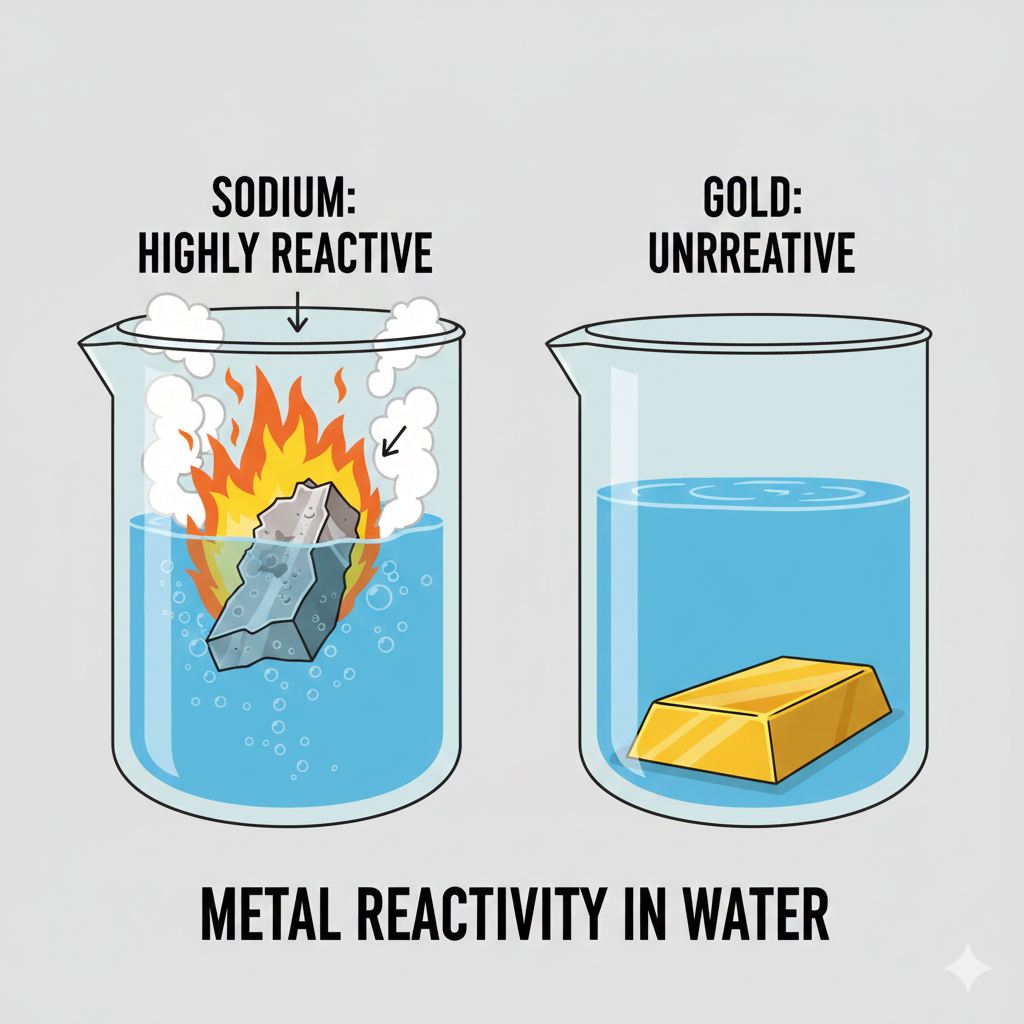
Imagine you drop sodium into a container of water. If you did this, you would see the sodium metal skate around the surface of the water and would fizz violently. Now drop a piece of gold into the same container of water. Nothing will happen. Why would sodium react so violently, but gold would remain completely inert? Can you assume that all metals behave the same when placed in water?
Chemistry is the study of predicting and explaining reactions. This knowledge is important to remove metals from their ores, avoid corrosion, and develop new experiments that are safe. To accomplish this, chemists have discovered a method to rank metals through order of reactivity, which makes the reactivity series a very important tool in chemistry.
When studying chemistry, the reactivity series helps to bring order and structure to what might seem to be the wild and unpredictable behavior of metals.
For example:
This metal reacts… It's vague.
Zinc is more reactive than copper, so zinc displaces copper from the copper sulfate solution.… It's concise.
The reactivity series is a scale that ranks metals from the most reactive to the least reactive.
It demonstrates how metals:
Potassium, being the most reactive, is located at the top of the series and is highly dangerous to work with. Gold, being located at the bottom of the series, is considered to be relatively safe to handle as it does not corrode, rust, or tarnish over the course of thousands of years.
Ancient jewelry made of gold will still shine and be in pristine condition due to the low reactivity of gold. However, from the same time period, tools made of iron would have rusted into nothing.
Memory aid: "Please Send Charlie's Monkeys And Zebras In Tiny Lead Cages Somewhere Safe, Gold Palace."
Remember! Metals above hydrogen in the reactivity series react with acids to produce hydrogen gas. Metals below hydrogen do not react with dilute acids.
The most important thing for reactivity for all metals is how easily the metal atom loses its outermost (valence) electrons to form positive ions. The easier it is to lose electrons, the more reactive the metal.
Metals with more electron shells have valence electrons farther from the nucleus, making it easier to remove those electrons. For example, Potassium (K) with 4 electron shells loses electrons more easily than Sodium (Na) with 3 electron shells.
is the process in which inner electron shells block outer electrons from the complete nuclear charge of the atom. Thus, the attraction from the outer electrons is weakened. In the case of potassium, the three inner shells of the atom provide the valence electron shielding from the nucleus, allowing the electron to easily be removed. This is the reason why the further down the periodic table you go, the greater the reactivity becomes.
The reactivity series demonstrates the reactivity of the different elements in the chemical reactions that are detectable. The series indicates how different metals within the same prescribed environment behave, to varying degrees.
The degree of reactivity with which metals above gold exhibit towards O₂ differs.
are Potassium, Sodium, and Calcium. These metals are stored in oil as their reactivity with O₂ causes them to oxidize and become oiled metals. For example, Potassium metal reacts with O₂ and oxidizes as follows: 4Na + O₂ → 2Na₂O.
metals include Magnesium, Aluminium, Zinc, and Iron. Their metals are burned in order to provide heat to them so that they can oxidize. In fact, Magnesium metal is so reactive that it burns with a bright white light as it oxidises as shown in the reaction: 2Mg + O₂ → 2MgO. Iron, on the other hand, is less reactive and will only oxidise (i.e, rust) in the presence of moist air as illustrated in the reaction: 4Fe + 3O₂ → 2Fe2O3.
are Copper and Silver. These metals only oxidise when a strong external heat source is supplied to them. If you provide strong heat to copper, its surface will turn black as shown in the reaction: 2Cu + O₂ → 2CuO.
There is enormous variation in the metals' reactivity with water across the series, from no reaction at all to violent reactions.
Metals such as K, Na, and Ca react strongly and violently to form metal hydroxides and hydrogen gas from cold water. For example, Sodium fizzes, melts, and then moves across water to the other side. [2Na + 2H2O \rightarrow 2NaOH + H2 ],
Metals such as Mg react slowly to cold water and violently to steam. [Mg + H2O \rightarrow MgO + H2],
Zn and Fe react slowly to steam and not to cold water.
Metals such as Cu, Ag, and Au do not react with cold and steam water.
Metals that react with water and are present above the hydrogen in the activity series react with dilute acids, with the release of hydrogen gas and formation of salt. Metals present below hydrogen do not react.
For example, [Metal + Acid \rightarrow Salt + H_2],
Mg reacts with the greatest vigor and dissolves rapidly with the greatest amount of gas evolution. [Mg + 2HCl \rightarrow MgCl2 + H2],
Metals such as Zn and Fe react with moderate vigor and show some gas evolution [Zn + H2SO4 \rightarrow ZnSO4 + H2],
Metals such as Cu, Ag, and Au do not react with dilute acids.
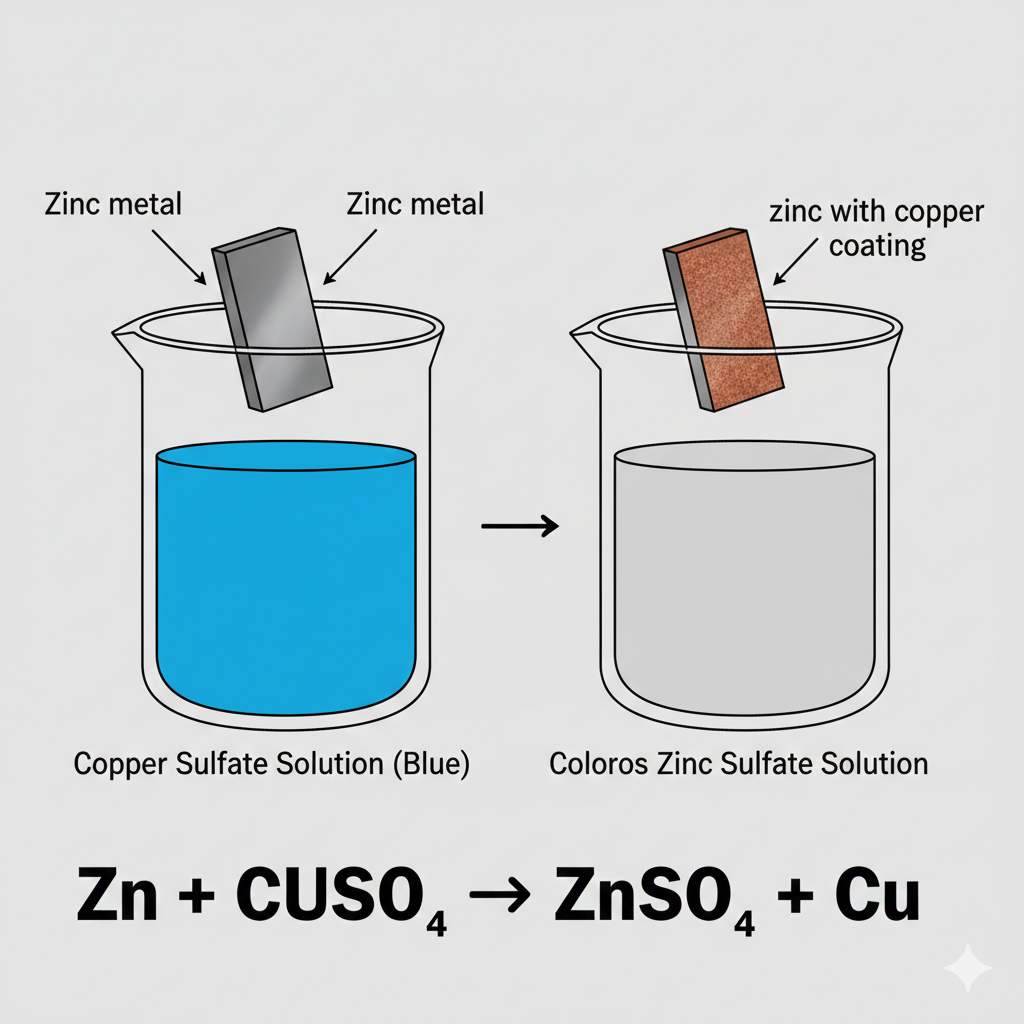
Displacement reactions involve more reactive metals pushing out less reactive metals from their compounds in solution. This serves as the most significant use of the reactivity series for prediction purposes.
The more reactive metal can push out the less reactive metal from the salt solution of the metal. In the case of a less reactive metal, they cannot push out more reactive metals.
However, we can view it as a competition. The more reactive metal can lose electrons with more ease, which results in the less reactive metal being able to gain those electrons and become a completely pure metal again.
The reaction involves the use of zinc metal in a blue copper sulfate solution. The solution changes color to colorless, and the blue color fades, meaning that there are brown copper metal deposits on the zinc. The reaction can also be represented by the following equation: Zn + CuSO₄ → ZnSO₄ + Cu. This means that the zinc metal gets oxidized while the copper solution undergoes reduction to become copper metal.
The reaction is carried out by placing an iron nail in a copper sulfate solution. The iron nail gets coated with reddish-brown copper while the blue color of the solution fades slowly as the reaction proceeds: Fe + CuSO₄ → FeSO₄ + Cu.
Since copper is lower on the reactivity series than zinc, it cannot displace it. Cutting copper wire and placing it into zinc sulfate solution will result in no reaction, shown by the lack of displacement.
The reactivity series determines which techniques can be employed when extracting metals from ores.
Any metal less reactive than carbon can be extracted by heating its oxide and carbon, which allows carbon to displace the metal.
For example,
Zinc oxide can be reduced by carbon: ZnO + C → Zn + CO
Iron oxide can be reduced by carbon in a blast furnace (this is the industrial method for iron extraction): 2Fe₂O₃ + 3C → 4Fe + 3CO₂
This method is the cheapest and is used for the industrial production of iron, zinc, tin, and lead.
Any metal that is more reactive than carbon cannot be extracted by the method of reduction using carbon. They need to undergo electrolysis.
For example, Sodium, calcium, magnesium, and aluminum are extracted by electrolysis. To extract Aluminum metal, Aluminum oxide is melted and then subjected to electrolysis.
The method incurred significant expense due to the increased costs associated with obtaining energy.
Gold, silver, and platinum are the unmatched native metals, forming the simplest, most stable, and least complex native compounds which to not require extraction due to their pure and uncombined state.
These are the reasons why ancient civilizations primarily focused on the occurrence of metals in their native states and uncombined (i.e., free state), such as gold and silver.
Corrosion is the process by which metals are destroyed over time as they react with the environment in a chemical process (i.e., oxidation). The rate of corrosion largely depends on the reactivity of the metal itself.
The method of protective coating is possible due to the differences in reactivity of metals. Protective coating: Covering a metal with a more reactive metal to protect a less reactive (protected) metal. The more reactive metal will corrode, thereby offering protection to the unreacted metal
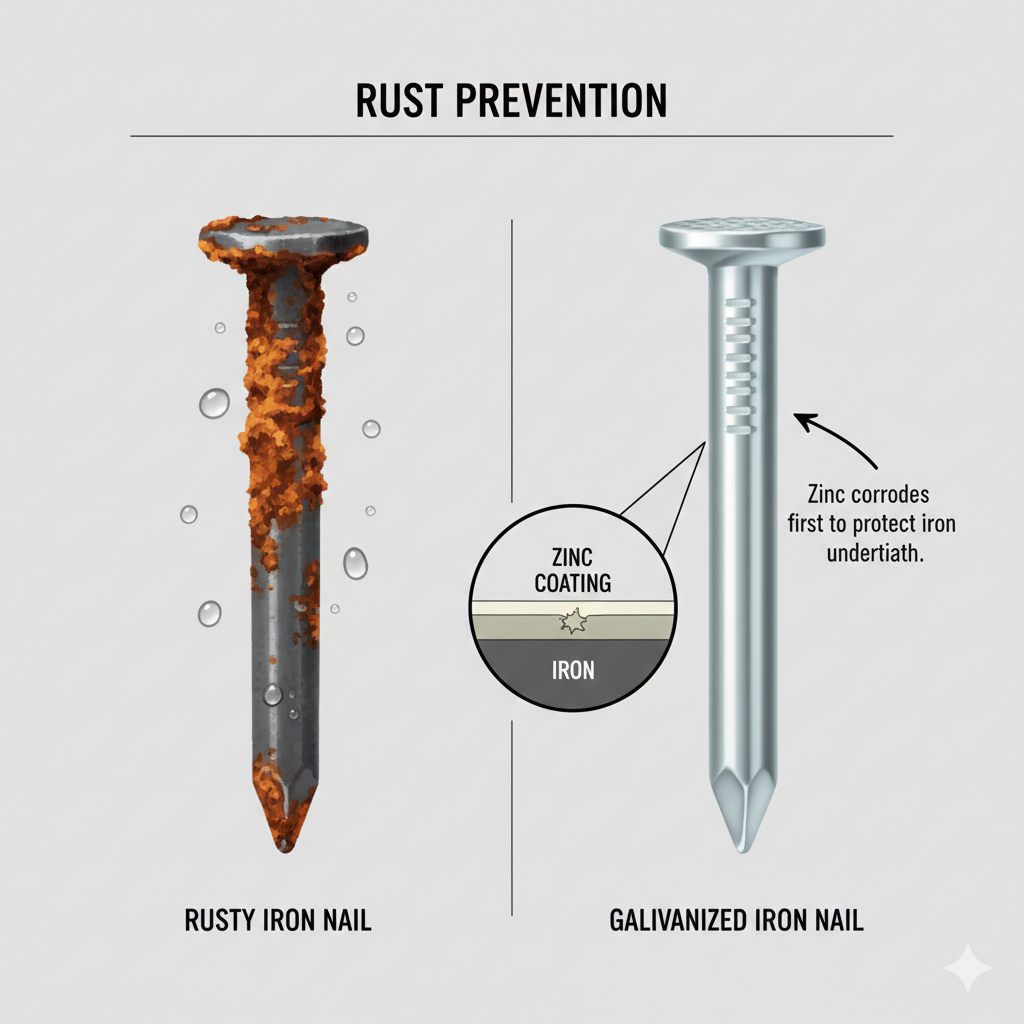
and the use of Zinc blocks, which are more reactive than Iron are used to protect the Iron hull.
The method of protective coating used by galvanizing iron, even if the zinc coating is scratched, the zinc will corrode, which is referred to as cathodic protection of the iron that is left unreacted (under the zinc).
involves coating iron with a less reactive metal (tin). Though applicable only when the coating is intact.
When the coating is scratched, iron will corrode faster as tin will not protect it sacrificially.
In chemistry, there will be:
All of these rely on:
For example, to see whether magnesium will react with zinc chloride solution, one has to refer to the reactivity series. Since magnesium is above zinc, it will displace zinc. If one does not understand the reactivity series, one can not predict reactions, choose appropriate extraction methods, or conduct safe experiments with metals.
The reactivity series makes metal chemistry predictable, rather than a collection of random observations.